Predestination and free will
The Bible teaches that God chooses, or predestines, people for salvation in Christ, but Christians have long disagreed about what that means. John Calvin taught that God decrees some people to eternal life and others to damnation. The mainline churches do not teach a decree of damnation: the Thirty-Nine Articles speak only of predestination to life, Methodists teach that God’s grace reaches every person, and the Presbyterian Church (U.S.A.) confesses that God “desires not the death of any sinner.”
who desires all people to be saved and come to full knowledge of the truth.

If you have ever lain awake wondering whether God chose you, or whether someone you love was destined from eternity to be lost, you are asking a question that has troubled faithful Christians for sixteen centuries. The Bible says that God chooses, or predestines, people for salvation in Christ, and it also says, in the First Letter to Timothy, that God “desires all people to be saved.” The mainline churches hold those two teachings together, and they hear in God’s choosing good news: a choice for life, made in Christ, by a God who wills the salvation of every person.
John Calvin taught “double predestination,” the belief that God decreed from eternity who would be saved and who would be damned. The mainline churches have taken another path. The Thirty-Nine Articles of the Church of England speak only of predestination to life, and the Lutheran Formula of Concord, part of the ELCA’s confessions, teaches that God predestines no one to damnation. The United Methodist Church teaches that God’s grace reaches every person, and the Presbyterian Church (U.S.A.) confesses that God “desires not the death of any sinner.” All of them rest on the promise of 1 Timothy 2:4.
What does the Bible say about predestination?
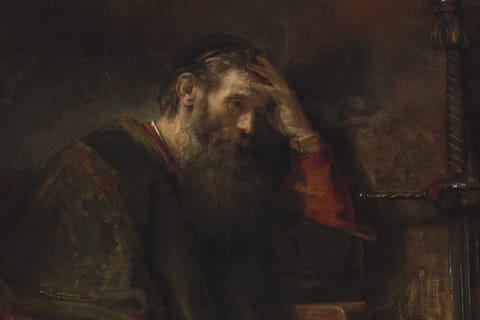
The word comes from Paul. In his letter to the Romans, he describes God’s purpose as an unbroken chain from beginning to end:
For whom he foreknew, he also predestined to be conformed to the image of his Son, that he might be the firstborn among many brothers. Whom he predestined, those he also called. Whom he called, those he also justified. Whom he justified, those he also glorified.
The Letter to the Ephesians speaks the same way:
even as he chose us in him before the foundation of the world, that we would be holy and without defect before him in love, having predestined us for adoption as children through Jesus Christ to himself, according to the good pleasure of his desire,
In both passages God chooses people “in him,” in Christ, and chooses them for something: holiness, adoption, and likeness to Christ. Paul meant predestination as a comfort. Nothing in a believer’s salvation depends on how strong their faith feels on a given day, because it rests on God’s love from before the foundation of the world.
Romans 9 is harder. Paul quotes God’s words to Moses, “I will have mercy on whom I have mercy” (Romans 9:15), and compares God to a potter who makes some vessels “for honor” and others “for dishonor” (Romans 9:21). Many readers have taken the chapter as a statement about individual souls. Most modern scholars note that Romans 9–11 is about peoples, Israel and the Gentiles, and that Paul’s argument ends in mercy:
For God has bound all to disobedience, that he might have mercy on all.
The New Testament also states what God wants:
For this is good and acceptable in the sight of God our Savior, who desires all people to be saved and come to full knowledge of the truth.
What did Augustine and Pelagius disagree about?
Around 400 CE the British monk Pelagius taught that human beings can choose to obey God by their own free will, with God’s law and Christ’s example as help. Augustine of Hippo answered that sin has so bent the human will that no one can turn to God without grace, and that God freely chooses whom to save. Councils in North Africa condemned Pelagius’s teaching in 418.
The Western church accepted Augustine’s teaching on grace without accepting all of his conclusions. The Council of Orange in 529 taught that every good impulse toward God begins with grace, and it rejected with “abhorrence” the idea that God predestines anyone to evil.
The Greek-speaking East never adopted Augustine’s teaching on predestination. Eastern Orthodox theologians speak of synergy, a Greek word for working together: God’s grace always comes first, and human freedom answers it. John of Damascus, an eighth-century monk whose summary of doctrine became a standard guide to Orthodox teaching, wrote that “while God knows all things beforehand, yet He does not predetermine all things” (Exact Exposition of the Orthodox Faith II.30). For the Orthodox, the goal of salvation is theosis, healing and union with God, and God wills it for everyone.
What did John Calvin teach?
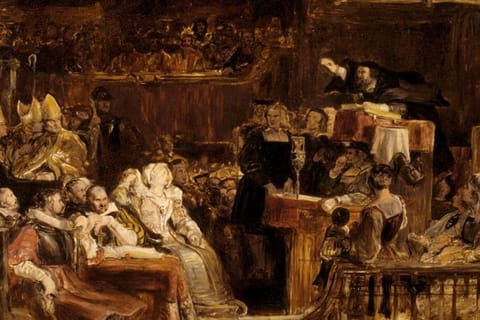
John Calvin, the Reformer of Geneva, pressed Augustine’s logic to its end. In his Institutes of the Christian Religion he wrote: “All are not created on equal terms, but some are preordained to eternal life, others to eternal damnation” (III.21.5). He admitted that the decree was “dreadful” (III.23.7), and he held to it because he believed Scripture taught it. The Westminster Confession of 1646 put the teaching into a confession: “some men and angels are predestinated unto everlasting life, and others fore-ordained to everlasting death.”
Other Reformers saw it differently. The Lutheran Formula of Concord (1577) taught that God predestines people to salvation and predestines no one to damnation.
What did Arminius and Wesley teach?
Jacob Arminius (1560–1609), a Dutch Reformed professor at Leiden, taught that God elects those whom he foresees will believe, and that people can resist God’s grace. His followers stated these views in 1610, and the Synod of Dort (1618–1619) rejected them. The debate between Calvinists and Arminians has continued ever since.
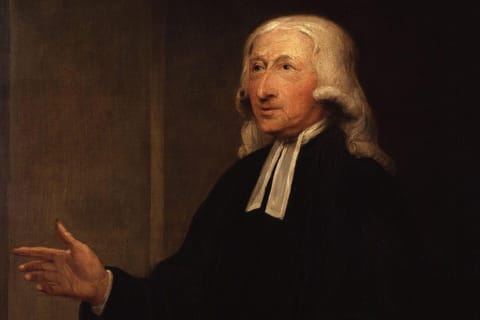
John Wesley, the founder of Methodism, took the Arminian side. In his 1739 sermon “Free Grace” he declared, “The grace or love of God, whence cometh our salvation, is free in all, and free for all.” Wesley taught prevenient grace, the grace that goes before every human decision and frees the will to respond to God. The United Methodist Church describes it as “the divine love that surrounds all persons” before they are aware of it. Wesley’s teaching echoes Moses’ appeal to Israel: “Therefore choose life, that you may live” (Deuteronomy 30:19). For the Methodist tradition, see what do Methodists believe?
What do Anglicans teach about predestination?
Article XVII of the Thirty-Nine Articles teaches that “Predestination to Life is the everlasting purpose of God” to deliver “those whom he hath chosen in Christ.” It says nothing of a decree to damnation. It calls the doctrine “full of sweet, pleasant, and unspeakable comfort to godly persons,” and it warns that for others it can be “a most dangerous downfall” into despair. It ends by telling Christians to receive God’s promises “as they be generally set forth to us in Holy Scripture,” that is, as promises made to all.
How did Karl Barth change the question?
The Swiss Reformed theologian Karl Barth reworked the doctrine in his Church Dogmatics (volume II, part 2, 1942), which opens its treatment of the subject by calling election “the sum of the Gospel.” Barth taught that Jesus Christ is both the God who chooses and the human being who is chosen. In Christ, God chose rejection for himself and chose humanity for life. Election, on Barth’s reading, is good news about Christ before it is a question about who is in and who is out. Barth stopped short of teaching that every person will be saved. He refused to rule it out, and he held that Christians may hope for it.
What do the mainline churches teach today?
The PC(USA) still includes the Westminster Confession in its Book of Confessions, and in 1903 its predecessor church added a Declaratory Statement. The Declaratory Statement holds the doctrine of God’s decree “in harmony with the doctrine of his love to all mankind” and teaches “that God desires not the death of any sinner.” The church’s introduction to the Book of Confessions notes that Westminster’s double predestination is not taught in the Scots Confession or the Second Helvetic Confession. The Second Helvetic Confession says that “we must hope well of all, and not rashly judge any man to be a reprobate” (5.055).
The PC(USA)’s later confessions describe election as God’s choice of a people for service and blessing. The Confession of 1967 does not use the language of predestination; it confesses that “The risen Christ is the Savior for all men” (9.10). The Brief Statement of Faith (1991) says: “In everlasting love, the God of Abraham and Sarah chose a covenant people to bless all families of the earth.”
Christians who hold to double predestination do so out of reverence for God’s sovereignty and for passages such as Romans 9, and many of them find deep assurance in it. Many mainline theologians, with Gregory of Nyssa and Isaac the Syrian in the Christian East, go further in hope. They trust that God, who “has bound all to disobedience, that he might have mercy on all” (Romans 11:32), will in the end be “all in all” (1 Corinthians 15:28). They read the Bible’s pictures of hell as God’s judgment on wrongdoing, which answers the human need for justice; see is hell real? For related questions, see can you lose your salvation?, are we saved by faith or works?, and what do Presbyterians believe?
Augustine, whose teaching on grace began this long debate, prayed in his Confessions: “And all my hope is no where but in Thy exceeding great mercy. Give what Thou enjoinest, and enjoin what Thou wilt” (10.29, translated by E. B. Pusey). Whatever Christians conclude about predestination, they can all pray those words, and rest their hope where Augustine rested his.
Common questions
What is double predestination?
Double predestination is the teaching that God has decreed from eternity both who will be saved and who will be damned. John Calvin and the Westminster Confession of 1646 taught it. The Thirty-Nine Articles, the Lutheran Formula of Concord, and Methodist teaching do not, and the PC(USA)’s Book of Confessions notes that the Scots Confession and the Second Helvetic Confession do not teach it.
If God knows the future, do I have free will?
Most Christian teachers have held that God’s knowledge of what you will do does not force you to do it. The sixth-century philosopher Boethius explained that God sees all of time at once, the way you might watch someone walking without making them walk. John of Damascus, an eighth-century teacher of the Eastern church, wrote that God “knows beforehand those things that are in our power, but He does not predetermine them.”
What is prevenient grace?
Prevenient grace is the grace that comes before any human decision. John Wesley taught that God’s grace reaches every person and frees the will enough to respond to God, so no one is left without help. The United Methodist Church describes it as the divine love that surrounds all persons, before they are aware of it.
How can I know whether God has chosen me?
The Second Helvetic Confession, part of the PC(USA)’s Book of Confessions, warns against asking the question apart from Christ and says that if you believe and are in Christ, you are elected. Article XVII of the Thirty-Nine Articles likewise tells Christians to trust God’s promises as Scripture sets them out for everyone. Anxiety about whether you are chosen is a reason to look away from yourself and toward Christ, in whom God’s choice is made known.
Sources
- Romans 8:29–30 (WEB)
- Romans 9:15–21 (WEB)
- Romans 11:32 (WEB)
- Ephesians 1:4–5 (WEB)
- 1 Timothy 2:3–4 (WEB)
- John Calvin, Institutes of the Christian Religion III.21 and III.23 (CCEL)
- The Thirty-Nine Articles of Religion, Article XVII (Church of England)
- Presbyterian Church (U.S.A.), The Book of Confessions (Westminster Confession 6.016, Declaratory Statement 6.192, Second Helvetic Confession 5.055–.059, Confession of 1967, Brief Statement of Faith)
- John Wesley, “Free Grace” (Christian History Institute, “War of Words”)
- United Methodist Church, Prevenient grace (People of God handbook)
- John of Damascus, An Exact Exposition of the Orthodox Faith II.30 (CCEL)
- Augustine, Confessions, Book X, trans. E. B. Pusey (Project Gutenberg)