God beyond the gender binary
God is neither male nor female, so Christian teaching agrees that God is beyond the gender binary. Jesus said “God is spirit,” and Moses warned Israel not to picture God as male or female. Gregory of Nyssa taught that the distinction of male and female does not exist in God. Many Christians still hesitate to call God “nonbinary,” because the word names a human gender identity, and God is beyond every human category.
God is spirit, and those who worship him must worship in spirit and truth.
God is neither male nor female. Christians across the centuries have taught that God is spirit, without a body, and beyond every category that belongs to creatures, including the categories of sex and gender. In that sense the ancient faith of the church already affirms what many people mean when they ask whether God is nonbinary. Whether the word itself fits God is a separate question, and Christians answer it in different ways.
You may have searched this after seeing an angry clip online. You may be nonbinary yourself and wondering where you stand with God. Either way the answer begins in the same place: the God of Scripture made every human being in the divine image and is greater than all our words.
Why are people asking whether God is nonbinary?
The phrase spread widely in late September 2026, when a clip from a sermon preached that March at a cathedral in New York circulated on social media and drew millions of views. The preacher said that God is nonbinary and went further, suggesting that God is also trans. Critics called the sermon heresy, and the preacher acknowledged that parts of it were personal speculation that the Bible does not state.
The argument touches an older question, asked in every generation, about how human words drawn from human bodies and families can speak truly about God. For the church’s broader teaching on that question, see Does God have a gender?
What does the Bible say about God and gender?
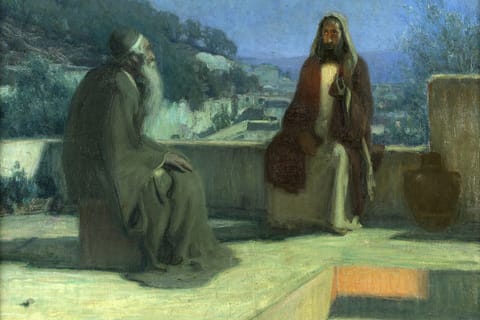
Jesus spoke about the nature of God to a Samaritan woman at a well:
God is spirit, and those who worship him must worship in spirit and truth.
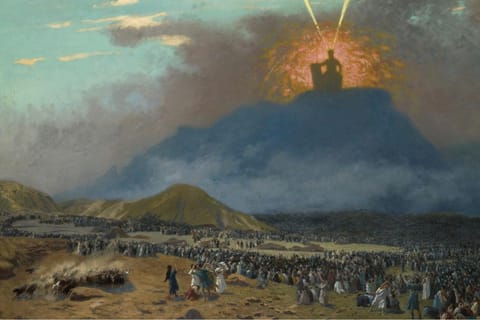
Moses gave Israel a related warning. At Horeb, the mountain also called Sinai, the people heard God’s voice and saw no shape, so they were never to carve an image of God “in the form of any figure, the likeness of male or female” (Deuteronomy 4:15–16). Balaam’s oracle in the Book of Numbers declares that “God is not a man” (Numbers 23:19).
The first chapter of the Bible says that both sexes bear God’s image:
God created man in his own image. In God’s image he created him; male and female he created them.
The Hebrew word translated “man” in Genesis 1:27 is adam, humankind as a whole. If male and female together reflect God, God cannot be pictured as only one of them. Scripture calls God “he,” “Father,” and “King” far more often than it uses feminine images. It also pictures God carrying Israel “from the womb” to old age (Isaiah 46:3–4) and, in one of Jesus’ parables, as a woman sweeping her house for a lost coin (Luke 15:8–10).
What did the Church Fathers teach about God and gender?
The teachers of the early church, East and West, agreed that God has no sex. Gregory of Nyssa, a fourth-century bishop in Cappadocia whose brother Basil and friend Gregory of Nazianzus helped shape the Nicene faith, read Genesis 1:27 with great care. He noticed that the verse first says humanity was made in God’s image and only afterward adds “male and female.” In his treatise On the Making of Man he concluded that “the distinction of male and female does not exist in the Divine and blessed nature” (chapter 17). He linked his reading to Paul’s words that in Christ “there is neither male nor female” (Galatians 3:28).
Gregory of Nazianzus made the same case with a touch of humor. If grammar decided the matter, he said, the Godhead would be feminine, since the Greek word for deity is feminine, and the Spirit would be neuter (Oration 31.7).
Christians call this way of speaking apophatic theology, from the Greek apophasis, “denial.” Every name given to God must also be confessed as falling short, because God is greater than anything the name can hold. When Moses asked God’s name, he heard, “I AM WHO I AM” (Exodus 3:14). For more on that path of prayer, see What is apophatic theology?
Can the word “nonbinary” describe God?
“Nonbinary” usually describes a person whose gender identity is neither only male nor only female. When Christians say God is nonbinary, most mean what the creeds and the Fathers already teach: God is neither a man nor a woman.
Christians who hesitate to use the word raise two concerns. The first is that “nonbinary” names a human identity, and God has no gender identity at all, because God has no body and is the Creator of every human way of being. The second is that any single label, however kindly meant, can shrink God into one more category alongside the others.
Both concerns are reasonable, and the two sides share more than the online argument suggests. The Evangelical Lutheran Church in America (ELCA), in its 2019 social statement Faith, Sexism, and Justice, speaks of God “who is beyond gender” and warns that insisting on male language alone restricts our understanding of God “to one human category.” The same warning applies to every human word for God. The Christian tradition’s answer is to use many names from Scripture and to let each one point beyond itself.
Should Christians call God “Father” or “they”?
Christians call God Father because Jesus taught his disciples to pray “Our Father in heaven” (Matthew 6:9). The name speaks of closeness and trust, and the church baptizes in the name of the Father, the Son, and the Holy Spirit. Gregory of Nazianzus explained that “Father” names the relation of the Father to the Son and describes no body (Oration 29.16).
Many congregations in the mainline churches pray with the traditional names and add Scripture’s other images of God: mother, shepherd, rock, and hen. A few Christians use “they” for God, though those who confess one God in three persons take care that no pronoun suggests three gods. For the doctrine behind that care, see What is the Trinity?
What do the churches teach about nonbinary people?
Nonbinary Christians bear God’s image as fully as anyone, and they are baptized into the same Christ. Paul wrote to the churches of Galatia:
There is neither Jew nor Greek, there is neither slave nor free man, there is neither male nor female; for you are all one in Christ Jesus.
The ELCA’s 2019 statement reads Galatians 3:28 to mean that “‘male and female’ do not limit the gender identity of those joined to and in Christ.” In 2025 the Presbyterian Church (U.S.A.) added “gender identity” to the section of its constitution that rules out discrimination in the church’s life. The United Methodist Church’s Social Principles, revised in 2024, support equal rights for all people “regardless of sexual orientation or gender identity.” The Episcopal Church’s General Convention in 2018 passed a resolution supporting an end to discrimination against transgender and nonbinary people (Resolution 2018-C022).
For more, see Is it a sin to be transgender? and What Methodists, Lutherans, Presbyterians, and Episcopalians believe about transgender people.
Resting in the God beyond every name
If you are nonbinary, the psalmist’s prayer belongs to you as much as to anyone:
For you formed my inmost being. You knit me together in my mother’s womb. I will give thanks to you, for I am fearfully and wonderfully made. Your works are wonderful. My soul knows that very well.
The God who knit you together is greater than every word we have, and closer to you than your own breath. Augustine of Hippo began his Confessions with a prayer that every Christian can make their own: “You have made us for Yourself, and our hearts are restless until they rest in You” (Confessions 1.1).
Common questions
Is God a “they”?
Christians have almost always said “he” for God in prayer and worship, and some also say “she” at times, following Scripture’s mothering images. A few use “they” to show that God is beyond male and female, though Christians who confess one God in three persons take care that no pronoun suggests three gods. Every pronoun falls short of the God who told Moses, “I AM WHO I AM.”
Does calling God nonbinary deny that God is Father?
The churches still baptize in the name of the Father, the Son, and the Holy Spirit. Gregory of Nazianzus taught in the fourth century that “Father” names the relation of the Father to the Son and does not describe a body or a sex. Christians can call God Father with full devotion while confessing that God is neither male nor female.
Can nonbinary people be Christians?
Nonbinary Christians are baptized into Christ like every other Christian and bear God’s image fully. Paul wrote that in Christ “there is neither male nor female” (Galatians 3:28). The ELCA, the Presbyterian Church (U.S.A.), the United Methodist Church, and the Episcopal Church all oppose discrimination based on gender identity.
Is it wrong to say God is nonbinary?
Christians disagree about the word, and people on both sides speak in good faith. Those who use it usually mean what the church has always taught, that God is neither a man nor a woman. Those who object worry that it makes God sound like one more human identity. Both can say with Jesus that “God is spirit” (John 4:24).
Sources
- John 4:24 (WEB)
- Deuteronomy 4:15–16 (WEB)
- Genesis 1:27 (WEB)
- Isaiah 46:3–4 (WEB)
- Galatians 3:28 (WEB)
- Psalm 139:13–14 (WEB)
- Gregory of Nyssa, On the Making of Man, chapters 16–17 (New Advent)
- Gregory of Nazianzus, Third Theological Oration (Oration 29)
- Gregory of Nazianzus, Fifth Theological Oration (Oration 31)
- Augustine, Confessions, Book 1 (New Advent)
- ELCA social statement, Faith, Sexism, and Justice: A Call to Action (2019)
- Amendment 24-A wins approval of majority of presbyteries (PC(USA), 2025)
- United Methodist Social Principles (2024): The Political Community
- Episcopal General Convention Resolution 2018-C022, Support End of Discrimination Against Transgender and Non-Binary People
- Episcopal priestess stirs outrage for claiming Jesus is transgender (The Christian Post, September 25, 2026)