Transgender Christians
Being transgender is not a sin, and God loves you as you are. Several mainline churches have welcomed transgender people as members and as clergy. The Bible says nothing about gender identity as we understand it today. Its nearest parallel, the eunuchs, whose bodies did not fit the ancient world's idea of a man, receives a promise of welcome: Isaiah 56 gives them “an everlasting name,” and in Acts 8 Philip baptizes an Ethiopian eunuch.
I will give, in my house and within my walls, a monument and a name better than sons and daughters; I will give them an everlasting name that shall not be cut off.
Isaiah 56:5, NRSVUE
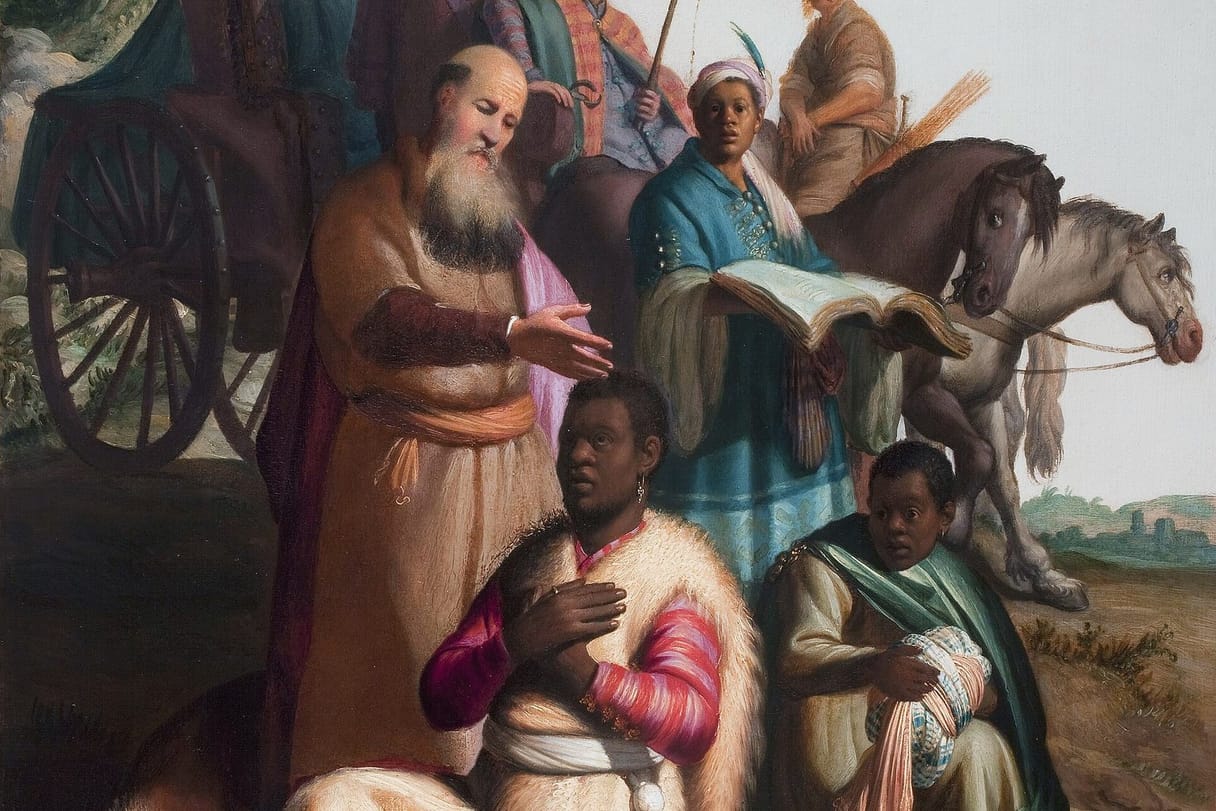
If you are trans or nonbinary, God formed you, knows you by name, and loves you. You may have been told otherwise, and words like that can wound the deepest part of a person. Scripture has other words for you. To the eunuchs, whose bodies did not fit what their world expected, God promised “an everlasting name,” and one of the first people baptized into Christ was a eunuch from Ethiopia.
Christians disagree on the question, and people on both sides want to honor God as Creator. The Orthodox churches and many evangelical churches teach that the sex a person is assigned at birth is given by God and should not be changed. Several mainline churches have concluded otherwise and welcome transgender people as members and as clergy. Their reasons start with Scripture.
Doesn’t Genesis 1:27 say God made us male and female?
Genesis 1:27 is the verse most often quoted against transgender people. It says that God created humankind in his own image, and it ends, “male and female he created them” (Genesis 1:27).
Read carefully, the verse’s first claim is that every human being bears the image of God. The Hebrew word for the ones God created, adam, means humankind as a whole. Transgender people bear God’s image as fully as anyone, and nothing in the verse takes it away.
The verse’s second claim, “male and female he created them,” stands in a chapter full of pairs. God separates light from darkness and calls them “day” and “night” (Genesis 1:5), yet dawn and dusk are part of God’s creation too. Some readers take “male and female” the same way, as naming the two ends of human variety without denying the people in between. Traditional readers take the phrase as fixing two sexes at birth, and they note that Jesus quotes it in Matthew 19:4.
Paul reworks the same phrase in his letter to the Galatians:
As many of you as were baptized into Christ have clothed yourselves with Christ. There is no longer Jew or Greek; there is no longer slave or free; there is no longer male and female, for all of you are one in Christ Jesus.
Galatians 3:27–28, NRSVUE
Paul writes “Jew or Greek” and “slave or free,” then switches to “male and female,” the exact words of Genesis 1:27 in the Greek Bible Paul read. In Christ, he says, the categories of creation do not decide who belongs to God’s people. Baptism does.
What does the Bible say about eunuchs?
The Bible has no word for transgender people. Its nearest parallel is the eunuch: a man who had been castrated, or who was born without the usual male anatomy. Eunuchs in the ancient world differed in many ways from transgender people today, but they too were people whose bodies and place in society did not fit what the ancient world expected of a man.
The law of Moses shut them out. Deuteronomy 23:1 says that a man “emasculated by crushing or cutting shall not enter into the LORD’s assembly.” Centuries later, the last chapters of the Book of Isaiah, written after the exile in Babylon, announced that God was reversing that exclusion:
Do not let the foreigner joined to the Lord say, “The Lord will surely separate me from his people,” and do not let the eunuch say, “I am just a dry tree.” For thus says the Lord: To the eunuchs who keep my Sabbaths, who choose the things that please me and hold fast my covenant, I will give, in my house and within my walls, a monument and a name better than sons and daughters; I will give them an everlasting name that shall not be cut off.
Isaiah 56:3–5, NRSVUE
Jesus spoke of eunuchs too, in the same conversation in which he quoted Genesis 1:27:
For there are eunuchs who have been so from birth, and there are eunuchs who have been made eunuchs by others, and there are eunuchs who have made themselves eunuchs for the sake of the kingdom of heaven. Let anyone accept this who can.
Matthew 19:12, NRSVUE
Jesus speaks calmly and with respect of people born outside the usual categories, in the same conversation in which he quotes “male and female.”
Who was the Ethiopian eunuch in Acts 8?
An angel sends the evangelist Philip to a desert road, where he meets “a man of Ethiopia, a eunuch of great authority under Candace, queen of the Ethiopians, who was over all her treasure” (Acts 8:26–27). The man is reading Isaiah, and Philip tells him the good news about Jesus. Then the eunuch asks a question:
As they were going along the road, they came to some water, and the eunuch said, “Look, here is water! What is to prevent me from being baptized?”
Acts 8:36, NRSVUE
Nothing prevents him. Philip baptizes him, and the eunuch goes “on his way rejoicing” (Acts 8:38–39). Acts does not say whether he was a Jew or a Gentile. The church historian Eusebius, writing in the early fourth century, called him the first “among the Gentiles” to receive the faith (Church History 2.1). One of the first converts in the history of the church was a person the law of Moses had kept out of the assembly.
What about Deuteronomy 22:5?
Deuteronomy 22:5 says, “A woman shall not wear men’s clothing, neither shall a man put on women’s clothing.” The verse appears in the same chapter that forbids “clothes of wool and linen woven together” (Deuteronomy 22:11). The apostles decided in Acts 15 that Gentile Christians are not bound by the law of Moses, which is why Christians eat pork and wear blended fabrics (see Can Christians eat pork?). What counts as men’s or women’s clothing has also changed from one culture to another; many Christian women today wear trousers to church without a second thought.
Can a church bless a new name?
Scripture is full of new names. God renamed Abram as Abraham (Genesis 17:5), and the risen Christ promises “a white stone, and on the stone a new name written” (Revelation 2:17). Through the prophet Isaiah, God says to his people:
Do not fear, for I have redeemed you; I have called you by name; you are mine.
Isaiah 43:1, NRSVUE
Some churches have written prayers for that moment, so that a congregation can give thanks with a baptized person who has taken a new name, including a transgender person who has transitioned. Any pastor can pray with you in the same way.
What do the churches teach about transgender people?
Several mainline churches have made room for transgender people in their life and leadership. In 2007 the United Methodist Church’s Judicial Council, the church’s highest court, let the Rev. Drew Phoenix, a transgender pastor in Baltimore, remain in his appointment after his transition. In 2012 the Episcopal Church’s General Convention added “gender identity and expression” to its church law, so that no one may be denied access to the process of discernment “for any ministry, lay or ordained” or denied “an equal place in the life, worship, and governance of this Church.” In 2021 the Sierra Pacific Synod of the Evangelical Lutheran Church in America (ELCA) elected Megan Rohrer as bishop, the first openly transgender person to lead a synod or diocese of a major American denomination.
The Orthodox churches and many evangelical churches disagree, and they hold their view out of reverence for the created order as they read it in Genesis. For more on God beyond human categories, see Does God have a gender?
What should you do if you feel rejected?
When the prophet Samuel looked at outward appearance, God told him, “I don’t see as man sees. For man looks at the outward appearance, but the LORD looks at the heart” (1 Samuel 16:7). God knows who you are. Many mainline congregations will welcome you by the name you use, and their clergy will be glad to talk with you. See also Does God love me?
If you feel unsafe or are thinking about hurting yourself, please reach out today. In the United States you can call or text 988, or contact the Trevor Project, which serves LGBTQ young people, at 1-866-488-7386 or by texting START to 678-678.
The psalmist’s prayer of thanks for being made by God belongs to you as much as to anyone. You can pray it slowly, as your own:
For you formed my inmost being. You knit me together in my mother’s womb. I will give thanks to you, for I am fearfully and wonderfully made. Your works are wonderful. My soul knows that very well.
Common questions
Will I go to hell for being transgender?
Nothing in all creation can separate you from the love of God in Christ Jesus (Romans 8:38–39). In Acts 8 the Ethiopian eunuch asked, “What is to prevent me from being baptized?” and the answer was nothing. God's welcome rests on grace, and it reaches you as you are.
Is it a sin to transition?
Several mainline churches, including the ELCA, the United Methodist Church, and the Episcopal Church, have pastors and priests who have transitioned. Decisions about names, clothing, and medical care belong to you, your doctors, and the people who love you. Scripture's test for any decision is love and its fruit: “love, joy, peace, patience, kindness, goodness, faith, gentleness, and self-control” (Galatians 5:22–23).
Can transgender people be ordained?
Yes, in several churches. In 2007 the United Methodist Church’s highest court allowed a transgender pastor, Drew Phoenix, to remain in his congregation. Since 2012 the Episcopal Church’s church law has forbidden denying anyone access to ordination because of gender identity. In 2021 an ELCA synod elected Megan Rohrer as the first openly transgender bishop in a major American denomination.
Is it a sin to be nonbinary?
Nonbinary Christians are baptized into Christ like every other Christian. Paul wrote that in Christ “there is no longer male and female” (Galatians 3:28), and Jesus spoke with respect of people who did not fit the categories of his day (Matthew 19:12).
Sources
- Genesis 1:27 (WEB)
- Isaiah 56:3–5 (WEB)
- Matthew 19:4–12 (WEB)
- Acts 8:26–39 (WEB)
- Galatians 3:27–28 (WEB)
- Eusebius, Church History, Book 2, chapter 1 (New Advent)
- Episcopal General Convention 2012-D002: Amend Canon III.1.2
- Episcopal General Convention 2012-D019: Amend Canon I.17.5
- Episcopal General Convention 2018-A218: Approve Services from the Proposed Book of Occasional Services
- Court says transgender UMC pastor may stay (Christian Century, 2007)
- Megan Rohrer (Wikipedia)
- Psalm 139:13–14 (WEB)
- The Trevor Project: Get help