Christians and the biblical food laws
Christians can eat pork, and most churches teach that they may. Leviticus 11 forbade pork to Israel as one of the purity laws that set it apart as God’s people, and observant Jews still keep that law. The Gospel of Mark says that Jesus “declared all foods clean,” Peter heard in a vision that “what God has made clean, you must not call profane,” and the apostles in Acts 15 did not require Gentile Christians to keep the food laws.
The voice said to him again, a second time, “What God has made clean, you must not call profane.”
Acts 10:15, NRSVUE
Christians can eat pork, and nearly every church teaches that they may. The question usually comes up for a reason. A Jewish or Muslim friend may have asked why Christians eat what Leviticus forbids, a relative may have begun keeping the food laws, or you may have read Leviticus 11 for yourself and wondered whether you have been doing something wrong. The New Testament answers with good news about food and about people: God has gathered Jews and Gentiles into one family around one table.
Christians who eat pork can also honor those who do not. Observant Jews keep the food laws as part of God’s covenant with Israel, and some Christians abstain for reasons of conscience.
What does the Bible say about eating pork?
The ban on pork appears twice in the law of Moses, in Leviticus 11 and Deuteronomy 14. Leviticus calls the pig unclean because, although it has a split hoof, it “doesn’t chew the cud,” and it commands, “You shall not eat their meat” (Leviticus 11:7–8).
Leviticus does not give a health reason for the rule. It gives a reason of holiness: “For I am the LORD who brought you up out of the land of Egypt, to be your God. You shall therefore be holy, for I am holy” (Leviticus 11:45). The food laws were a daily sign that Israel belonged to God.
Faithful Jews have kept those laws at great cost. The Second Book of Maccabees, part of the Old Testament in Orthodox Bibles and printed among the Apocrypha in many Protestant ones, tells of the aged scribe Eleazar, who “was compelled to open his mouth to eat swine’s flesh” under the Greek king Antiochus IV in the 160s BCE, and who chose death instead (2 Maccabees 6:18). The next chapter tells of seven brothers and their mother who died rather than eat “the abominable swine’s flesh” (2 Maccabees 7:1). Christians can honor that faithfulness, which was given for the love of God.
Did Jesus say all foods are clean?
Jesus taught that what makes a person unclean comes from the heart:
He said to them, “So, are you also without understanding? Do you not see that whatever goes into a person from outside cannot defile, since it enters not the heart but the stomach and goes out into the sewer?” (Thus he declared all foods clean.)
Mark 7:18–19, NRSVUE
The words in parentheses are Mark’s comment on Jesus’ teaching, written for a church that by then included many Gentiles. Matthew’s version of the same scene has Jesus say, “That which enters into the mouth doesn’t defile the man; but that which proceeds out of the mouth, this defiles the man” (Matthew 15:11), without Mark’s comment. Jesus himself was an observant Jew (see Was Jesus Jewish?), and the Gospels never show him eating pork. The early church worked out what his teaching meant for Gentiles after his resurrection.
What did Peter’s vision in Acts 10 mean?
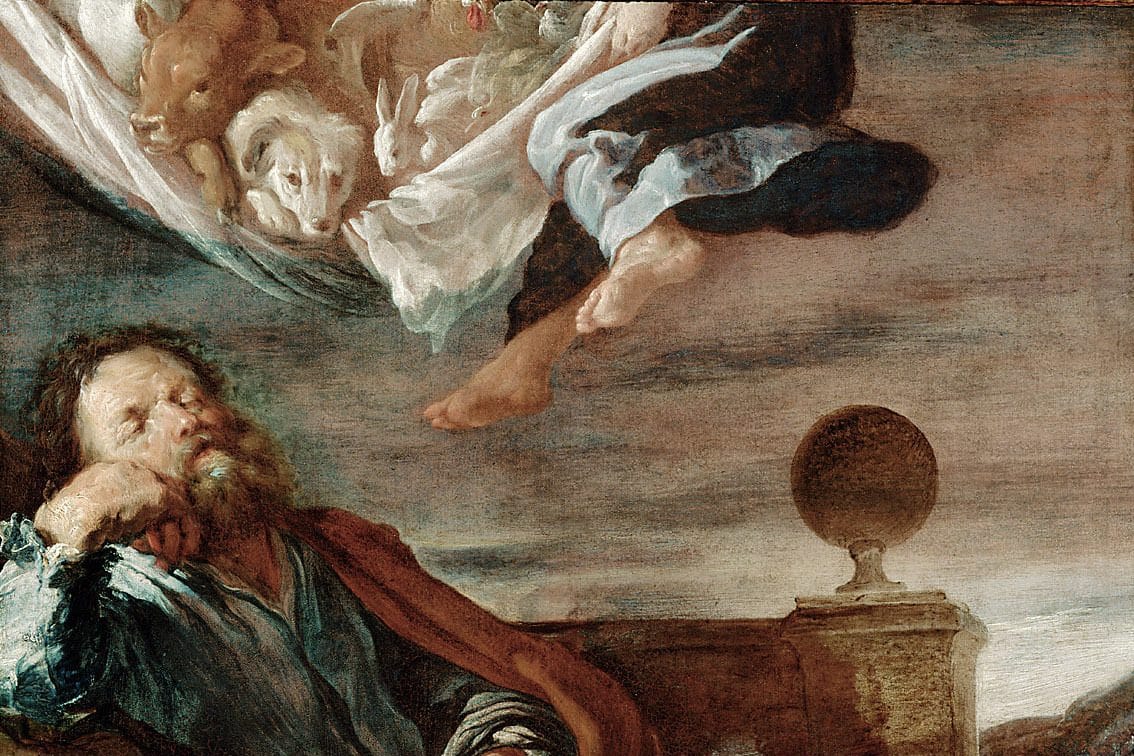
The question came to a head in Acts 10. Peter, praying on a rooftop, saw a sheet let down from heaven full of animals that the law called unclean:
In it were all kinds of four-footed creatures and reptiles and birds of the air. Then he heard a voice saying, “Get up, Peter; kill and eat.” But Peter said, “By no means, Lord, for I have never eaten anything that is profane or unclean.” The voice said to him again, a second time, “What God has made clean, you must not call profane.”
Acts 10:12–15, NRSVUE
Peter then went to the house of Cornelius, a Roman officer, and explained what the vision meant: “God has shown me that I shouldn’t call any man unholy or unclean” (Acts 10:28). The vision was about people as much as food. The food laws had kept Jews and Gentiles from eating together, and God was making one family of both at one table. The welcome Peter learned on that rooftop is the welcome every church is still learning. Paul later rebuked Peter for drawing back from eating with Gentile Christians in Antioch (Galatians 2:11–14).
Did the apostles require Christians to keep the food laws?
The apostles set Gentile Christians free from the food laws. When some believers taught that Gentile converts had to keep the law of Moses, the apostles and elders met in Jerusalem. Their letter to the Gentile churches named only a few requirements:
For it has seemed good to the Holy Spirit and to us to impose on you no further burden than these essentials: that you abstain from what has been sacrificed to idols and from blood and from what is strangled and from sexual immorality.
Acts 15:28–29, NRSVUE
Pork is absent from the list. Paul stated the principle in Romans: “I know and am persuaded in the Lord Jesus that nothing is unclean of itself” (Romans 14:14). He told the Corinthians, “Whatever is sold in the butcher shop, eat, asking no question for the sake of conscience” (1 Corinthians 10:25). The letter to the Colossians says, “Let no one therefore judge you in eating or drinking” (Colossians 2:16), and 1 Timothy says that “every creature of God is good, and nothing is to be rejected if it is received with thanksgiving” (1 Timothy 4:4).
Do any Christians avoid pork?
Yes. The Seventh-day Adventist Church teaches its members to keep the clean and unclean food laws of Leviticus 11, so Adventists do not eat pork or shellfish. The Ethiopian and Eritrean Orthodox Churches keep traditional food restrictions as well. Many Messianic Jews, who believe in Jesus and keep Jewish practice, also keep kosher.
Paul’s counsel to the church in Rome, which was divided over food, applies to every such case:
Do not, for the sake of food, destroy the work of God. Everything is indeed clean, but it is wrong to make someone stumble by what you eat; it is good not to eat meat or drink wine or do anything that makes your brother or sister stumble.
Romans 14:20–21, NRSVUE
If you are sharing a meal with Jewish, Muslim, or Adventist friends who do not eat pork, love asks you to serve something else. If a fellow Christian keeps the food laws out of conscience, Paul tells you not to despise that choice, and he tells that Christian not to judge you.
What do the churches teach about eating pork?
The ELCA, the PC(USA), the United Methodist Church, and the Episcopal Church, like the Orthodox churches of the Greek and Russian traditions and nearly every other church, teach that Christians may eat pork. The Thirty-Nine Articles of the Church of England state the principle in Article VII: “the Law given from God by Moses, as touching Ceremonies and Rites, do not bind Christian men,” while “no Christian man whatsoever is free from the obedience of the Commandments which are called Moral.” The same reasoning explains why most Christians do not treat tattoos as forbidden.
Christians do still practice fasting and abstinence as spiritual disciplines, such as giving up meat on Fridays in Lent. Those practices are acts of self-denial and prayer, and they treat no food as unclean in the way the pig was unclean for Israel. For more on what makes something a sin, see What is sin?
Whatever is on your plate, every meal can become a small act of thanksgiving, since “nothing is to be rejected if it is received with thanksgiving.” Martin Luther’s Small Catechism taught households to begin their meals with words from Psalm 145, and they make a good grace for any table: “The eyes of all wait for you. You give them their food in due season. You open your hand, and satisfy the desire of every living thing” (Psalm 145:15–16).
Common questions
Is eating pork a sin for Christians?
Christians are free to eat pork. Paul wrote, “I know and am persuaded in the Lord Jesus that nothing is unclean of itself” (Romans 14:14). The Thirty-Nine Articles of the Church of England teach that the ceremonial laws of Moses do not bind Christians. Paul also warned Christians not to use their freedom in ways that wound the conscience of others.
Did Jesus eat pork?
Almost certainly not. Jesus was an observant Jew in Galilee, where Jewish families kept the food laws, and the Gospels never show him eating unclean food. The Gospel of Mark says that his teaching about what defiles a person meant that “all foods” are clean, and the early church drew out that meaning after his resurrection.
Can Christians eat shellfish?
Yes. Leviticus 11:10 forbids sea creatures without fins and scales, which includes shrimp, crab, and lobster. The same New Testament passages that free Christians to eat pork free them to eat shellfish, and most churches place both rules among the purity laws given to Israel.
Why did God forbid pork in the Old Testament?
Leviticus does not say, beyond calling the pig unclean because it has a split hoof but does not chew the cud. The stated purpose of the food laws is holiness: “You shall therefore be holy, for I am holy” (Leviticus 11:45). Scholars have proposed health reasons, the anthropologist Mary Douglas argued in Purity and Danger (1966) that the laws reflect Israel’s categories of order, and many Jewish teachers say the laws are kept for no other reason than that God commanded them.
Why do Seventh-day Adventists not eat pork?
The Seventh-day Adventist Church teaches its members to follow the clean and unclean food laws of Leviticus 11, so Adventists do not eat pork or shellfish. The Ethiopian and Eritrean Orthodox Churches also keep traditional food restrictions. Paul’s counsel in Romans 14 applies here: Christians who eat and Christians who abstain should not judge each other.
Sources
- Leviticus 11:1–47 (WEB)
- Deuteronomy 14:2–8 (WEB)
- 2 Maccabees 6:18–7:1 (WEB)
- Mark 7:14–23 (WEB)
- Acts 10:9–28 (WEB)
- Acts 15:1–29 (WEB)
- Romans 14:1–23 (WEB)
- Galatians 2:11–14 (WEB)
- Colossians 2:16–17 and 1 Timothy 4:4 (WEB)
- Psalm 145:15–16 (WEB)
- Martin Luther, Small Catechism, Daily Prayers (BookOfConcord.org)
- The Thirty-Nine Articles of Religion, Article VII (Church of England)
- Christian dietary laws (Wikipedia)