Artificial intelligence and the human soul
Christians approach artificial intelligence with the conviction that every human being is made in the image of God (Genesis 1:27), a dignity given by God’s love that no measure of intelligence or usefulness can add to or take away. Scripture speaks often of tools, wisdom, and pride. The ELCA and the Presbyterian Church (U.S.A.) welcome human inventiveness as a gift from God and call for humility, truthfulness, and care for the neighbor in how AI is built and used.
God created humankind in his image; in the image of God he created them; male and female he created them.
Genesis 1:27, translated from the Hebrew
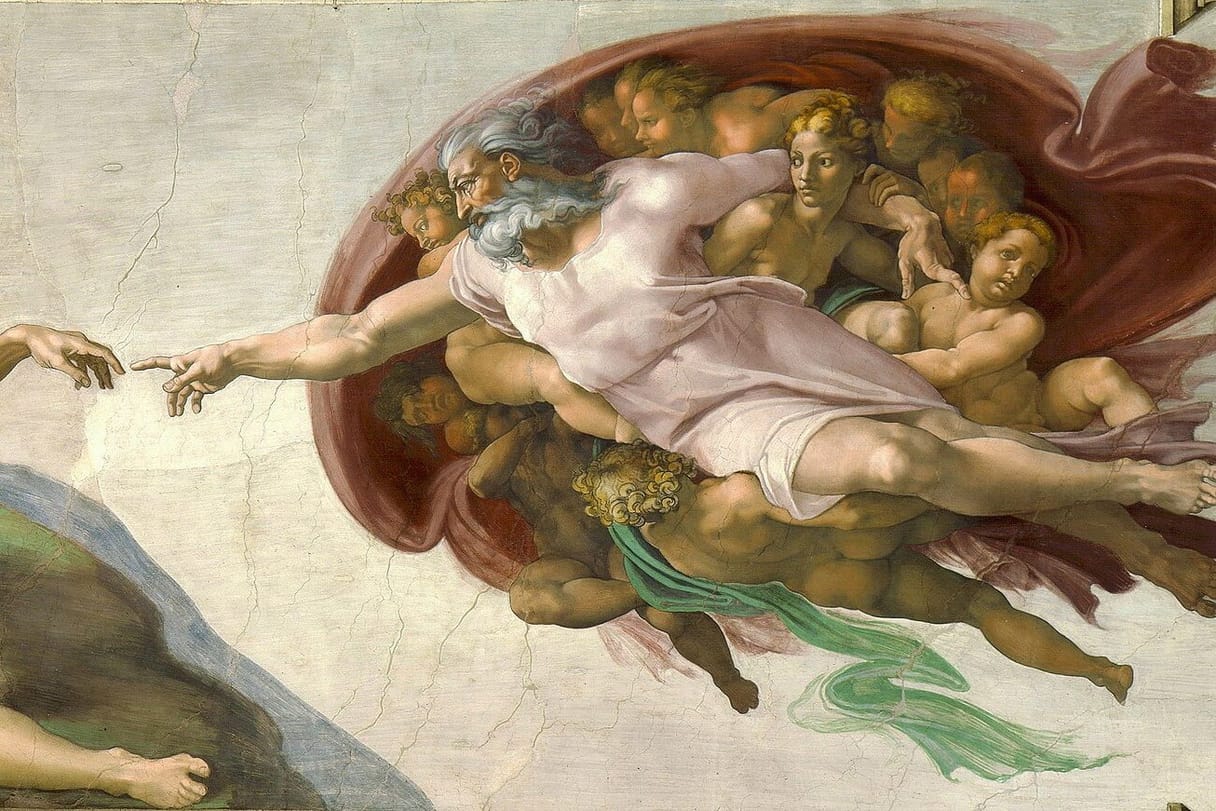
You may have asked an AI chatbot a question this week, or wondered what it will mean for your work, or felt uneasy when a machine sounded like a person. Christians bring to these questions a conviction much older than any computer: every human being is made in the image of God and loved by God. The Bible never mentions artificial intelligence, and it has a great deal to say about what human beings are, what tools are for, and where wisdom comes from.
What does it mean to be made in the image of God?
The first chapter of Genesis gives humanity its title of honor:
God created humankind in his image; in the image of God he created them; male and female he created them.
Genesis 1:27, translated from the Hebrew1
In the ancient Near East, kings set up statues of themselves, called images, to mark the lands they ruled. Genesis gives that royal dignity to every human being, the servant as much as the king, women and men alike. Psalm 8 marvels at the same gift: “What is man, that you think of him? … crowned him with glory and honor” (Psalm 8:4–5).
The church has always found human dignity in God’s gift. A newborn who cannot yet speak, a grandmother with advanced dementia, and a man with a severe intellectual disability bear God’s image as fully as any genius. A person’s worth was never measured by intelligence or output, so a machine that writes faster or calculates better cannot lessen anyone’s worth before God (see God’s love for you).
The New Testament calls Christ “the image of the invisible God” (Colossians 1:15), and the church confesses that in him God took on human flesh (John 1:14). Athanasius of Alexandria, the fourth-century bishop, wrote of Christ, “He was made man that we might be made God” (On the Incarnation 54). Eastern Orthodox Christians call this theosis, the healing of human beings and their union with God.
Can artificial intelligence have a soul?
The second chapter of Genesis tells the creation of the first human with tender, earthy detail:
The LORD God formed man from the dust of the ground, and breathed into his nostrils the breath of life; and man became a living soul.
The Hebrew word translated “soul,” nephesh, means a living being, the whole breathing person, body and all. The Apostles’ Creed confesses “the resurrection of the body,” and Christian teaching about the soul concerns embodied creatures who receive their life as a gift from God.
Whether a machine could ever have an inner life is a question that philosophers, scientists, and theologians still debate, and no church has ruled on it. Today’s AI chatbots are programs trained on vast collections of human writing to predict what words should come next, and their own makers disagree about what, if anything, such systems experience. Christians can leave that question open with humility, while the faith teaches with confidence that your soul is God’s gift, and that the love God has for you does not rise or fall with what machines can do.
Is it wrong for Christians to use AI?
Scripture honors human skill and invention. When Israel built the tabernacle, God said of the craftsman Bezalel:
I have filled him with the Spirit of God, in wisdom, and in understanding, and in knowledge, and in all kinds of workmanship, to devise skillful works…
From the beginning God placed the first human in the garden “to cultivate and keep it” (Genesis 2:15). The Presbyterian Church (U.S.A.) draws on this in its 2026 policy on AI, which teaches that humankind is created in the image of a creating God and that “human beings are, and always have been, creators.” The ELCA calls human beings “innovative stewards” of creation.
Scripture also knows how human works can become towers of pride or idols. The builders of Babel said, “let’s make a name for ourselves” (Genesis 11:4). Psalm 115 says of idols, “Those who make them will be like them” (Psalm 115:8). Paul’s rule for Christian freedom fits a powerful tool well: “I will not be brought under the power of anything” (1 Corinthians 6:12).
Christians are free to use AI for good work, such as translating a letter or reading a page aloud for someone who is blind. The questions to ask are whether it serves love of God and neighbor, and whether it is crowding out prayer, friendship, or the work of your own mind and conscience.
What does Christian wisdom say about new technology?
“The fear of the LORD is the beginning of wisdom,” says Proverbs (Proverbs 9:10). Paul’s counsel to the Thessalonians has become a motto for Christians weighing AI:
Test all things, and hold firmly that which is good.
The World Council of Churches, to which the ELCA, the PC(USA), the United Methodist Church, and the Episcopal Church all belong, used those words as the title of its 2023 statement on AI, which raised concern for “human uniqueness as created in the image of God” and asked that “human beings – rather than profit – remain at the centre of this technology.”
The ELCA’s 2026 paper on AI names two ways sin enters technology: “excessive pride or self-assertion arising from misplaced trust in human knowledge, will and ability,” and a failure of trust that shows itself as “negligence, complacency, resignation, or fatalism.” Wisdom, the paper says, listens to experts, stays humble, and takes precautions when serious harm is plausible. The prophet Micah gave the same counsel in a single line: “to act justly, to love mercy, and to walk humbly with your God” (see Micah 6:8).
What do the mainline churches teach about AI?
In 2026 the 227th General Assembly of the Presbyterian Church (U.S.A.) approved a social witness policy titled The Algorithm and the Almighty: Navigating Artificial Intelligence through a Reformed Lens. It asks the church’s agencies to recognize “the fundamental, inherent dignity of every human and the goodness of all creation.” It asks church leaders who use AI to disclose it, to refuse to present AI-generated material as their own work, and never to use it in place of prayerful study of Scripture, sermon preparation, pastoral counseling, or spiritual direction.
In August 2026 the Evangelical Lutheran Church in America published a theological foundation paper on AI that applies its existing social teaching, especially the 2011 social statement Genetics, Faith and Responsibility. It summarizes the Christian task as the call to “respect and promote the community of life with justice and wisdom.” The paper presents itself as a beginning.
The Episcopal Church’s General Convention created a task force in 2024 to study generative AI in sermons, liturgy, and church writing, and to propose guidelines for its use. Eastern Orthodox Christians speak in the same spirit. Ecumenical Patriarch Bartholomew told an audience at the University of Athens in 2025 that “there is nothing more sacred than the human being, with whom God Himself shared His nature,” and that the church’s tradition “upholds the absolute priority of the person over systems.”
How can I use AI wisely as a Christian?
A few practices can help you keep a powerful tool in its place:
- Pray in your own words. AI can help you find a psalm, and prayer remains your own conversation with God (see How to pray).
- Check what it tells you. AI systems can state false things with confidence, so check facts and Bible quotations against reliable sources.
- Tell the truth about its use. Say so when a machine wrote or shaped something you share, as the PC(USA) asks of its own leaders.
- Guard your friendships. The PC(USA) warns that relying on AI alone for companionship “can lead to decreased human interaction and increased social isolation.”
- Remember the workers. When AI changes someone’s job, the church’s teaching on the dignity of work and care for the neighbor still applies.
Whatever machines learn to do, you remain someone God formed from the dust, filled with the breath of life, and called by name for a purpose (see What is the meaning of life?). The psalmist’s thanksgiving belongs to you: “I will give thanks to you, for I am fearfully and wonderfully made” (Psalm 139:14).
Notes
-
Hebrew (Westminster Leningrad Codex): וַיִּבְרָ֨א אֱלֹהִ֤ים ׀ אֶת־הָֽאָדָם֙ בְּצַלְמ֔וֹ בְּצֶ֥לֶם אֱלֹהִ֖ים בָּרָ֣א אֹת֑וֹ זָכָ֥ר וּנְקֵבָ֖ה בָּרָ֥א אֹתָֽם׃ Ha-adam means “the human being” or “humankind”; tselem means “image” or “statue”; oto, literally “him,” refers to humankind as a whole, which the verse then describes as “male and female.” ↩︎
Common questions
Can AI have a soul?
Christians have not reached a single answer, and no church has ruled on the question. In the Bible a soul (Hebrew nephesh) is a whole living being who receives life from God (Genesis 2:7). Whatever machines turn out to be, Christian teaching holds that human dignity comes from God’s gift and love, and no machine’s abilities can diminish it.
Is AI the Antichrist or the mark of the beast?
Most biblical scholars read the beast of Revelation 13 as a picture of the Roman Empire and its demand for worship in the first century. The word “antichrist” appears only in the letters of John, where it describes those who deny that Jesus is the Christ or that he came in the flesh (1 John 2:22; 2 John 7). AI is a human-made tool, and Christians are called to use it wisely and keep their worship for God.
Is it okay for a pastor to use AI to write a sermon?
The Presbyterian Church (U.S.A.)’s 2026 policy on AI asks church leaders never to use generative AI in place of prayerful study of Scripture and sermon preparation, and to disclose any substantial AI assistance. The Episcopal Church has a task force studying the use of AI in sermons and worship. A sermon is a pastor’s own witness to God’s word for a particular congregation.
Should Christians be afraid of AI?
The PC(USA)’s 2026 policy says Christians are called “neither to fear increasingly complex machines nor to express optimism in the capacity of those machines to resolve our present crises.” Christians can take real risks seriously, support wise safeguards, and still live in hope, because the future belongs to God.
Can I use AI to study the Bible?
AI can help you find passages, compare translations, or summarize historical background, much as a concordance or commentary can. It also makes mistakes, so check its quotations against a printed Bible and its claims against trusted sources. Bible study grows best with prayer and with other people, in a church class or with a friend.
Sources
- Genesis 1:26–28 (WEB)
- Genesis 2:7 (WEB)
- Psalm 8:3–6 (WEB)
- Exodus 31:1–5 (WEB)
- Psalm 115:4–8 (WEB)
- 1 Thessalonians 5:21 (WEB)
- Presbyterian Church (U.S.A.), The Algorithm and the Almighty: Navigating Artificial Intelligence through a Reformed Lens (227th General Assembly, 2026)
- Evangelical Lutheran Church in America, A Theological Foundation Paper on Artificial Intelligence (AI) and ELCA Social Teaching (2026)
- Episcopal Church, Task Force on Artificial Intelligence and Intellectual Property: mandate (2024-D020, 2024-D045)
- World Council of Churches Central Committee, Statement on the Unregulated Development of Artificial Intelligence (2023)
- Orthodox church leader says faith is humanity’s safeguard against the impending ‘robotocracy’ (Associated Press, May 2025)
- Athanasius, On the Incarnation of the Word (New Advent)





.jpg)