Women of the Bible
The Bible tells the stories of many women who served God and led God’s people: Miriam the prophet, Deborah the judge, Ruth, Hannah, the prophet Huldah, Queen Esther, Mary the mother of Jesus, and Mary Magdalene, the first witness of the resurrection. In the early church Phoebe served as a deacon, Paul called Junia “notable among the apostles,” and Priscilla taught the faith. Their stories show God calling women and men alike.
I will pour out my Spirit on all flesh. Your sons and your daughters will prophesy.
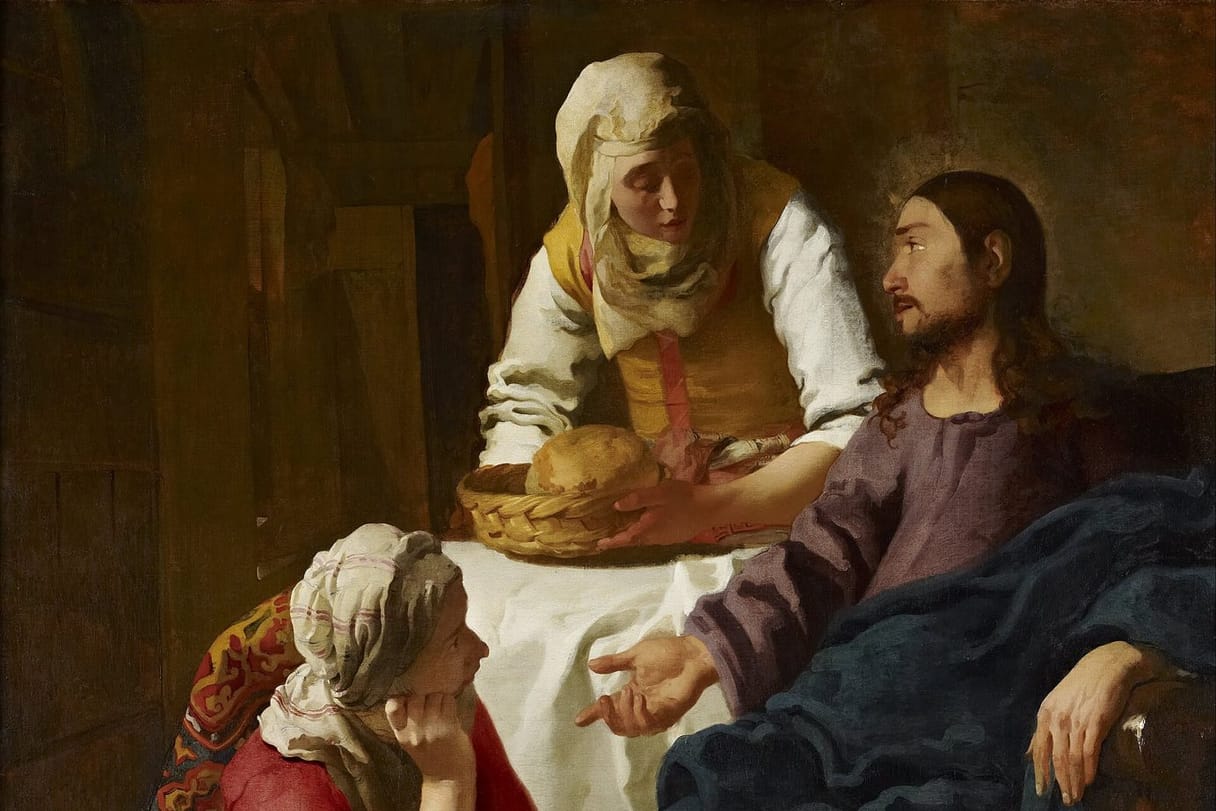
If you grew up hearing Bible stories, you may remember Abraham, Moses, David, Peter, and Paul. Women stand at nearly every turning point of the same story, from the exodus to the empty tomb and the first churches. The Bible was written in societies where men held most public power, which makes the women it remembers all the more striking. Their stories show God calling women by name, and the mainline churches read them as part of the witness of Scripture that God gives gifts of leadership to women and men alike.
Who are the great women of the Old Testament?
Miriam, the sister of Moses and Aaron, is the first woman the Bible calls a prophet. After Israel crossed the sea, “Miriam the prophetess, the sister of Aaron, took a tambourine in her hand; and all the women went out after her” (Exodus 15:20). Centuries later, God reminded Israel through the prophet Micah, “I sent before you Moses, Aaron, and Miriam” (Micah 6:4).
Deborah led all Israel as prophet and judge:
Now Deborah, a prophetess, the wife of Lappidoth, judged Israel at that time. … The children of Israel came up to her for judgment.
She summoned the general Barak to battle, and her victory song in Judges 5, which many scholars count among the oldest poems in the Bible, calls her “a mother in Israel” (Judges 5:7).
Ruth was a Moabite widow who refused to abandon her mother-in-law, Naomi. Her vow is one of the most loved sentences in Scripture: “where you go, I will go; and where you stay, I will stay. Your people will be my people, and your God my God” (Ruth 1:16). The book celebrates hesed, the Hebrew word for loyal, covenant love. Ruth became the great-grandmother of King David, and Matthew names her in the family line of Jesus (Matthew 1:5; see Immigrants and refugees in the Bible).
Hannah prayed so fervently for a child at the shrine of Shiloh that the priest Eli thought she was drunk. She told him, “I poured out my soul before the LORD” (1 Samuel 1:15). When her son Samuel was born, she sang of a God who “raises up the poor out of the dust” (1 Samuel 2:8), and her song echoes centuries later in the song of Mary.
Huldah was a prophet in Jerusalem in the days of King Josiah. When workers repairing the temple found “the book of the law” (2 Kings 22:8), the king’s officials, the high priest among them, went to Huldah to ask what it meant (2 Kings 22:14). Her word set off Josiah’s reform. Many scholars think the scroll was an early form of Deuteronomy, which would make Huldah the first person in the Bible to speak for a written book as God’s word.
Esther, a Jewish queen in Persia, risked her life to save her people. Her cousin Mordecai asked her, “Who knows if you haven’t come to the kingdom for such a time as this?” (Esther 4:14), and she answered, “if I perish, I perish” (Esther 4:16). The Hebrew book never mentions God by name, and readers have long seen God’s hidden care in its turns.
Who were the women around Jesus?
Mary of Nazareth answered God’s call with trust: “Behold, the servant of the Lord; let it be done to me according to your word” (Luke 1:38). Her song, the Magnificat, is a prophet’s song in Hannah’s line:
He has put down princes from their thrones, and has exalted the lowly. He has filled the hungry with good things. He has sent the rich away empty.
The Council of Ephesus in 431 honored her as Theotokos, “God-bearer,” and the Eastern Orthodox churches praise her in nearly every service (see Mary, the mother of Jesus).
Women traveled with Jesus as disciples. Luke names Mary Magdalene, Joanna, and Susanna, with “many others who served them from their possessions” (Luke 8:3).
In Bethany, Mary “sat at Jesus’ feet and heard his word” (Luke 10:39), the place of a student before a teacher, as Paul was brought up “at the feet of Gamaliel” (Acts 22:3). Jesus said, “Mary has chosen the good part” (Luke 10:42). Her sister Martha, grieving for their brother Lazarus, made one of the great confessions of faith in the Gospels: “I have come to believe that you are the Christ, God’s Son” (John 11:27).
At Jacob’s well, Jesus talked at length with a Samaritan woman about living water and true worship. She went back to her town, and “many of the Samaritans believed in him because of the word of the woman” (John 4:39). The Orthodox Church remembers her as Saint Photini, “the enlightened one,” and honors her with the title “Equal to the Apostles.”
When most of the disciples fled, the women from Galilee stayed near the cross (Mark 15:40–41), and on Easter morning they came with spices to the tomb. Mary Magdalene was the first to meet the risen Christ, and she “told the disciples that she had seen the Lord” (John 20:18). Church tradition calls her “the apostle to the apostles.” The Orthodox churches honor her as “Equal to the Apostles” and keep the Sunday of the Myrrh-bearing Women two weeks after Easter, in memory of the women who carried spices to the tomb (see Mary Magdalene).
Which women led the early church?
On the day of Pentecost, Peter explained the outpouring of the Holy Spirit with the words of the prophet Joel:
I will pour out my Spirit on all flesh. Your sons and your daughters will prophesy. … Yes, and on my servants and on my handmaidens in those days, I will pour out my Spirit, and they will prophesy.
The promise came true. Philip the evangelist had “four virgin daughters who prophesied” (Acts 21:9), and women prayed and prophesied in the worship of the church at Corinth (1 Corinthians 11:5).
Lydia, “a seller of purple” from Thyatira, is the first person in Europe whom Acts names as baptized (Acts 16:14–15), and her house became the meeting place of the church in Philippi (Acts 16:40). Priscilla and her husband Aquila, tentmakers, hosted a church in their home and taught the gifted preacher Apollos, explaining “the way of God more accurately” (Acts 18:26). In four of the six places the New Testament names the couple, Priscilla comes first.
Paul’s letter to the Romans ends with a list of greetings full of women. He commends Phoebe, a diakonos of the church at Cenchreae (Romans 16:1), the same Greek word used for the deacons of the church at Philippi (Philippians 1:1), and many scholars think she carried the letter to Rome. He greets Andronicus and Junia as “notable among the apostles” (Romans 16:7). John Chrysostom, the great preacher of the Eastern church, marveled at her: “Oh! How great is the devotion of this woman, that she should be even counted worthy of the appellation of apostle!” (Homily 31 on Romans).
What do the mainline churches teach about the women of the Bible?
The mainline churches read these stories as part of the reason they ordain women. Women received full ordination in the Methodist and Presbyterian predecessor churches in 1956, in two Lutheran predecessor churches of the ELCA in 1970, and in the Episcopal Church in 1976, and today they serve as pastors, priests, and bishops in all four churches (see Women as priests, pastors, and bishops and the mainline churches on women pastors). Paul’s baptismal words stand behind that practice: “there is neither male nor female; for you are all one in Christ Jesus” (Galatians 3:28).
Many Christians read 1 Timothy 2:12 and 1 Corinthians 14:34 as limiting the ministry of women, and they hold that view out of reverence for Scripture. The mainline churches read those instructions as addressed to particular congregations in the first century, alongside a Bible full of women who prophesied, judged, taught, and led. For the poem in praise of the “woman of strength,” see Proverbs 31 in context.
These women prayed, sang, argued, risked their lives, and told the good news. Christians still pray Mary’s words at evening prayer and vespers around the world: “My soul magnifies the Lord. My spirit has rejoiced in God my Savior, for he has looked at the humble state of his servant” (Luke 1:46–48).
Common questions
Who was the first woman prophet in the Bible?
Miriam, the sister of Moses and Aaron, is the first woman the Bible calls a prophet (Exodus 15:20). She led the women of Israel in song after the crossing of the sea, and the prophet Micah later remembered her alongside Moses and Aaron as one of the leaders God sent to Israel (Micah 6:4). Deborah, Huldah, and the prophet Anna in Luke 2 follow her.
Who was Junia in the Bible?
Junia was a Jewish Christian whom Paul greets in Romans 16:7 together with Andronicus, calling them “notable among the apostles” and saying they were in Christ before him. John Chrysostom, the fourth-century bishop, praised her as a woman counted worthy of the name of apostle. Some later readers took the name as a man’s, Junias, but most scholars today read it as Junia, a woman.
What does “Equal to the Apostles” mean?
It is a title the Eastern Orthodox Church gives to saints whose witness spread the faith as the apostles did. Among biblical women, Orthodox Christians give it to Mary Magdalene, the first witness of the resurrection, and to Photini, the name tradition gives the Samaritan woman of John 4, whose testimony brought her town to Jesus.
Were there women disciples of Jesus?
Yes. Luke names Mary Magdalene, Joanna, and Susanna among “many others” who traveled with Jesus and supported his ministry from their own means (Luke 8:1–3). Mary of Bethany sat at Jesus’ feet to learn from him, the posture of a disciple, and the women who followed him from Galilee stayed at the cross when most of the men had fled.
Sources
- Exodus 15:20–21 (WEB)
- Judges 4–5 (WEB)
- Luke 8:1–3 (WEB)
- Ruth 1–4 (WEB)
- 1 Samuel 1:1–2:10 (WEB)
- 2 Kings 22:8–20 (WEB)
- Luke 1:26–56 (WEB)
- John 4:1–42 (WEB)
- Acts 16:11–15, 40 (WEB)
- Romans 16:1–7 (WEB)
- John Chrysostom, Homily 31 on Romans (New Advent)
- St Photini, the Samaritan Woman (OrthoChristian.com)
- Episcopal General Convention Resolution 1976-B005, Amend Canon III.9
_Vermeer_-_Christ_in_the_House_of_Martha_and_Mary_-_Google_Art_Project.jpg)