Sodom and Gomorrah
Genesis says God destroyed Sodom and Gomorrah because of the “outcry” against them, the Bible’s word for the cry of the oppressed. Mainline churches read the story as Ezekiel and Jesus did, as judgment on cruelty and inhospitality. In Genesis the whole city tries to gang-rape two guests. Ezekiel names Sodom’s guilt as pride, excess of food, and prosperous ease while it “did not aid the poor and needy.” The story calls every comfortable society to welcome the stranger.
This was the guilt of your sister Sodom: she and her daughters had pride, excess of food, and prosperous ease but did not aid the poor and needy.
Ezekiel 16:49, NRSVUE
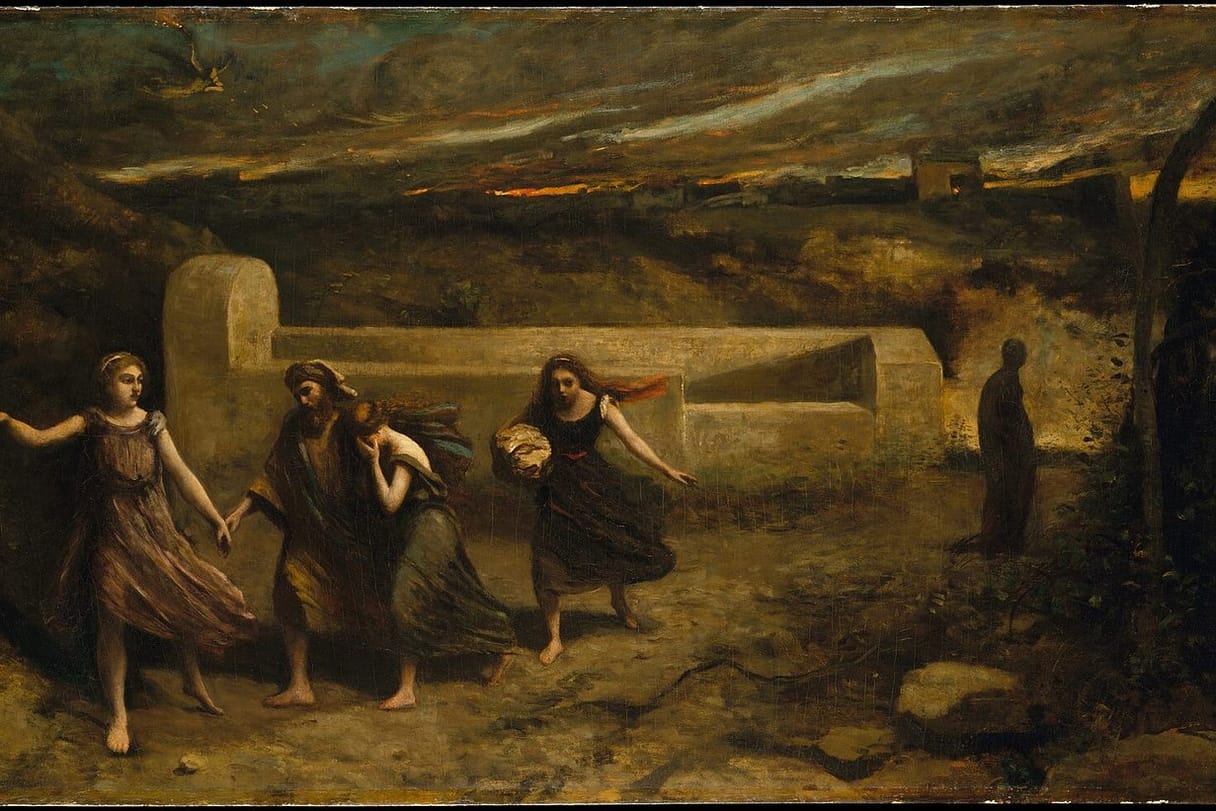
When the Bible looks back on Sodom, it remembers a city that was cruel to strangers and deaf to the poor. Genesis says that God heard an “outcry” against Sodom and Gomorrah, and the prophets and Jesus read the story as a call to justice and hospitality. If you are gay, or love someone who is, and have heard this story used against you, the Bible’s own reading of it may come as a relief. The story warns every comfortable society that God hears the cry of the people it crushes.
What happened at Sodom and Gomorrah?
The story begins with an act of hospitality. In Genesis 18 Abraham sees three strangers near his tent, runs to meet them, and feeds them, and they turn out to be messengers of God. The Lord then tells Abraham what he has heard:
Then the Lord said, “How great is the outcry against Sodom and Gomorrah and how very grave their sin! I must go down and see whether they have done altogether according to the outcry that has come to me, and if not, I will know.”
Genesis 18:20–21, NRSVUE
The Hebrew word for “outcry”1 is the word the Bible uses for the cry of the oppressed. When God speaks to Moses at the burning bush, God says of the Israelites in Egypt that he has “heard their cry because of their taskmasters” (Exodus 3:7). Sodom’s victims were crying out to God, and God heard them.
Two of the messengers go on to Sodom, and Abraham’s nephew Lot takes them into his house. Then the city comes for them. The men of Sodom, “both young and old, all the people from every quarter,” surround the house and demand that Lot bring the two men out so that the crowd can have sex with them (Genesis 19:4–5).
The Hebrew verb in that demand is yada, “know,” which can refer to sex; from a mob outside the door it is a threat of gang rape. Lot’s response is also horrifying: he offers the mob his two daughters instead (Genesis 19:8). The angels pull Lot inside, strike the mob blind, and lead Lot’s family out. Then “the LORD rained on Sodom and on Gomorrah sulfur and fire” (Genesis 19:24).
What was the sin of Sodom?
The Bible answers that question several times, and each answer names injustice. The prophet Ezekiel gave the fullest answer:
This was the guilt of your sister Sodom: she and her daughters had pride, excess of food, and prosperous ease but did not aid the poor and needy. They were haughty and did abominable things before me; therefore I removed them when I saw it.
Ezekiel 16:49–50, NRSVUE
Isaiah addressed the rulers of Jerusalem as “you rulers of Sodom” (Isaiah 1:10), and his remedy was justice: “Seek justice. Relieve the oppressed. Defend the fatherless. Plead for the widow” (Isaiah 1:17). Jeremiah, speaking for God, said that Jerusalem’s prophets, who “commit adultery and walk in lies” and “strengthen the hands of evildoers,” had “all become to me as Sodom” (Jeremiah 23:14).
The Wisdom of Solomon, a Jewish book from around the first century BCE that the Orthodox churches, among others, include in the Old Testament, recalls an earlier people, understood to be Sodom, who “didn’t receive the strangers when they came to them” (Wisdom of Solomon 19:14). Jewish tradition remembers Sodom the same way. The Talmud, in tractate Sanhedrin 109a–b, recounts legends of Sodom’s laws against charity and its cruelty to travelers. The Mishnah, in Pirkei Avot 5:10, describes the person who says “mine is mine, and yours is yours,” and adds that some sages called that attitude the character of Sodom.
What did Jesus say about Sodom?
Jesus mentioned Sodom when he sent out his disciples to preach, and he tied Sodom’s fate to how a town treats God’s messengers:
If anyone will not welcome you or listen to your words, shake off the dust from your feet as you leave that house or town. Truly I tell you, it will be more tolerable for the land of Sodom and Gomorrah on the day of judgment than for that town.
Matthew 10:14–15, NRSVUE
In the Gospels, Sodom stands for a place that refuses hospitality. The Letter to the Hebrews draws the lesson that Abraham and Lot learned: “Don’t forget to show hospitality to strangers, for in doing so, some have entertained angels without knowing it” (Hebrews 13:2).
Was Sodom destroyed for homosexuality?
No passage of Scripture says that Sodom was destroyed for same-sex love. The men of Sodom tried to gang-rape strangers, and rape is violence whoever its victims are. A story about a mob threatening rape says nothing about two people of the same sex who love each other faithfully.
Jude 7 says that Sodom and Gomorrah had “given themselves over to sexual immorality and gone after strange flesh” (Jude 7). The Greek behind “strange flesh,” sarkos heteras, means literally “other flesh,” and the verse before speaks of angels, so many interpreters read Jude as referring to the attempted assault on the angelic visitors. The identification of Sodom’s sin mainly with same-sex acts became common in later Christian tradition, and the English word “sodomy” comes from that later reading.
Christians who hold the traditional view read Genesis 19 and Jude 7 together as a condemnation of same-sex relations, and they do so out of a desire to be faithful to Scripture. The Evangelical Lutheran Church in America, the Presbyterian Church (U.S.A.), the United Methodist Church, and the Episcopal Church, which all ordain gay and lesbian Christians and permit their clergy to marry same-sex couples, read the story as Ezekiel and Jesus did. For the full discussion, see What does the Bible say about homosexuality? and Gay, lesbian, and bisexual Christians
Why would a loving God destroy a city?
Christians feel the force of that question, and so did Abraham. Before the destruction, Abraham bargained with God for the city, asking, “Shouldn’t the Judge of all the earth do right?” (Genesis 18:25). Abraham bargained God down from fifty righteous people to ten, and God answered, “I will not destroy it for the ten’s sake” (Genesis 18:32). The story shows a God who is willing to spare the many for the sake of a few, and who invites human beings to plead for mercy.
The story’s own word for Sodom’s guilt, “outcry,” explains why it has a judgment at all. The Bible pictures God hearing the cry of people who are wronged and refusing to let cruelty stand, and the fire on Sodom is its picture of that justice. Some Christians have also read the fire as a picture of hell. A long line of Christian teachers, especially in the East, from Gregory of Nyssa to Isaac the Syrian, has hoped that God’s judgment in the end heals those it touches, and the prophets point the same way.
The Bible does not leave Sodom in ashes. Through Ezekiel, God makes a startling promise: “I will reverse their captivity, the captivity of Sodom and her daughters” (Ezekiel 16:53). Jesus said that if Sodom had seen the deeds of power done in Capernaum, “it would have remained until today” (Matthew 11:23). Those words give Christians reason to hope that God’s judgment on Sodom was not God’s last word. On that hope, see Is hell real?
What does the story of Sodom mean today?
The story of Sodom asks every comfortable society how it treats strangers, refugees, and the poor. Ezekiel’s list of Sodom’s sins, “pride, excess of food, and prosperous ease” while the needy go without, describes temptations that wealthy nations know well. The law of Moses commanded Israel to love the stranger as itself (see What does the Bible say about immigrants?), and Sodom is the Bible’s picture of the opposite. For the wider question of judgment and violence in the Old Testament, see Why is the Old Testament so violent?
The story begins at Abraham’s tent, where an old man runs out in the heat of the day to welcome strangers and finds that he has welcomed the Lord (Genesis 18:1–2). It continues with Abraham pleading for a city he had every reason to fear. Christians are called to both: to open the door to the stranger, and to pray for mercy even for those they find hardest to love.
Notes
-
Hebrew (Westminster Leningrad Codex): וַיֹּ֣אמֶר יְהוָ֔ה זַעֲקַ֛ת סְדֹ֥ם וַעֲמֹרָ֖ה כִּי־רָ֑בָּה וְחַ֨טָּאתָ֔ם כִּ֥י כָבְדָ֖ה מְאֹֽד׃ אֵֽרֲדָה־נָּ֣א וְאֶרְאֶ֔ה הַכְּצַעֲקָתָ֛הּ הַבָּ֥אָה אֵלַ֖י עָשׂ֣וּ ׀ כָּלָ֑ה וְאִם־לֹ֖א אֵדָֽעָה׃ Za’aqat (verse 20) and tse’aqah (verse 21) are two forms of one word, “outcry,” the cry for help of people who are wronged; ha-ketsa’aqatah means literally “according to its outcry.” ↩︎
Common questions
Was Sodom destroyed because of homosexuality?
No passage of Scripture names same-sex love as the sin of Sodom. In Genesis 19 the men of the city try to gang-rape two guests, which is violence. Ezekiel names Sodom’s guilt as pride, excess, and neglect of “the poor and needy,” and Jesus links Sodom with towns that refuse hospitality. The identification of Sodom’s sin with same-sex relations became common in later Christian tradition, and the English word “sodomy” comes from that later reading.
Why did Lot’s wife turn into a pillar of salt?
Genesis 19:26 says that Lot’s wife “looked back from behind him, and she became a pillar of salt,” after the angels had told the family not to look back. The story warns against clinging to a life God is calling you out of. Jesus told his disciples, “Remember Lot’s wife” (Luke 17:32), as a call to be ready for God’s kingdom without longing for what is left behind.
Where were Sodom and Gomorrah?
Genesis places Sodom and Gomorrah in the plain of the Jordan near the Dead Sea, a region of salt and sulfur deposits. Archaeologists have not identified either city with certainty. Several sites near the Dead Sea have been proposed, and none has won general agreement among scholars.
Will the people of Sodom be saved?
The Bible holds out surprising hope for Sodom. Through Ezekiel God promises, “I will reverse their captivity, the captivity of Sodom and her daughters” (Ezekiel 16:53). Jesus said that if Sodom had seen his deeds of power, “it would have remained until today” (Matthew 11:23), and that the judgment will be “more tolerable” for Sodom than for towns that rejected him.


_MET_DT2014.jpg)