Gay, lesbian, and bisexual Christians
Being gay, lesbian, or bisexual is not a sin, and God made you and loves you as you are. The ELCA, the Presbyterian Church (U.S.A.), the United Methodist Church, and the Episcopal Church ordain gay and lesbian Christians and permit their clergy to marry same-sex couples. No verse of the Bible addresses a person’s attractions, and these churches read the few verses usually quoted as addressing ancient practices that differ from the faithful love of two people.
There is no fear in love, but perfect love casts out fear; for fear has to do with punishment, and whoever fears has not reached perfection in love.
1 John 4:18, NRSVUE
If you are gay, lesbian, or bisexual, God made you, knows you, and loves you, and the love you are able to give belongs to the person God made. You did not choose your orientation, and the biblical writers never discussed sexual orientation as we understand it today. What Scripture asks of you is what it asks of every Christian: to love God, to love your neighbor, and to keep faith with the people you love.
The Evangelical Lutheran Church in America (ELCA), the Presbyterian Church (U.S.A.), the United Methodist Church, and the Episcopal Church have studied Scripture on the question for decades. They have concluded that gay and lesbian Christians may marry, be ordained, and receive the sacraments on the same terms as everyone else. Christians do disagree about same-sex relationships, and the sections below give these churches’ reasons from Scripture and from the church’s own history.
Does God love gay people?
Yes. The First Letter of John gives the shortest description of God in the Bible: “God is love” (1 John 4:8). Paul lists every power he can think of that might come between a person and God, and he says none of them can:
For I am convinced that neither death, nor life, nor angels, nor rulers, nor things present, nor things to come, nor powers, nor height, nor depth, nor anything else in all creation will be able to separate us from the love of God in Christ Jesus our Lord.
Romans 8:38–39, NRSVUE
Your sexuality is part of creation, and Paul says that nothing in creation can separate you from God’s love. The psalmist prays, “I will give thanks to you, for I am fearfully and wonderfully made” (Psalm 139:14). That prayer belongs to gay Christians as much as to anyone. For more on God’s love for you in particular, see Does God love me?
What does the Bible say about being gay?
No verse of the Bible addresses a person’s attractions, and no verse describes two people of the same sex in a faithful, lifelong partnership.
Six passages are usually quoted against gay people: Genesis 19 (the story of Sodom), Leviticus 18:22 and 20:13, Romans 1:26–27, 1 Corinthians 6:9–10, 1 Timothy 1:10, and Jude 7. Each of these passages describes or condemns certain sexual acts. None of them speaks about gay people as such.
The traditional reading, held by the Orthodox churches and many evangelical churches, is that these six passages together forbid every sexual relationship between people of the same sex. Mainline churches read them differently. Genesis 19 describes an attempted gang rape. Leviticus belongs to the purity code of ancient Israel, which also forbids mixing two kinds of fabric. Paul’s letters address the exploitative and excessive forms of same-sex sex that he saw in the Greek and Roman world. Each passage is examined carefully in What does the Bible say about homosexuality?
How did the first Christians decide to welcome people they once excluded?
The Book of Acts records the church changing its mind about who could belong. Under the law of Moses, every male among God’s people had to be circumcised, and Genesis calls the requirement “an everlasting covenant” (Genesis 17:10–13). The first Christians were Jews, and many of them assumed that Gentiles who followed Jesus would have to keep that law.
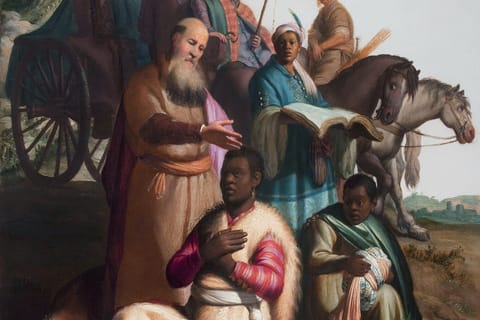
In Acts 10, Peter has a vision in which a voice tells him, “What God has cleansed, you must not call unclean” (Acts 10:15). He then visits the household of Cornelius, a Gentile, and watches the Holy Spirit fall on people who had never been circumcised. Peter asks:
“Can anyone withhold the water for baptizing these people who have received the Holy Spirit just as we have?”
Acts 10:47, NRSVUE
At the council in Jerusalem, Peter argued from what he had seen. God “testified about them, giving them the Holy Spirit, just like he did to us,” he said, and “made no distinction between us and them, cleansing their hearts by faith” (Acts 15:8–9). The apostles then decided not to require circumcision of Gentile believers.
Mainline churches have reasoned from the same precedent. Gay and lesbian Christians are baptized, confess the creeds, pray, serve the poor, and show the gifts of the Spirit in their lives and marriages. Peter’s question at the end of Acts 11 applies to them: “who was I, that I could withstand God?” (Acts 11:17).
What does “you will know them by their fruits” mean for gay Christians?
Jesus gave his followers a test for telling good teaching from bad: “By their fruits you will know them” (Matthew 7:16–20). Paul names the fruit that the Holy Spirit produces:
By contrast, the fruit of the Spirit is love, joy, peace, patience, kindness, generosity, faithfulness, gentleness, and self-control. There is no law against such things.
Galatians 5:22–23, NRSVUE
Mainline congregations have seen in the marriages of gay and lesbian Christians the same fruit they see in any faithful marriage: patience, generosity, and joy, and a home open to children, friends, and strangers.
Scripture also says, near its very beginning, “It is not good for the man to be alone” (Genesis 2:18). Paul wished that everyone could remain unmarried as he was, but he wrote that “each man has his own gift from God” and that “if they don’t have self-control, let them marry” (1 Corinthians 7:7–9). Mainline churches have concluded that gay Christians, like everyone else, may receive either gift: a celibate life for those called to it, and marriage for those who are not.
Augustine gave the church a rule for reading Scripture in On Christian Teaching (1.36.40). Anyone whose reading does not build up the love of God and neighbor, he wrote, “does not yet understand them as he ought.”
What do the mainline churches teach?
The mainline churches reached their decisions slowly, over several decades of study and debate. The Episcopal Church resolved in 1976 that gay people “are children of God who have a full and equal claim” with all others on the church’s love, acceptance, and pastoral care, and in 2003 it consecrated Gene Robinson, its first openly gay bishop. The Evangelical Lutheran Church in America (ELCA) voted in 2009 to allow people in “publicly accountable, lifelong, monogamous, same-gender relationships” to serve as its pastors.
The Presbyterian Church (U.S.A.) removed its requirement of “chastity in singleness” for clergy in 2011 and changed its definition of marriage to “two people” in 2015, the same year the Episcopal Church opened its marriage rites to same-sex couples. The United Methodist Church removed its ban on gay clergy and its ban on same-sex weddings at its 2024 General Conference. The Church of England has offered prayers of blessing for same-sex couples since December 2023, though it does not marry them.
The Orthodox churches and many evangelical churches still teach that same-sex sexual relationships are wrong, while many of them distinguish orientation from conduct and call for gay people to be treated with respect. To learn more about the mainline churches, see What is mainline Protestantism?, and for weddings, see Can same-sex couples get married in church?
What if you are afraid you will go to hell?
The God revealed in Jesus Christ made you in love and holds your life in love. Jesus’ warnings about Gehenna are the Bible’s picture-language for God’s judgment on cruelty and injustice, such as harm done to “little ones” and neglect of the poor, and they answer the cry of people who have been wronged. Teachers of the church from Gregory of Nyssa and Isaac the Syrian to Julian of Norwich hoped that God’s love would in the end reach everyone; Isaac wrote that even those in Gehenna are “scourged by love.” Read more in Hell and the mercy of God.
There is no fear in love, but perfect love casts out fear; for fear has to do with punishment, and whoever fears has not reached perfection in love.
1 John 4:18, NRSVUE
If your family or your church has called you an abomination, hear what God said to a frightened people through Isaiah: “you have been precious and honored in my sight, and I have loved you” (Isaiah 43:4). You are not alone. Many Lutheran, Presbyterian, Methodist, and Episcopal congregations will welcome you as you are, and a priest or pastor there will be glad to talk with you.
If you feel unsafe or are thinking about hurting yourself, please reach out today. In the United States you can call or text 988, or contact the Trevor Project, which serves LGBTQ young people, at 1-866-488-7386 or by texting START to 678-678.
Julian of Norwich, the fourteenth-century English mystic, was shown in a vision something as small as a hazelnut lying in the palm of her hand, and she understood that it was “all that is made.” She saw three things in it: “The first is that God made it, the second is that God loveth it, the third, that God keepeth it.” All three are true of you.
Common questions
Is it a sin to be bisexual?
Bisexual Christians are made and loved by God, and they are called to what every Christian is called to: faithfulness, honesty, and love in any relationship they enter. Being bisexual means you can be attracted to people of more than one sex. In the mainline churches, a bisexual Christian may marry a person of either sex.
Will I go to hell for being gay or for dating someone of the same gender?
Nothing in all creation can separate you from the love of God in Christ Jesus (Romans 8:38–39), and that love holds gay Christians as surely as anyone. Mainline churches hold a same-sex relationship to the same standard as any other: love, faithfulness, honesty, and care for the other person. As the First Letter of John says, “perfect love casts out fear” (1 John 4:18).
Can you be gay and Christian?
Yes. Gay and lesbian Christians are baptized, receive Holy Communion, and serve as pastors, priests, and bishops in the mainline churches. Baptism makes a person a Christian, and Paul wrote that “as many of you as were baptized into Christ have put on Christ” (Galatians 3:27).
Do gay Christians have to be celibate?
The Orthodox churches and many evangelical churches teach that they do. The ELCA, the Presbyterian Church (U.S.A.), the United Methodist Church, the Episcopal Church, and others do not, and their clergy may marry same-sex couples. Paul treated lifelong celibacy as a particular gift from God that not everyone has (1 Corinthians 7:7–9), and some gay Christians freely choose it as their calling.
Can a gay person become a priest or pastor?
Yes, in many churches. The ELCA has allowed pastors in same-sex relationships since 2009, the Presbyterian Church (U.S.A.) has ordained gay and lesbian ministers since 2011, the Episcopal Church consecrated its first openly gay bishop in 2003, and the United Methodist Church removed its ban on gay clergy in 2024.
Sources
- Romans 8:38–39 (WEB)
- Acts 10:34–48 (WEB)
- Acts 15:1–29 (WEB)
- Isaiah 43:4 (WEB)
- Galatians 5:22–23 (WEB)
- Augustine, On Christian Doctrine, Book 1 (New Advent)
- Episcopal General Convention 1976-A069: Recognize the Equal Claims of Homosexuals
- Episcopal General Convention 2015-A036: Amend Canon I.18
- 2009 ELCA Churchwide Assembly
- PC(USA) approves change in ordination standards (2011)
- United Methodists strike down ban on ordination of gay clergy (RNS, 2024)
- Isaac of Nineveh (Isaac the Syrian) (Wikipedia)
- Julian of Norwich, Revelations of Divine Love, chapter 5, ed. Grace Warrack (Project Gutenberg)
- The Trevor Project: Get help



.jpg)