Homosexuality and the Bible
The Bible mentions sexual acts between people of the same sex in six passages: Genesis 19, Leviticus 18:22 and 20:13, Romans 1:26–27, 1 Corinthians 6:9–10, 1 Timothy 1:10, and Jude 7. The ELCA, the PC(USA), the United Methodist Church, and the Episcopal Church read them as addressing rape, the ancient purity code, and exploitative sex; they ordain gay and lesbian clergy, and most marry same-sex couples. None of the passages describes a faithful, lifelong partnership. The traditional reading takes them as forbidding all same-sex relations.
This was the guilt of your sister Sodom: she and her daughters had pride, excess of food, and prosperous ease but did not aid the poor and needy.
Ezekiel 16:49, NRSVUE

If you are gay, lesbian, or bisexual, or you love someone who is, you may have come to these verses wanting to read them for yourself. The ELCA, the PC(USA), the United Methodist Church, and the Episcopal Church welcome gay and lesbian people as full members, and they ordain gay and lesbian Christians to serve as clergy. You can open these passages with confidence, because the God who speaks through them is love.
Christians read the six biblical passages that mention same-sex acts in two main ways. The traditional reading, held by the Orthodox churches, many evangelical churches, and many other Christians, takes them together as forbidding every sexual relationship between people of the same sex. The mainline churches read each passage in its setting and conclude that none of them addresses faithful same-sex marriage. Both readings come from Christians who take Scripture seriously and want to obey God.
What happened at Sodom in Genesis 19?
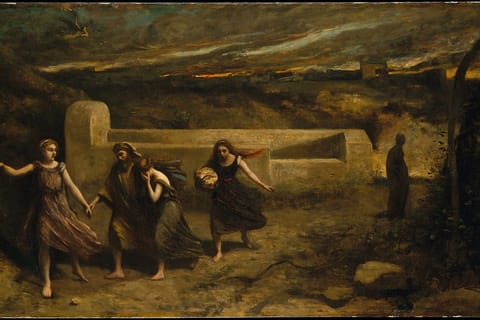
Two angels come to Sodom as guests, and Lot takes them into his house. Then the men of Sodom, young and old, surround the house and demand that Lot bring out his guests, “that we may have sex with them” (Genesis 19:4–5).
The mob intends to gang-rape the strangers. A story about a whole city threatening violence against guests describes something very far from two people who love each other. The Bible itself names Sodom’s sin in other terms:
This was the guilt of your sister Sodom: she and her daughters had pride, excess of food, and prosperous ease but did not aid the poor and needy. They were haughty and did abominable things before me; therefore I removed them when I saw it.
Ezekiel 16:49–50, NRSVUE
Jesus also mentions Sodom when he sends out his disciples. A town that refuses to welcome them, he says, will fare worse than Sodom on the day of judgment (Luke 10:10–12). In the Gospels, the sin of Sodom is the refusal of hospitality. See Why did God destroy Sodom and Gomorrah?
What does Leviticus 18:22 say?
Leviticus contains the two verses that speak most directly. Leviticus 18:22 forbids a man to “lie with a man as with a woman” and calls the act detestable. Leviticus 20:13 repeats the command and prescribes death for both men. Both verses belong to the Holiness Code, a body of law in Leviticus 17–26 meant to keep ancient Israel distinct from its neighbors. The same code forbids sex during menstruation (Leviticus 18:19), forbids wearing “a garment made of two kinds of material” (Leviticus 19:19), and prescribes death for anyone who curses a parent (Leviticus 20:9).
The Hebrew word translated “detestable” in Leviticus 18:22, to’evah (often translated “abomination”), also describes forbidden food in Deuteronomy 14:3. The apostles decided in Acts 15 that Gentile Christians did not have to keep the law of Moses, and Christians have eaten pork ever since (see Can Christians eat pork?).
Traditional Christians point out that Leviticus 18 also forbids incest and adultery, and they distinguish moral laws, which bind Christians, from ceremonial laws, which do not. Mainline churches ask of each law whom it protected. Incest and adultery wrong another person, and a faithful marriage between two men or two women wrongs no one.
What does Paul mean in Romans 1:26–27?
Romans 1 is the only passage that may mention women as well as men. In Romans 1:26–27, Paul writes that God gave people up to “vile passions”: their women exchanged natural relations for unnatural ones, and men gave up relations with women for relations with one another.
The passage begins with idolatry. People “exchanged the truth of God for a lie, and worshiped and served the creature rather than the Creator” (Romans 1:24–25), and Paul describes the lust that followed as a sign of that exchange. Then Paul addresses the reader who agrees with him: “in that which you judge another, you condemn yourself” (Romans 2:1).
Paul’s phrase “against nature” in Romans 1:26 (Greek para physin) did not always mean “morally wrong” in his letters. Paul uses the same Greek phrase for God’s own act of grafting Gentiles into Israel “contrary to nature” (Romans 11:24). He also wrote that “nature itself” teaches that long hair dishonors a man (1 Corinthians 11:14).
James Brownson, a Reformed New Testament scholar, argues in Bible, Gender, Sexuality (2013) that Romans 1 condemns excessive, self-seeking lust, which is how ancient moralists described same-sex desire. Most of the same-sex relationships that Greek and Roman writers describe were between unequal partners, such as a grown man and an adolescent boy, or a master and a slave. Traditional readers answer that Paul grounds his words in creation itself, and so they apply them to every same-sex relationship.
What do malakoi and arsenokoitai mean?
Two Greek words in Paul’s lists of vices carry most of the weight in the debate. In 1 Corinthians 6:9–10, Paul says that the unrighteous “will not inherit God’s Kingdom,” and he lists the sexually immoral, idolaters, adulterers, malakoi, arsenokoitai, thieves, the greedy, drunkards, slanderers, and swindlers (translated from the Greek).1
Malakoi literally means “soft.” Jesus uses the same word for the “soft clothing” worn in kings’ houses (Matthew 11:8), and the King James Version translated it “effeminate.” Arsenokoitai is a compound of the Greek words for “male” and “bed.” Some modern translations, including the World English Bible, render one or both words as “homosexuals,” an English word coined in the nineteenth century for a sexual orientation, which neither Greek word names. Scholars disagree about the exact meaning of both Greek words.
Arsenokoitai appears once more, in 1 Timothy 1:10, where it stands between “the sexually immoral” and “slave-traders.” Traditional interpreters read the word as a broad term for men who have sex with men and connect it with Leviticus 18:22. Other scholars think it named men who used others for sex, which would fit its place beside slave traders. Paul’s next sentence in 1 Corinthians is the good news for everyone on his list: “Some of you were such, but you were washed. You were sanctified. You were justified” (1 Corinthians 6:11).
What does Jude 7 mean by “unnatural lust”?
Jude 7 says that Sodom, Gomorrah, and the cities around them gave themselves over to sexual immorality and went after “strange flesh,” and that they serve as an example of the punishment of eternal fire. Some translations render the phrase as “unnatural lust,” but the Greek, sarkos heteras, means literally “other flesh.” The verse before it speaks of angels who “deserted their own dwelling place” (Jude 6), and the visitors at Sodom were angels. Many interpreters therefore read “other flesh” as the flesh of angels.
Why do mainline churches read these passages differently?
The church has changed its teaching before when it understood Scripture better. The law forbids charging interest (Exodus 22:25; Deuteronomy 23:19), and the Council of Nicaea in 325 ordered that clergy who lent at interest be deposed (Canon 17). Three New Testament letters tell slaves to obey their masters (Ephesians 6:5; Colossians 3:22; 1 Peter 2:18), and every church now condemns slavery (see Does the Bible support slavery?). Jesus calls remarriage after divorce adultery (Mark 10:11–12), and the mainline churches and many others now remarry divorced people. The Orthodox churches, too, have long allowed a second marriage after divorce as an act of pastoral mercy, which they call oikonomia, “household management.”
In each case the church came to see, often slowly and with much prayer, that Scripture’s own command to love God and neighbor required a different practice. Brownson argues that the Bible’s picture of marriage as “one flesh” (Genesis 2:24) describes a bond of kinship and lifelong commitment, which two people of the same sex can share. Paul wrote that “the whole law is fulfilled in one word”: “You shall love your neighbor as yourself” (Galatians 5:14).
What do the churches teach today?
The Orthodox churches and many evangelical churches teach that same-sex sexual acts are sinful, and they call gay and lesbian Christians to celibacy. They hold this view out of conviction that Scripture and the church’s tradition reserve sex for marriage between a man and a woman, and many of them seek to care for gay and lesbian members as fellow believers. The ELCA, the Presbyterian Church (U.S.A.), the United Methodist Church, and the Episcopal Church ordain gay and lesbian clergy. The Presbyterian, United Methodist, and Episcopal churches allow their clergy to marry same-sex couples, and the ELCA leaves the decision to recognize same-gender marriages to each congregation and its pastor. For what this means for you personally, see Is it a sin to be gay? and Can same-sex couples get married in church?
God made you, knows you, and loves you. Whether you are gay or straight, single or married, your calling is the same as every Christian’s, to receive God’s love and to share it. The First Letter of John puts it this way:
God is love, and he who remains in love remains in God, and God remains in him. … There is no fear in love; but perfect love casts out fear
Notes
-
Greek (SBL Greek New Testament): Ἢ οὐκ οἴδατε ὅτι ἄδικοι θεοῦ βασιλείαν οὐ κληρονομήσουσιν; μὴ πλανᾶσθε· οὔτε πόρνοι οὔτε εἰδωλολάτραι οὔτε μοιχοὶ οὔτε μαλακοὶ οὔτε ἀρσενοκοῖται οὔτε κλέπται οὔτε πλεονέκται, οὐ μέθυσοι, οὐ λοίδοροι, οὐχ ἅρπαγες βασιλείαν θεοῦ κληρονομήσουσιν. Malakoi means literally “soft ones”; arsenokoitai combines “male” and “bed.” ↩︎
Common questions
Did Jesus say anything about homosexuality?
No words of Jesus about same-sex relationships are recorded in the Gospels. Jesus mentions Sodom when he warns towns that refuse to welcome his disciples (Matthew 10:14–15). Traditional Christians point to his teaching on marriage in Matthew 19:4–6, which quotes “male and female” from Genesis, while mainline readers note that Jesus was answering a question about divorce.
Does the Bible call homosexuality an abomination?
Leviticus 18:22 calls a man lying with a male “as with a woman” to'evah, a Hebrew word translated “abomination” or “detestable.” The same word is also used for eating forbidden food in Deuteronomy 14:3. Christians have never kept the food laws, and mainline churches do not treat the purity code of Leviticus as binding on the church.
Was the sin of Sodom homosexuality?
The men of Sodom tried to gang-rape two visitors, an act of violence against strangers. The prophet Ezekiel named Sodom's guilt as pride, excess, and failure to aid the poor and needy (Ezekiel 16:49). Jesus links Sodom with towns that refuse hospitality to his messengers (Luke 10:10–12).
Does the Bible mention lesbians?
Romans 1:26 is the only verse in the Bible that may refer to sex between women, and interpreters disagree about its meaning. The Hebrew Scriptures contain no law about sex between women. No passage describes a faithful relationship between two women.
Sources
- Genesis 19:1–9 (WEB)
- Ezekiel 16:49–50 (WEB)
- Leviticus 18:22 and 20:13 (WEB)
- Romans 1:18–2:1 (WEB)
- 1 Corinthians 6:9–11 (WEB)
- 1 Timothy 1:9–10 (WEB)
- Jude 6–7 (WEB)
- Council of Nicaea (325), Canon 17 (New Advent)
- James V. Brownson, Bible, Gender, Sexuality (2013), review in Fulcrum
- PC(USA) approves change in ordination standards (2011)
- United Methodists remove same-sex wedding ban (UM News, 2024)
- Episcopal General Convention 2015-A036: Amend Canon I.18