The name of God
God’s personal name in the Hebrew Bible is written with four letters, YHWH, and most scholars think it was pronounced “Yahweh.” God reveals the name to Moses at the burning bush with the words “I AM WHO I AM” (Exodus 3:14). Jews stopped saying the name aloud before the time of Jesus and read Adonai, “my Lord,” in its place, so most English Bibles print “the LORD.” “Jehovah” is a later blend of YHWH with the vowels of Adonai.
God said to Moses, “I AM WHO I AM,” and he said, “You shall tell the children of Israel this: ‘I AM has sent me to you.’”
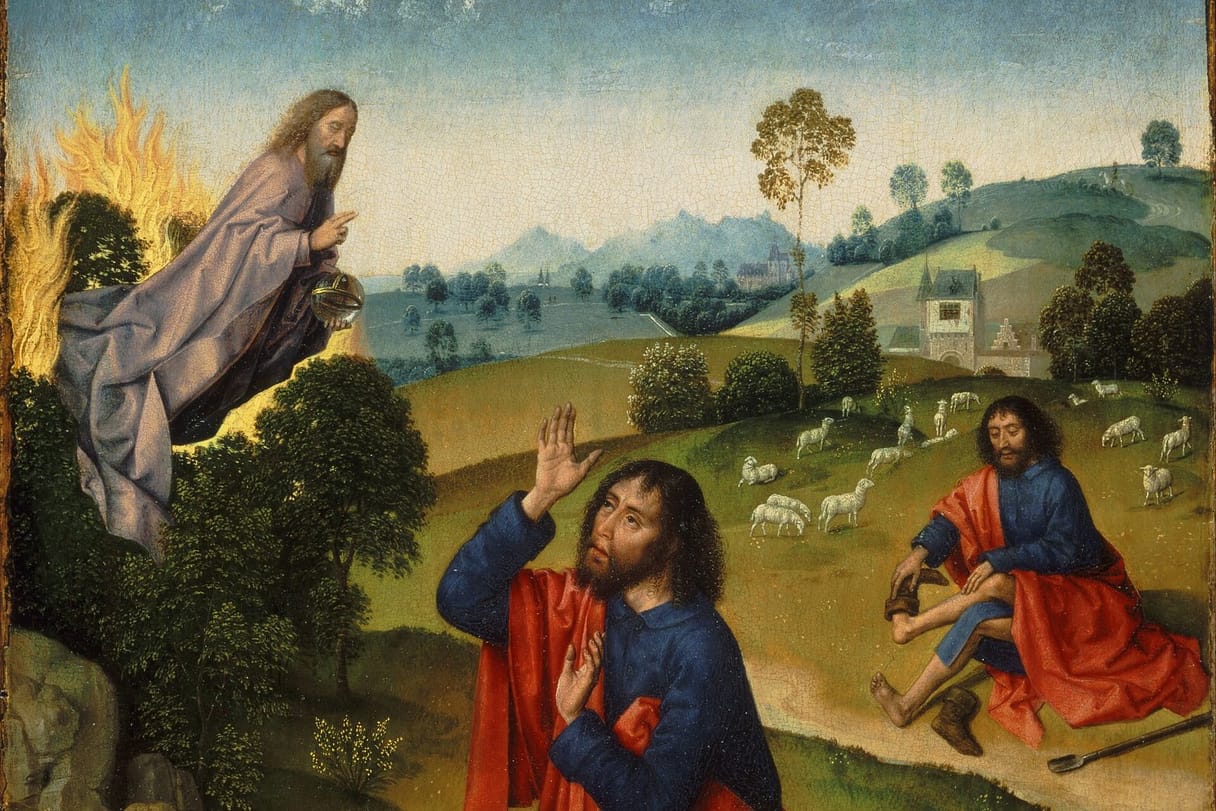
To know someone’s name is to be able to call on them. In the Hebrew Bible, God gives Israel a personal name, written with four Hebrew letters that correspond to YHWH, and gives it at a moment of great need, when the people were slaves in Egypt and God had “heard their cry” (Exodus 3:7). Jews have avoided pronouncing the name aloud for more than two thousand years, and Christian worship has largely followed that reverence from the beginning. The liturgies of the Eastern and Western churches and most English Bibles say “the LORD” wherever the Hebrew has the name.
What did God tell Moses his name was?
The name is revealed in the story of the burning bush. Moses asks what he should say when the Israelites want to know who sent him:
Moses said to God, “Behold, when I come to the children of Israel, and tell them, ‘The God of your fathers has sent me to you,’ and they ask me, ‘What is his name?’ what should I tell them?” God said to Moses, “I AM WHO I AM,” and he said, “You shall tell the children of Israel this: ‘I AM has sent me to you.’”
The Hebrew words are ehyeh asher ehyeh. They can mean “I am who I am” or “I will be who I will be,” and interpreters have found both senses true. God exists in God’s own right (see Who made God?), and God promises to be present with Israel in whatever lies ahead. In the next verse God gives the four-letter name itself, which most scholars connect with the same Hebrew verb “to be,” and says, “This is my name forever” (Exodus 3:15).
Later, on Mount Sinai, God proclaims the name to Moses together with a description of God’s character. The name and the mercy are given together:
The LORD passed by before him, and proclaimed, “The LORD! The LORD, a merciful and gracious God, slow to anger, and abundant in loving kindness and truth.
What are the four letters YHWH?
Scholars call the four-letter name the Tetragrammaton, from the Greek for “four letters.” It appears more than 6,000 times in the Hebrew Bible. Ancient Hebrew was written without vowels, so the spelling alone does not show how the name was pronounced. Early Christian writers who wrote the name in Greek letters, and the short form Yah found in many Hebrew names and in the word hallelujah (“praise Yah”), point to the pronunciation most scholars accept: Yahweh.
The name is carried in many biblical names, so that the people of Israel bore God’s name in their own. Elijah means “my God is Yah,” Isaiah means “Yah saves,” and Joshua means “the LORD saves.” Jesus’ own name, Yeshua in Hebrew or Aramaic, is a form of Joshua, which explains the angel’s words to Joseph: “You shall name him Jesus, for it is he who shall save his people from their sins” (Matthew 1:21).
Why don’t Jewish people say God’s name?
Jews stopped pronouncing the name in ordinary speech some time before the birth of Jesus, out of reverence and out of care to keep the Third Commandment: “You shall not misuse the name of the LORD your God” (Exodus 20:7). The Mishnah, the code of Jewish law compiled around 200 CE, remembers that in the Temple the high priest spoke the name on the Day of Atonement, and that the people who heard it fell on their faces (Mishnah Yoma 6:2). The same collection records the rabbi Abba Shaul’s teaching that anyone who pronounces the name as it is written has no share in the world to come (Mishnah Sanhedrin 10:1).
When Jews read Scripture aloud, they say Adonai, “my Lord,” where the name is written. In everyday speech many say HaShem, “the Name.” Christians can learn from this reverence, which treats the name of God as something too holy to use carelessly.
Why do English Bibles say “the LORD”?
Christians inherited the Jewish practice. The Septuagint, the Greek translation of the Hebrew Scriptures used by the first Christians, survives in Christian copies that render the name as Kyrios, “Lord.” Some early Jewish copies wrote the four Hebrew letters inside the Greek text instead. The New Testament quotes the Old Testament with Kyrios: when Paul writes, “Whoever will call on the name of the Lord will be saved” (Romans 10:13), he is quoting Joel 2:32, where the Hebrew has the name. Jerome’s Latin Bible used Dominus, “Lord,” for the same reason.
Most English Bibles since the King James Version of 1611 have printed the word as “LORD” in capital letters, often small capitals, to show readers where the Hebrew has the name. The World English Bible Updated, the translation quoted throughout Mainline Christian, says on its edition page that it “uses ‘LORD’ or ‘GOD’ in place of ‘Yahweh’ or ‘Yah’ in the Old Testament.” The older edition of the same translation, the World English Bible Classic, prints “Yahweh” throughout. For more on how translations differ, see Which Bible translation is best?
Where does the name “Jehovah” come from?
Medieval Jewish scribes known as the Masoretes added vowel marks to the Hebrew text. Over the four letters of the name they placed the vowels of Adonai, as a reminder to readers to say “Adonai.” Christian scholars who read the consonants with those borrowed vowels produced forms such as Yohoua, which appears in the work of the Dominican friar Raymund Martini around 1270. William Tyndale’s 1530 English translation of the first five books of the Bible spelled it “Iehouah.”
The King James Version prints “JEHOVAH” in four verses, including Exodus 6:3 and Psalm 83:18, and the American Standard Version of 1901 used it throughout the Old Testament. Jehovah’s Witnesses take their name from it. Most scholars regard “Jehovah” as a hybrid form that arose from the medieval vowel marks, and the name also has a long, honored place in Christian hymns such as “Guide me, O thou great Jehovah.”
Should Christians say “Yahweh”?
Christians differ in practice. The custom of saying “Lord” is very old: the New Testament writers used Kyrios when they quoted the Old Testament, and the Eastern Orthodox churches still read the Old Testament in the Septuagint and say Kyrios in their worship.
The Evangelical Lutheran Church in America, the Presbyterian Church (U.S.A.), the United Methodist Church, and the Episcopal Church have no rule about the name, and their worship generally follows the same custom of saying “Lord.” Many Christians also avoid “Yahweh” in prayer out of respect for Jewish practice, which Jesus himself appears to have shared (see Was Jesus Jewish?). Scholars, teachers, and some Bible translations use the name freely. Whichever word you use, what matters most is the reverence and love with which you call on God.
What does “I AM” mean in John’s Gospel?
In John’s Gospel, Jesus uses the Greek words egō eimi, “I am,” in ways that many interpreters hear as echoes of the name revealed to Moses. The Septuagint begins God’s answer in Exodus 3:14 with the same words: egō eimi ho ōn, “I am the one who is.” The clearest example comes at the end of an argument in the Temple:
Jesus said to them, “Most certainly, I tell you, before Abraham came into existence, I AM.”
When soldiers come to arrest Jesus and he answers them with the same words, “I am he,” they draw back and fall to the ground (John 18:5–6). Paul makes a related claim in a passage that many scholars think was an early Christian hymn:
Therefore God also highly exalted him, and gave to him the name which is above every name, that at the name of Jesus every knee should bow, of those in heaven, those on earth, and those under the earth, and that every tongue should confess that Jesus Christ is Lord, to the glory of God the Father.
The word “Lord” in Philippians 2:11 is Kyrios, the word that stood for the divine name in the Greek Scriptures, and “every knee should bow” echoes a promise in Isaiah where God says “to me every knee shall bow” (Isaiah 45:23). The church read such passages as evidence that Jesus shares the identity of the God of Israel (see Is Jesus God?). Christians honor the name each time they pray the first petition of the Lord’s Prayer: “Our Father in heaven, may your name be kept holy” (Matthew 6:9).
Eastern Orthodox Christians honor the name of Jesus in the Jesus Prayer, a short prayer repeated slowly and often: “Lord Jesus Christ, Son of God, have mercy on me, a sinner.” Monks and lay people of the Christian East have prayed it for many centuries as a way to follow Paul’s call to “pray without ceasing” (1 Thessalonians 5:17). The prayer joins the confession that Jesus is Kyrios, Lord, to the plea of the tax collector in the Temple, “God, be merciful to me, a sinner” (Luke 18:13).
The God who told Moses “I AM” gave the name so that people could call on it, in slavery, in the wilderness, and in every trouble since. You can call on that name now, in the words of the psalm Israel sang:
LORD, our Lord, how majestic is your name in all the earth! You have set your glory above the heavens!
Common questions
Is it wrong for a Christian to say “Yahweh”?
Christians are free to say “Yahweh,” and many scholars and some Bible translations use it. Many Christians prefer “the Lord” in worship out of respect for the ancient practice that Jesus and the apostles appear to have followed. In study and teaching, Christians of every tradition use the name freely.
What does “taking the Lord’s name in vain” mean?
The Third Commandment, in Exodus 20:7, forbids misusing the name of the Lord. In ancient Israel the command applied above all to false oaths, in which a person swore by God’s name to back a lie. Jesus taught the positive side of the command in the first petition of the Lord’s Prayer: “may your name be kept holy” (Matthew 6:9).
What does Elohim mean?
Elohim is the ordinary Hebrew word for God, used in the first verse of Genesis. It is plural in form but takes singular verbs when it refers to the God of Israel. The Bible also uses titles such as El Shaddai, usually translated “God Almighty,” and Adonai, “my Lord,” alongside the personal name YHWH.
Why do some Jewish people write “G-d”?
Jewish law forbids erasing or destroying the written name of God in Hebrew. Some Jews extend that reverence to the English word and write “G-d,” so that a paper or screen can be discarded without dishonoring the name. Christians can honor the practice as an expression of the same reverence the Lord’s Prayer asks for.






,_first_securely_documented_1447,_died_1475_-_Moses_and_the_Burning_Bush,_with_Moses_Removing_His_Shoes_-_Google_Art_Project.jpg)