Starting over after divorce
Starting over after divorce begins with grief, and God meets that grief with mercy. Scripture promises that the Lord “heals the broken in heart” (Psalm 147:3) and is “making all things new” (Revelation 21:5). The mainline churches welcome divorced people fully into the life of the church and allow them to marry again. Your baptism, more than your marriage, tells you who you are, and God can build a new life from what remains.
Behold, I will do a new thing. It springs out now. Don’t you know it? I will even make a way in the wilderness, and rivers in the desert.
Starting over after divorce begins with grief, and God meets that grief with mercy. Whether you chose to end your marriage, your spouse chose it for you, or it came after years of trying, a divorce is a kind of death. A shared home, a shared future, shared friends, and often daily life with your children change all at once. Many people also carry shame, especially in church. Scripture speaks tenderly to people whose lives have broken apart, and it promises a God who builds something new from the ruins.
Is it normal to grieve a divorce?
Grief after divorce is natural and right, because something precious has been lost. A psalmist who had been betrayed by someone close to him described the particular pain of a broken bond:
For it was not an enemy who insulted me, then I could have endured it. Neither was it he who hated me who raised himself up against me, then I would have hidden myself from him. But it was you, a man like me, my companion, and my familiar friend. We took sweet fellowship together. We walked in God’s house with company.
Scripture lets grieving people say exactly how they feel. When Naomi returned to Bethlehem after losing her husband and both sons, she told the women of the town, “Don’t call me Naomi. Call me Mara, for the Almighty has dealt very bitterly with me” (Ruth 1:20). Naomi means “pleasant,” and Mara means “bitter.” God did not rebuke her, and by the end of the book her life was full again.
Grief after divorce is often tangled. A single day can hold anger, relief, guilt, loneliness, and fear for the future. All of it can be brought to God, who “is near to those who have a broken heart” (Psalm 34:18).
Does God still love me after divorce?
God’s love for you is the same today as on your wedding day. The Bible tells of Hagar, an enslaved woman who fled into the wilderness after Sarai treated her harshly in Abram’s household. An angel of the Lord found her by a spring, and she gave God a new name: “You are a God who sees” (Genesis 16:13). God sees you too, in the empty apartment and the courthouse hallway.
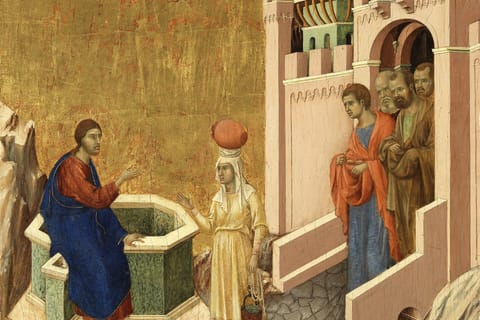
In John’s Gospel, Jesus met a Samaritan woman at a well who had “had five husbands” (John 4:18). He knew her whole history, and he offered her living water. She went back to her town to tell people about him, and many believed because of her. Her past did not keep her from becoming one of the first witnesses to Christ.
Your identity rests on something deeper than any marriage. Paul wrote that “as many of you as were baptized into Christ have put on Christ” (Galatians 3:27). No court can dissolve your baptism. If you need to confess your own part in the marriage’s end, God forgives freely (see God’s forgiveness).
What do the churches teach about divorce and remarriage?
The mainline churches hold that marriage is meant to last for life, and they also receive divorced people with care. The United Methodist Church’s Social Principles call divorce a “regrettable but necessary alternative” when a marriage is beyond repair, destructive, or irrevocably estranged. The Social Principles state that “divorce does not preclude remarriage” and urge pastors and congregations “to provide ministries and programs that support divorced people.” The Evangelical Lutheran Church in America says that it “does not treat divorce lightly,” and it says that those who marry again “may be assured of the Gospel’s freedom, in the midst of brokenness and forgiveness, to enter into their new responsibilities in joy and hope.”
The Presbyterian Church (U.S.A.) and the Episcopal Church also allow divorced people to remarry in church; an Episcopal priest needs the bishop’s consent when a former spouse is living. The Orthodox Church, while it opposes divorce, permits a second and even a third marriage by “economy,” a pastoral exception for the good of the people involved, and the service for such a marriage has a penitential character. Some Christians hold that remarriage is forbidden while a former spouse lives, out of reverence for Jesus’ words about marriage. For the biblical texts, see Divorce and remarriage, and for each church’s teaching, see What the mainline churches believe about divorce.
How do I forgive my former spouse?
Forgiveness after divorce usually comes slowly, and it may need to be chosen again and again. Forgiveness never requires you to stay in danger, to keep silent about wrongs, or to resume a relationship. Paul’s counsel is realistic: “If it is possible, as much as it is up to you, be at peace with all men” (Romans 12:18). Some days, peace may mean only refusing to speak badly of your former spouse in front of the children. For more help, see How to forgive someone who hurt you.
If your marriage involved abuse, God wills your safety. The United Methodist Social Principles say that “fidelity to the marriage covenant does not require spouses to remain in a physically or mentally abusive relationship.” In the United States, the National Domestic Violence Hotline is available at 1-800-799-7233, or text START to 88788.
How can I begin again?
God speaks to people at the end of one chapter and the start of another:
Don’t remember the former things, and don’t consider the things of old. Behold, I will do a new thing. It springs out now. Don’t you know it? I will even make a way in the wilderness, and rivers in the desert.
The prophet Hosea gave a promise in the language of a broken marriage. God says he will give his people “the valley of Achor for a door of hope” (Hosea 2:15). Achor means “trouble.” The place of your deepest trouble can become, in God’s hands, a doorway.
Starting over happens in small, faithful steps. Keep worshiping with a congregation, even when sitting alone in the pew is hard. Tell your pastor what has happened, and let a few trusted friends walk with you. A counselor can help you understand what happened and heal before you enter a new relationship. If your new life is lonely, see Loneliness and the gift of community and Being single as a Christian. If grief turns into despair, call or text 988 in the United States, or find a helpline in another country at findahelpline.com.
The Lord “heals the broken in heart, and binds up their wounds” (Psalm 147:3), and the One seated on the throne in the Book of Revelation promises, “Behold, I am making all things new” (Revelation 21:5). May the psalmist’s words become your own in time:
You have turned my mourning into dancing for me. You have removed my sackcloth, and clothed me with gladness.
Common questions
Does God forgive divorce?
God forgives every sin that is confessed, including whatever wrongs you brought to the end of your marriage, and God heals the wounds that others caused you. The First Letter of John promises that if we confess our sins, God “is faithful and righteous to forgive us the sins.” Divorce is a loss to grieve and a place where grace can work.
Can I remarry in church after a divorce?
In the mainline churches, yes. The United Methodist Church’s Social Principles say that “divorce does not preclude remarriage,” and the ELCA, the Presbyterian Church (U.S.A.), and the Episcopal Church also allow divorced people to marry again in church, with each pastor deciding about each wedding. An Episcopal priest needs the bishop’s consent if a former spouse is living.
How long does it take to heal from divorce?
There is no set time, and many people find that the grief comes in waves for a year or two or longer, especially around holidays and anniversaries. Healing usually comes through steady practices: prayer, honest friendships, counseling, worship with a congregation, and patience with yourself. Many counselors advise waiting before entering a serious new relationship.
How can I help my children through a divorce?
Assure them often that the divorce is not their fault and that both parents love them, and avoid making them carry messages or take sides. Keep routines steady, including worship if your family attends church. The Episcopal Church’s canons ask divorced parents who remarry to show continuing concern for their children and former spouse, which is wise counsel for every family.
Sources
- Psalm 55:12–14 (WEB)
- Ruth 1:20–21 (WEB)
- Genesis 16:7–13 (WEB)
- John 4:7–42 (WEB)
- Isaiah 43:18–19 (WEB)
- Hosea 2:14–15 (WEB)
- Psalm 147:3 (WEB)
- United Methodist Church, Social Principles: The Social Community
- ELCA, Human Sexuality: Gift and Trust (2009)
- Orthodox Church in America, Divorce and Remarriage
- Constitution and Canons of the Episcopal Church
- National Domestic Violence Hotline
- 988 Suicide & Crisis Lifeline