War, peace, and self-defense
Most churches teach that killing in self-defense or in a just war is not murder, though it is always grave and sorrowful. The commandment says “You shall not murder” (Exodus 20:13), and since Augustine most Christians have followed the just-war tradition, which allows force only under strict conditions. A strong minority, from Tertullian and Origen to modern pacifists, holds that Jesus’s command to love enemies rules out killing.
Blessed are the peacemakers, for they will be called children of God.
Matthew 5:9, NRSVUE
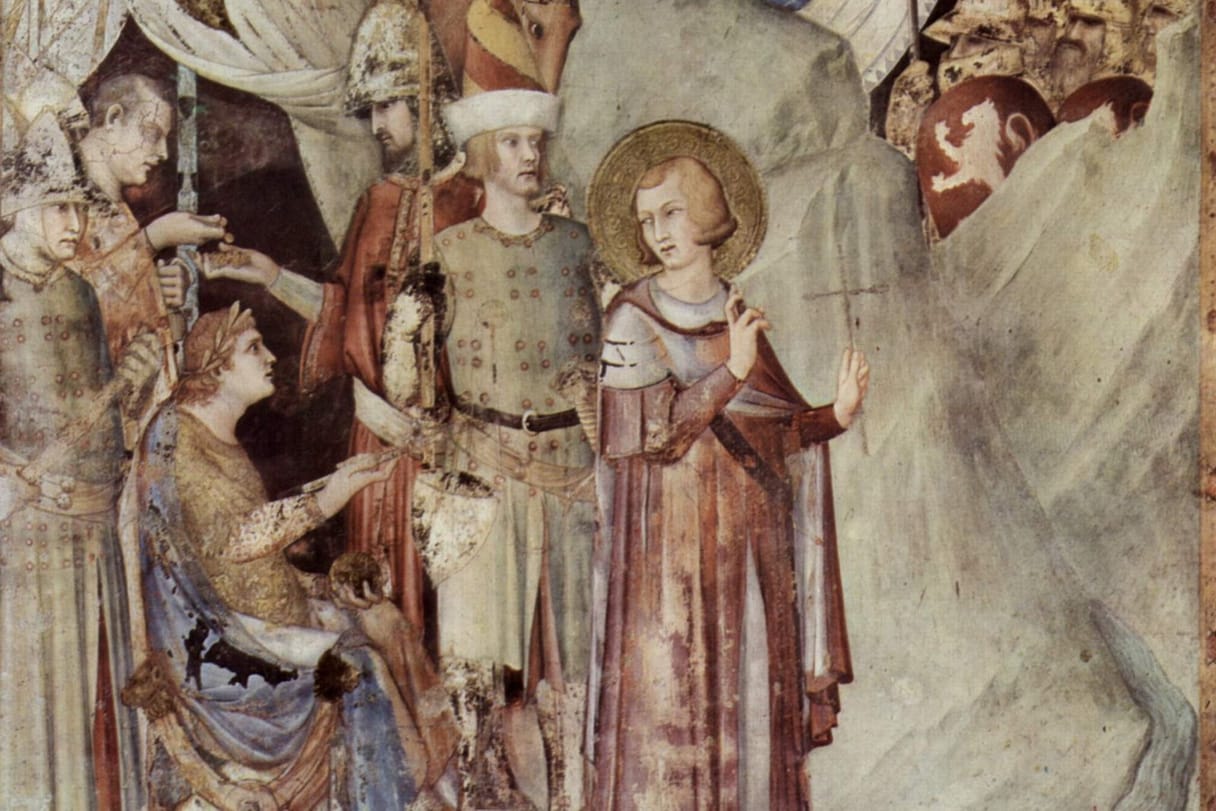
You may be asking this because you serve or have served in the military, because you once had to defend yourself or someone else, or because you are trying to understand how to follow Jesus in a violent world. Most churches teach that killing in self-defense or in a just war is not murder, though it is always grave and sorrowful. A strong Christian tradition of pacifism, reaching back to the early church, holds that Jesus’s command to love enemies rules out killing altogether. Both traditions hold that every human life belongs to God, and both long for the peace Christ promised.
Does the Bible say “You shall not kill” or “You shall not murder”?
The King James Version renders the sixth commandment “Thou shalt not kill.” Modern translations, including the World English Bible, read “You shall not murder” (Exodus 20:13). The modern wording reflects the rest of the law of Moses, which allowed killing in war and as a legal penalty, and which distinguished murder from other kinds of killing.
The law even addressed self-defense at home. If a thief breaking in at night “is struck so that he dies, there shall be no guilt of bloodshed for him,” but “If the sun has risen on him, he is guilty of bloodshed” (Exodus 22:2–3). Even then, the law set limits on defensive force.
Jesus deepened the commandment instead of narrowing it. He taught that anger and contempt toward a brother or sister already fall under judgment (Matthew 5:21–22).
What did Jesus teach about violence?
Jesus’s words in the Sermon on the Mount are the starting point for every Christian discussion of killing:
You have heard that it was said, ‘You shall love your neighbor and hate your enemy.’ But I say to you: Love your enemies and pray for those who persecute you, so that you may be children of your Father in heaven, for he makes his sun rise on the evil and on the good and sends rain on the righteous and on the unrighteous.
Matthew 5:43–45, NRSVUE
When Peter drew a sword to defend him at his arrest, Jesus said, “Put your sword back into its place, for all those who take the sword will die by the sword” (Matthew 26:52). In Luke’s account he answered, “Let me at least do this,” and healed the wounded man (Luke 22:51); his Greek words, Eate heōs toutou, are hard to translate, and many English Bibles render them “No more of this!” Before Pilate he said, “If my Kingdom were of this world, then my servants would fight” (John 18:36).
Other passages have shaped the many Christians who accept military service. When soldiers asked John the Baptist what they should do, he told them not to extort money and to “Be content with your wages,” without telling them to leave the army (Luke 3:14). Jesus praised a Roman centurion’s faith (Matthew 8:10), and Acts describes Cornelius, the centurion whose household Peter welcomed into the church, as “a devout man, and one who feared God” (Acts 10:1–2). Paul wrote that the governing authority “doesn’t bear the sword in vain” (Romans 13:4), right after telling Christians never to avenge themselves (Romans 12:19).
Were the first Christians pacifists?
Many early Christian writers taught that Christians should not kill. Around 200 CE Tertullian of Carthage asked, “how will a Christian man war, nay, how will he serve even in peace, without a sword, which the Lord has taken away?” (On Idolatry 19). He argued that when Christ disarmed Peter, he disarmed every soldier. In the next generation Origen of Alexandria answered a pagan critic who said Christians should fight for the emperor: “We do not indeed fight under him, although he require it; but we fight on his behalf” by prayer (Against Celsus 8.73).
Historians debate how many early Christians served in the army. Tertullian’s own discussion shows that some soldiers had already joined the church. Even after Christians began serving widely, the church went on treating killing in war as something that wounds the soul, as the counsel of Basil the Great, described below, shows.
What is the just war tradition?
Augustine of Hippo (354–430) gave the church its classic account of when war may be just. He wrote to a Roman military commander, “war is waged in order that peace may be obtained,” and urged him, “Let necessity, therefore, and not your will, slay the enemy who fights against you” (Letter 189). He named the real evils of war as “love of violence, revengeful cruelty, fierce and implacable enmity” and “the lust of power” (Reply to Faustus 22.74).
Thomas Aquinas later set out three conditions for a just war: the authority of the ruler who declares it, a just cause, and a right intention, so that the war aims at good and the avoidance of evil (Summa Theologiae II-II, question 40, article 1). Later teachers added further tests. The Evangelical Lutheran Church in America’s 1995 statement For Peace in God’s World lists right intention, justifiable cause, legitimate authority, last resort, declaration of war aims, proportionality, and reasonable chance of success, and it adds noncombatant immunity and proportionality as rules for how a war is fought.
The just-war tradition exists to restrain war. The ELCA statement gives its spirit in one sentence: “We begin with a strong presumption against all war.”
Is killing in self-defense a sin?
Christian moral teaching has generally held that it is not, when the force used is necessary and proportionate. Aquinas explained that an act of self-defense can have two effects, saving one’s own life and the death of the attacker, and that only the first is intended. He added that using “more than necessary violence” makes the act unlawful (Summa Theologiae II-II, question 64, article 7).
The Christian East adds a caution. Basil the Great, the fourth-century bishop of Caesarea, wrote that the earlier Fathers had not counted killing in war as murder. Even so, he advised that soldiers whose “hands are not clean” should refrain from Holy Communion for three years (Letter 188, canon 13). Basil never called the soldier a murderer; he treated killing, even when it could not be avoided, as a wound that needs repentance and healing. The Orthodox churches have never developed a formal theory of just war.
People who have killed, even rightly, often carry grief, guilt, and what chaplains and counselors call moral injury. If that is you, those feelings come from a conscience that honors life, and they deserve gentle care. Basil’s counsel, for all its strictness, can be read the same way: a person who has taken a life needs time, prayer, and the church’s company to heal. A priest or pastor can listen, pray with you, and, if you wish, hear your confession; see do I have to confess my sins to a priest? and what is sin?.
What about Dietrich Bonhoeffer?
The German Lutheran pastor Dietrich Bonhoeffer is the hardest modern case. He had held pacifist convictions, yet he joined the Abwehr, Germany’s military intelligence service, through his brother-in-law Hans von Dohnányi, who was part of the conspiracy against Hitler. Bonhoeffer was arrested in April 1943 and hanged at Flossenbürg on 9 April 1945. Historians still debate how directly he was involved in plots to kill Hitler. Bonhoeffer did not claim that resisting Hitler left his hands clean; he wrote that a person who acts responsibly may have to take guilt upon himself. His life shows how a Christian can face a choice where every path carries guilt.
What do the churches teach?
The Church of England’s Thirty-Nine Articles say, “It is lawful for Christian men, at the commandment of the Magistrate, to wear weapons, and serve in the wars” (Article XXXVII). The bishops of the Anglican Communion declared at the Lambeth Conference of 1930, and reaffirmed in 1978, that “war as a method of settling international disputes is incompatible with the teaching and example of our Lord Jesus Christ.”
The ELCA does not rule out the use of military force, and it supports members “who conscientiously object to bearing arms in military service.” The United Methodist Social Principles honor both those who choose military service and pacifists. In 1988 the Episcopal Church’s General Convention declared that “non-violent refusal to participate in or prepare for war is a faithful response of a member of this Church,” and that people who decide either to serve or to refuse should have “the respect, the support and the ministry of the Church.” The articles on the death penalty, violence in the Old Testament, and forgiving someone who hurt you take up related questions.
Christians who carry weapons and Christians who refuse them pray for the same day, the one Isaiah saw: “They shall beat their swords into plowshares, and their spears into pruning hooks. Nation shall not lift up sword against nation, neither shall they learn war any more” (Isaiah 2:4). Until that day comes, Jesus calls every one of his followers to be a peacemaker, and his mercy reaches every hand that has had to hold a sword.
Common questions
Is killing in self-defense a sin?
Most Christian teaching says no, provided the force used is no more than necessary. Thomas Aquinas taught that a person who acts to save his own life, using moderate force, does not sin even if the attacker dies. The Orthodox tradition, following Basil the Great, adds that even justified killing leaves a wound that calls for repentance and healing.
Can a Christian be a soldier?
Most churches say yes. John the Baptist told soldiers not to extort money and to be content with their wages (Luke 3:14), and the New Testament praises the faith of two Roman centurions. The ELCA, the United Methodist Church, and the Episcopal Church all support both members who serve in the military and members who refuse to bear arms for reasons of conscience.
Does “Thou shalt not kill” apply to war?
Modern translations, including the World English Bible, render the commandment “You shall not murder” (Exodus 20:13), because the same law allowed killing in war and as a legal penalty. Most Christians have therefore held that a soldier fighting in a just war does not break the commandment. Christian pacifists answer that Jesus’s teaching on loving enemies goes beyond the commandment.
What did Jesus mean by “turn the other cheek”?
In Matthew 5:39 Jesus told his followers not to answer insult and violence with revenge. Christians have read the teaching in two main ways: pacifists take it as a rule for all Christian conduct, while the just-war tradition reads it as governing personal revenge, without forbidding the defense of innocent people. Both readings agree that a Christian may never act out of hatred or vengeance.
Sources
- Exodus 20:13 and 22:2–3 (WEB)
- Matthew 5:38–48 (WEB)
- Romans 12:17–13:7 (WEB)
- Tertullian, On Idolatry, chapter 19 (New Advent)
- Origen, Against Celsus, Book 8 (New Advent)
- Basil the Great, Letter 188, canon 13 (New Advent)
- Augustine, Letter 189 to Boniface (New Advent)
- Augustine, Reply to Faustus, Book 22 (New Advent)
- Thomas Aquinas, Summa Theologiae II-II, question 40 (New Advent)
- Thomas Aquinas, Summa Theologiae II-II, question 64 (New Advent)
- Articles of Religion, Article XXXVII (Church of England)
- Episcopal Church General Convention, Resolution 1988-D017, Support Conscientious Decisions Regarding Individual Participation in War
- Lambeth Conference 1978, Resolution 5, War and Violence
- Isaiah 2:4 (WEB)
- ELCA social statement, For Peace in God’s World (1995)