The death penalty
The law of Moses prescribed death for murder and other crimes (Genesis 9:6; Exodus 21:12), while limiting revenge and requiring at least two witnesses. Jesus set aside “an eye for an eye” (Matthew 5:38–39) and stopped the stoning of a woman (John 8:7). Christians have long disagreed about capital punishment. Today the ELCA, the PC(USA), the United Methodist Church, and the Episcopal Church all oppose the death penalty.
As I live, says the Lord God, I have no pleasure in the death of the wicked but that the wicked turn from their ways and live; turn back, turn back from your evil ways, for why will you die, O house of Israel?
Ezekiel 33:11, NRSVUE
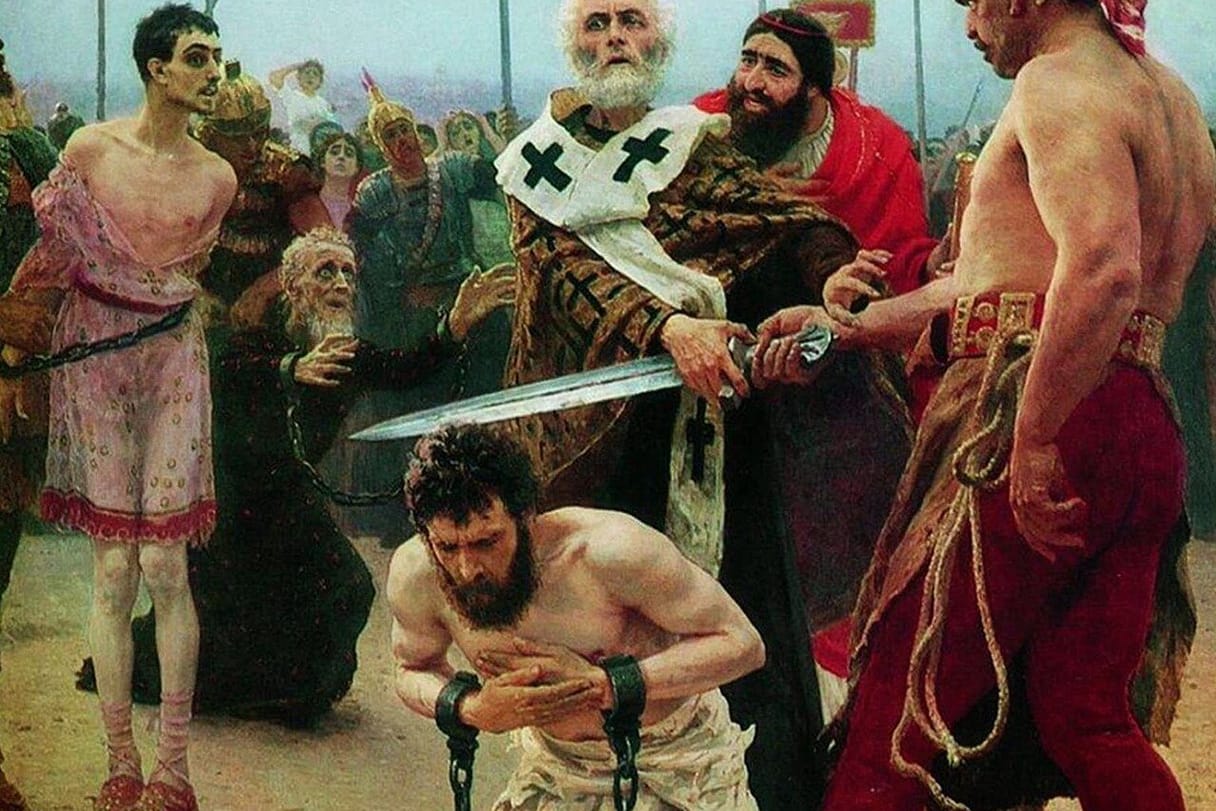
Some people come to this question because someone they loved was killed, and they long for justice. Others love someone in prison, have served on a jury, or want to know what their faith asks of them as citizens. The Bible takes both justice and mercy seriously. It hears the cry of victims, from Abel’s blood crying out from the ground (Genesis 4:10) to the martyrs in Revelation who ask God, “How long?” (Revelation 6:10). The law of Moses prescribed death for murder, Jesus taught mercy and was himself executed, and Christians have disagreed about capital punishment ever since.
Does the Old Testament command the death penalty?
Yes. After the flood, God tells Noah that taking a human life calls for a reckoning: “Whoever sheds man’s blood, his blood will be shed by man” (Genesis 9:6). The verse grounds the command in the image of God, in which every human being was made.
The law of Moses repeats the rule, “One who strikes a man so that he dies shall surely be put to death” (Exodus 21:12). The same chapter prescribes death for kidnapping and for striking or cursing one’s father or mother (Exodus 21:15–17). Other laws in the Torah extend the penalty further. Few Christians today argue that all of those laws should be enforced, so Christians on every side of this question read these commands through some principle of interpretation.
The same law also restrained the use of death. No one could be executed on the word of one witness: “At the mouth of two witnesses, or three witnesses, he who is to die shall be put to death” (Deuteronomy 17:6). Someone who killed by accident could flee to a city of refuge, “that the man slayer not die until he stands before the congregation for judgment” (Numbers 35:12). Children could never be put to death for their parents’ crimes (Deuteronomy 24:16).
The Bible also tells of God sparing killers. God put a mark on Cain “so that anyone finding him would not strike him” (Genesis 4:15). Moses killed an Egyptian and David arranged the death of Uriah, and both lived to serve God.
Jewish tradition read these laws with great caution. The Mishnah says that a court which executed one person in seven years was called “a destructive tribunal,” and it records that Rabbi Tarfon and Rabbi Akiva said that if they had sat on the court, no one would ever have been executed. Rabban Shimon ben Gamliel answered that they would have increased the number of murderers (Mishnah Makkot 1:10).
What does “an eye for an eye” mean?
“An eye for an eye” comes from the law of Moses: “But if any harm follows, then you must take life for life, eye for eye, tooth for tooth” (Exodus 21:23–24). Scholars call this rule the law of retaliation, or lex talionis (Latin for “law of like for like”). Leviticus states its purpose: “It shall be done to him as he has injured someone” (Leviticus 24:20).
The rule set a limit on revenge. Early in Genesis, Lamech boasts that he has killed a young man for striking him and will be avenged “seventy-seven times” (Genesis 4:23–24). Against that kind of escalating vengeance, the law allowed no more than one eye for one eye.
Jesus went further and set the rule aside for his followers, asking them to answer harm with a love that does not strike back:
“You have heard that it was said, ‘An eye for an eye and a tooth for a tooth.’ But I say to you: Do not resist an evildoer. But if anyone strikes you on the right cheek, turn the other also,
Matthew 5:38–39, NRSVUE
What did Jesus say about the death penalty?
Jesus never spoke about capital punishment as a matter of public law. The closest he came was the story of a woman caught in adultery, a crime the law of Moses punished with death. The scribes and Pharisees asked him whether she should be stoned. He answered, “He who is without sin among you, let him throw the first stone at her” (John 8:7), and her accusers left one by one.
Jesus straightened up and said to her, “Woman, where are they? Has no one condemned you?” She said, “No one, sir.” And Jesus said, “Neither do I condemn you. Go your way, and from now on do not sin again.”
John 8:10–11, NRSVUE
The story is missing from the oldest manuscripts of John’s Gospel, and most scholars think it was added later. The church has received it as Scripture, and many scholars think it preserves an old memory of Jesus.
Jesus’s own death matters here. He was condemned by a court and executed by the Roman state, and every crucifix in a church shows a man put to death by public authority. As he died, he promised a condemned criminal beside him, “Assuredly I tell you, today you will be with me in Paradise” (Luke 23:43). The prophet Ezekiel had already declared God’s will for the guilty: “I have no pleasure in the death of the wicked but that the wicked turn from their ways and live” (Ezekiel 33:11).
Paul forbids Christians to take revenge: “Don’t seek revenge yourselves, beloved, but give place to God’s wrath” (Romans 12:19). A few verses later he says that the governing authority “doesn’t bear the sword in vain” and is “a servant of God, an avenger for wrath to him who does evil” (Romans 13:4). Supporters of capital punishment have relied on Romans 13:4 for centuries. Opponents answer that the verse grants the state authority to punish without requiring death as a punishment.
What has the church taught through history?
For most of Christian history, the church accepted that the state could execute criminals, while urging mercy. Some early teachers went further. Lactantius, a Christian teacher who later tutored the son of the emperor Constantine, wrote in the early 300s that “it is always unlawful to put to death a man, whom God willed to be a sacred animal” (Divine Institutes 6.20). In 412 CE Augustine wrote to a Roman official who was judging men who had murdered one priest and maimed another, and he begged him not to execute them: “Fulfil, Christian judge, the duty of an affectionate father” (Letter 133). Thomas Aquinas taught in the thirteenth century that public authority, acting for the common good, may lawfully put evildoers to death, and that private individuals may not (Summa Theologiae II-II, question 64, articles 2–3).
The Church of England’s Thirty-Nine Articles state, “The Laws of the Realm may punish Christian men with death, for heinous and grievous offences” (Article XXXVII). In the centuries since, many churches that once accepted the death penalty have come to see in Christ’s mercy a call to end it.
What do the mainline churches teach today?
The Evangelical Lutheran Church in America’s 1991 social statement The Death Penalty recognizes the state’s authority but concludes, “It is because of this church’s ministry with and to people affected by violent crime that we oppose the death penalty.” The General Assembly of the Presbyterian Church (U.S.A.) has called for the abolition of the death penalty. The United Methodist Social Principles “call for the abolition of the death penalty” and ask congregations to minister to people who have lost loved ones to violent crime. The Episcopal Church’s General Convention reaffirmed “its opposition to capital punishment” in 1979 (Resolution 1979-D004), and in 2015 it called the death penalty “in direct opposition to the witness of Jesus” (Resolution 2015-D025).
Many Christians, especially in evangelical churches, still support capital punishment for murder, citing Genesis 9:6 and Romans 13:4, and they hold the view out of concern for justice and for victims. The churches that oppose the death penalty share that concern for victims. They hold that the image of God remains in every person, that no one is beyond repentance, and that the state need not kill in order to protect the public. For related questions, see killing in war and self-defense, forgiving someone who hurt you, and who killed Jesus.
Justice and mercy both belong to God. If you grieve someone taken by violence, God hears your cry for justice, and if you love someone who has done terrible harm, God’s love reaches that person too. The psalmist describes God’s salvation as the place where the two meet:
Mercy and truth meet together. Righteousness and peace have kissed each other.
Common questions
Does Genesis 9:6 require the death penalty?
Genesis 9:6 says, “Whoever sheds man’s blood, his blood will be shed by man, for God made man in his own image.” Christians who support capital punishment read the verse as a permanent command, given to Noah for all humanity. Christians who oppose it note that the verse grounds its words in the image of God, which every person keeps, including the murderer, and that the Bible itself spared murderers such as Cain, Moses, and David.
Did Jesus oppose the death penalty?
Jesus never addressed the death penalty as a question of law. He rejected retaliation (Matthew 5:38–39), stopped a crowd from stoning a woman (John 8:7), promised paradise to a condemned man dying beside him (Luke 23:43), and was himself executed by the state. Many churches conclude that his teaching and example point away from capital punishment.
Does Romans 13 support capital punishment?
Romans 13:4 says the governing authority “doesn’t bear the sword in vain” and is “a servant of God, an avenger for wrath to him who does evil.” Christians have long cited the verse to show that the state may punish, even with death. The verse establishes the authority of government to punish wrongdoing, but it does not require any particular penalty, and the verses just before it forbid personal revenge.
Which churches oppose the death penalty?
The ELCA, the Presbyterian Church (U.S.A.), the United Methodist Church, and the Episcopal Church have all called for an end to the death penalty. Many evangelical Christians still support it for murder, citing Genesis 9:6 and Romans 13:4. The churches that oppose it hold that no one is beyond repentance and that the state can protect the public without killing.
Sources
- Genesis 9:5–6 (WEB)
- Exodus 21:12–25 (WEB)
- Matthew 5:38–48 (WEB)
- John 8:1–11 (WEB)
- Romans 12:17–13:4 (WEB)
- Mishnah Makkot 1:10 (Sefaria)
- Augustine, Letter 133 (New Advent)
- Thomas Aquinas, Summa Theologiae II-II, question 64 (New Advent)
- Articles of Religion, Article XXXVII (Church of England)
- Lactantius, Divine Institutes, Book 6, chapter 20 (New Advent)
- Episcopal Church General Convention, Resolution 1979-D004, Reaffirm Opposition to Capital Punishment
- Episcopal Church General Convention, Resolution 2015-D025, Abolish the Death Penalty
- Pew Research Center, Religious groups’ official positions on capital punishment (2009)
- ELCA social statement, The Death Penalty (1991)
- United Methodist Social Principles: The Political Community