Israel, Palestine, and the call to peace
The mainline churches teach that God’s covenant with the Jewish people endures, for “the gifts and the calling of God are irrevocable” (Romans 11:29), and they have repented of the church’s long history of contempt for Jews. They also affirm the dignity of Palestinians, including Palestinian Christians, whose churches have long lived in the land. The ELCA, the PC(USA), the United Methodist Church, and the Episcopal Church pray and work for peace, security, and justice for both peoples.
Pray for the peace of Jerusalem. Those who love you will prosper.
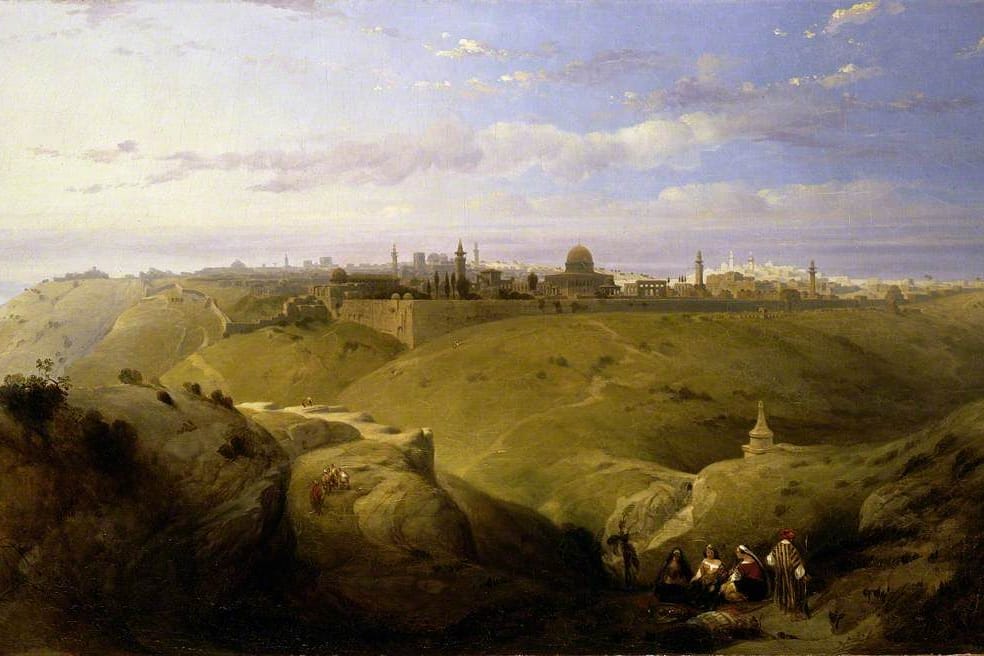
The mainline churches hold two commitments together when they speak of Israel and Palestine: God’s faithfulness to the Jewish people, and God’s love for Palestinians, who bear the same divine image. If you have watched the news from the Holy Land with grief, or felt torn between people you love on both sides, the Bible gives you somewhere to stand. It calls Christians to pray for the peace of Jerusalem and to seek peace, security, and justice for everyone who lives there.
Feelings run deep on this subject, and families on every side have buried their dead.
What does the Bible say about God’s covenant with the Jewish people?
Jesus was a Jew, as were his mother, his apostles, and the first members of the church (see was Jesus Jewish?). Paul, a Jew himself, wrote to the church in Rome about his own people with deep love. To the Israelites, he said, belong “the adoption, the glory, the covenants, the giving of the law, the service, and the promises” (Romans 9:4). Then he asked whether God had cast them off:
I ask then, did God reject his people? May it never be! For I also am an Israelite, a descendant of Abraham, of the tribe of Benjamin. God didn’t reject his people, whom he foreknew.
Paul compares the Gentile church to wild branches grafted onto an olive tree whose roots are Israel, and he warns Gentile believers not to boast, for “it is not you who support the root, but the root supports you” (Romans 11:18). His conclusion has become a cornerstone of Christian teaching about the Jewish people:
For the gifts and the calling of God are irrevocable.
Have the churches rejected antisemitism?
For many centuries Christians taught that God had rejected the Jews and that the church had taken their place, a view called supersessionism or replacement theology. That teaching fed centuries of contempt and violence against Jews, including the false charge that the Jewish people killed Christ (see who killed Jesus?), and after the Holocaust the churches began to examine it with repentance. The mainline churches have rejected supersessionism.
In 1987 the General Assembly of the Presbyterian Church (U.S.A.) commended a study paper that states, “Christians have not replaced Jews,” and acknowledges “in repentance the church’s long and deep complicity” in the “teaching of contempt.” In 1994 the ELCA Church Council adopted a declaration to the Jewish community that repudiates Martin Luther’s anti-Jewish writings and opposes antisemitism. The United Methodist General Conference of 1996 affirmed that God “is steadfastly faithful to the biblical covenant with the Jewish people” and called Methodists to “oppose anti-Semitism whenever and wherever it occurs.” Christians who love Jesus are called to stand with their Jewish neighbors whenever hatred rises against them.
Who are the Palestinian Christians?
Palestinian Christians are among the oldest Christian communities in the world. The church was born in Jerusalem at Pentecost (Acts 2:1–11), and Christians have lived in the land in every century since. Today Palestinian Christians worship in Orthodox, Lutheran, Anglican, and other churches in Jerusalem, Bethlehem, the West Bank, Gaza, and Israel itself.
The mainline churches know them as family. The Evangelical Lutheran Church in Jordan and the Holy Land is a companion church of the ELCA, and the Anglican Diocese of Jerusalem runs the Al-Ahli Arab Hospital in Gaza City. During the war in Gaza, Christian families sheltered in the Greek Orthodox Church of Saint Porphyrius. Palestinians of every faith bear the image of God (Genesis 1:27), and their dignity, safety, and hope matter to God as much as anyone’s.
What do the mainline churches say about peace in the Holy Land?
The mainline churches have long called for peace, security, and justice for Israelis and Palestinians alike. The United Methodist statement of 1996 commits the church to “the security, safety, and well-being of Jews and Palestinians in the Middle East.”
After the attack led by Hamas on southern Israel on October 7, 2023, in which about 1,200 people were killed and some 250 taken hostage, and during the war in Gaza that followed, in which tens of thousands of Palestinians were killed, the churches renewed those calls. In March 2024 the ELCA’s Conference of Bishops called for a permanent bilateral cease-fire, “the immediate and safe return of the hostages,” and the affirmation of “both Israel and Palestine’s right to exist.” That same month the presiding bishops of the Episcopal Church and the ELCA joined more than 140 Christian leaders in a Holy Week letter that called, among other things, for a cease-fire, the release of hostages, humanitarian aid for Gaza, and a settlement with “security and self-determination for Israelis and Palestinians.” A cease-fire was declared in October 2025, and on October 14 the Patriarchs and Heads of Churches in Jerusalem, including the Greek Orthodox Patriarch Theophilos III, welcomed the cease-fire and the release of captives and prayed that “a just and lasting peace be truly established in the Holy Land.”
The churches have also made decisions about their investments. In 2014 the PC(USA) General Assembly voted 310 to 303 to divest from three companies that do business with Israeli security services in the West Bank, while reaffirming Israel’s right to exist “as a sovereign nation within secure and internationally recognized borders.” The narrow vote reflected a real division among Presbyterians, and Jewish organizations such as the American Jewish Committee criticized it.
What about Christian Zionism?
Many evangelical Christians hold a view known as Christian Zionism: that the modern State of Israel fulfills biblical prophecy and that Christians are called to support it. They often cite God’s promise to Abraham, “I will bless those who bless you” (Genesis 12:3), and many are moved by love for the Jewish people. The mainline churches have not adopted that reading of prophecy. They affirm the State of Israel’s right to exist in security, as the ELCA’s bishops and the PC(USA)’s General Assembly have done, together with justice and self-determination for Palestinians.
How can I pray for peace in the Holy Land?
When Jesus came near Jerusalem, Luke says, “he saw the city and wept over it” (Luke 19:41), and he grieved, “If you, even you, had known today the things which belong to your peace!” (Luke 19:42). Christians can share his tears for the city and for everyone who loves it. The prophet Isaiah dared to imagine old enemies blessed together, when God would say, “Blessed be Egypt my people, Assyria the work of my hands, and Israel my inheritance” (Isaiah 19:25).
You can pray by name for Israeli families who lost loved ones and for Palestinian families who lost theirs, for those who were held hostage and their families, for the bereaved, for Palestinian Christians, and for Jewish neighbors in your own town. You can refuse hatred in your own speech, toward Jews, toward Palestinians, toward Muslims (see Christians, Muslims, and the one God), and toward people who see the conflict differently from you (see Micah 6:8).
The pilgrims who climbed to Jerusalem sang a prayer that Christians still pray:
Pray for the peace of Jerusalem. Those who love you will prosper. Peace be within your walls, and prosperity within your palaces. For my brothers’ and companions’ sakes, I will now say, “Peace be within you.”
Common questions
Are there Christians in Palestine?
Yes. Palestinian Christians belong to Orthodox, Lutheran, Anglican, and other churches in Jerusalem, Bethlehem, the West Bank, Gaza, and Israel itself. Their communities have lived in the land since the earliest centuries of the church. The Evangelical Lutheran Church in Jordan and the Holy Land is a companion church of the ELCA, and the Anglican Diocese of Jerusalem runs the Al-Ahli Arab Hospital in Gaza City.
What is supersessionism?
Supersessionism, sometimes called replacement theology, is the teaching that the church has replaced the Jewish people in God’s covenant. The mainline churches have rejected it. The Presbyterian Church (U.S.A.)’s 1987 study paper on Christians and Jews states that “Christians have not replaced Jews,” and the United Methodist Church’s 1996 statement calls God “steadfastly faithful to the biblical covenant with the Jewish people.”
What is Christian Zionism?
Christian Zionism is the belief, held by many evangelical Christians, that the modern State of Israel fulfills biblical prophecy and that Christians are called to support it. Its supporters often cite God’s promise to Abraham in Genesis 12:3. The mainline churches have not adopted this view, and they affirm Israel’s right to exist in security alongside justice for Palestinians.
What does “pray for the peace of Jerusalem” mean?
The words come from Psalm 122:6, a song pilgrims sang as they went up to Jerusalem to worship. The Hebrew word for peace, shalom, means wholeness and well-being for a whole community. Christians pray the psalm today for all who live in Jerusalem and the land around it, Jews, Muslims, and Christians alike.
Sources
- Romans 11:1–2, 11:18, and 11:29 (WEB)
- Romans 9:4–5 (WEB)
- Psalm 122:6–8 (WEB)
- Luke 19:41–42 (WEB)
- Isaiah 19:24–25 (WEB)
- Presbyterian Church (U.S.A.), A Theological Understanding of the Relationship between Christians and Jews (1987)
- Renewing a Declaration of the ELCA to the Jewish Community (ELCA)
- United Methodist Church, Building New Bridges in Hope (1996)
- ELCA Conference of Bishops statement on Gaza (Living Lutheran, March 4, 2024)
- More than 140 global Christian leaders call for Gaza cease-fire in Holy Week letter (Religion News Service, March 26, 2024)
- Patriarch of Jerusalem and church leaders welcome Gaza ceasefire (OrthoChristian, October 2025)
- At Presbyterian assembly, divestment advocates’ win is a limited one (JTA, June 24, 2014)
- AJC: Presbyterian Divestment a Breach with Jews, Undermines Israeli-Palestinian Peace (American Jewish Committee, June 20, 2014)



_-_Jerusalem_from_the_Mount_of_Olives_with_Pilgrims_Entering_from_the_River_Jordan_-_NWHCM_,_1918.12_,_F_-_Norfolk_Museums_Collections.jpg)