How to forgive yourself
Forgiving yourself begins with receiving the forgiveness God already offers. Scripture promises that “if we confess our sins, he is faithful and righteous to forgive us” (1 John 1:9), and that when “our heart condemns us, God is greater than our heart” (1 John 3:20). Christians confess, make amends where they can, and then trust God’s verdict over their own. Peter, who denied Jesus three times, was restored by the risen Christ and sent to feed his sheep.
If our heart condemns us, God is greater than our heart, and knows all things.
Forgiving yourself begins with receiving the forgiveness God has already given. Perhaps you hurt someone you love, broke a promise, made a choice you cannot undo, or failed a person who needed you. You may have confessed it to God many times and still lie awake replaying it. Scripture takes your guilt seriously, and it takes God’s mercy more seriously still.
Does the Bible talk about forgiving yourself?
Scripture knows the experience behind the phrase “forgive yourself” well, though the phrase itself never appears. The First Letter of John speaks to anyone whose own heart keeps up the accusation after God has forgiven:
And by this we know that we are of the truth and persuade our hearts before him, because if our heart condemns us, God is greater than our heart, and knows all things.
God knows everything you have done, more fully than you do, and God’s verdict is mercy. When Christians talk about forgiving themselves, they usually mean letting that verdict reach the place inside them that keeps passing sentence. Paul asked, “Who is he who condemns?” and answered with the name of the only one who has the right: “It is Christ who died, yes rather, who was raised from the dead, who is at the right hand of God, who also makes intercession for us” (Romans 8:34). The judge is your advocate.
Jesus also assumed a right love of self when he gave the commandment “You shall love your neighbor as yourself” (Matthew 22:39). Treating yourself with the mercy you would show a friend belongs to that love.
Why is it so hard to forgive yourself?
Guilt and shame often travel together, though they say different things. Guilt says, “I did something wrong,” and it can lead a person to repent and repair. Shame says, “I am something wrong,” and it drives a person to hide. Paul described the same difference:
For godly sorrow produces repentance leading to salvation, which brings no regret. But the sorrow of the world produces death.
Godly sorrow turns toward God and leads to new life. The other kind of sorrow turns in on itself and can go on punishing a person for years. It can even feel like humility, yet it treats your own judgment as weightier than God’s.
Hiding makes the weight heavier. A psalmist remembered, “When I kept silence, my bones wasted away through my groaning all day long,” and then the relief that came when he spoke: “I will confess my transgressions to the LORD, and you forgave the iniquity of my sin” (Psalm 32:3–5).
How did Jesus restore Peter after he denied him?
On the night Jesus was arrested, Peter denied three times that he knew him. Luke writes that “The Lord turned and looked at Peter,” and Peter “went out, and wept bitterly” (Luke 22:61–62). Few failures could weigh more heavily on a person.
After the resurrection, Jesus cooked breakfast for his disciples on the shore of the Sea of Galilee. Then he turned to Peter and asked him three times, once for each denial, whether he loved him:
He said to him the third time, “Simon, son of Jonah, do you have affection for me?” Peter was grieved because he asked him the third time, “Do you have affection for me?” He said to him, “Lord, you know everything. You know that I have affection for you.” Jesus said to him, “Feed my sheep.”
Jesus did not pretend the denial had never happened. He let Peter feel its weight, and then he gave him a task. Forgiveness in Christ restores a person to love and to work. Peter went on to preach at Pentecost and to become a leader of the early church, carrying the memory of his failure as part of his witness to grace.
How do I receive God’s forgiveness?
Begin by telling God the truth. “If we confess our sins, he is faithful and righteous to forgive us the sins and to cleanse us from all unrighteousness” (1 John 1:9). Name what you did clearly, without excuses and without exaggeration, and ask for mercy.
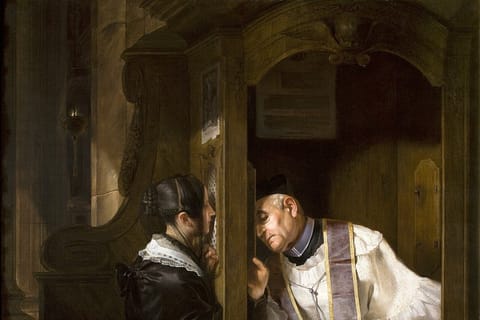
Then let someone speak the forgiveness to you. In most Sunday services the mainline churches confess their sins together and hear God’s forgiveness declared. In the service used across the ELCA, the pastor says, “In the mercy of almighty God, Jesus Christ was given to die for us, and for his sake God forgives us all our sins.” In the United Methodist service of Word and Table, the leader says, “In the name of Jesus Christ, you are forgiven!” and the people say the same words back to the leader, because every Christian needs to hear them. Lutheran and Episcopal churches also keep rites of private confession, and many Presbyterian and Methodist pastors will hear a confession privately (see Confession).
Make amends where you can. When Zacchaeus the tax collector met Jesus, he promised to repay four times over anyone he had cheated, and Jesus said, “Today, salvation has come to this house” (Luke 19:9). An apology, a debt repaid, or a truth finally told can heal more than your own heart. If the person you hurt cannot or will not forgive you, respect that, and trust that God’s forgiveness does not wait on theirs.
Then get up and begin again. A brother once told Sisoes, one of the desert monks of Egypt, “I have fallen, Abba; what shall I do?” Sisoes answered, “Get up again.” When the brother said he had risen and fallen again, the old monk said, “Get up again and again.”
What if I still cannot let go of the guilt?
Feelings often lag behind the truth. Keep returning to God’s promises, especially on the nights when they feel least true. God says through Isaiah, “I, even I, am he who blots out your transgressions for my own sake; and I will not remember your sins” (Isaiah 43:25). Isaac the Syrian, a seventh-century bishop of the Church of the East, wrote, “As a handful of sand thrown into the ocean, so are the sins of all flesh as compared with the mind of God.” The German-American theologian Paul Tillich, in his sermon “You Are Accepted,” urged hearers weighed down by guilt to “accept the fact that you are accepted.”
Some guilt needs more than prayer. If your guilt is constant, intrusive, or out of proportion to what happened, it may be a symptom of depression or of scrupulosity, a form of obsessive-compulsive disorder, and a counselor can help (see Anxiety, depression, and faith). If you were abused or betrayed and still blame yourself, the wrong was done to you, and what you need is comfort and healing. If your guilt has brought you to thoughts of ending your life, call or text 988 in the United States to reach the 988 Suicide & Crisis Lifeline, or find a helpline in your country at findahelpline.com.
For more on God’s mercy, see God’s forgiveness, and if you fear that your sin is beyond pardon, see The unforgivable sin. The psalmist sang of a God whose mercy is wider than any wrong:
He has not dealt with us according to our sins, nor repaid us for our iniquities. For as the heavens are high above the earth, so great is his loving kindness toward those who fear him. As far as the east is from the west, so far has he removed our transgressions from us.
Common questions
Is forgiving yourself in the Bible?
The phrase never appears in Scripture, though the need it names appears often. The Bible speaks of hearts that condemn us (1 John 3:20) and of consciences made clean by God’s mercy (Hebrews 10:22). When Christians speak of forgiving themselves, they usually mean letting God’s forgiveness reach the part of them that keeps accusing.
Why do I still feel guilty after God has forgiven me?
Feelings often lag behind the truth, especially after a serious wrong or a long habit of self-blame. Keep returning to God’s promises, and tell a pastor or trusted friend what you carry. If guilt is constant, intrusive, or out of proportion, a counselor can help, since persistent guilt can be a symptom of depression or of scrupulosity, a form of obsessive-compulsive disorder.
What if the person I hurt will not forgive me?
Apologize sincerely, make what amends you can, and respect their answer. Paul wrote, “If it is possible, as much as it is up to you, be at peace with all men” (Romans 12:18), which admits that peace is sometimes out of your hands. God’s forgiveness of you does not depend on theirs, and you can keep praying for their good.
Do I need to confess to a pastor to be forgiven?
No mainline church requires it. You can confess directly to God, who promises to forgive. Lutheran and Episcopal churches keep rites of private confession, and many Presbyterian and Methodist pastors will hear a confession, which can help when you need to hear forgiveness spoken aloud to you.
Sources
- 1 John 1:9 (WEB)
- 1 John 3:19–20 (WEB)
- 2 Corinthians 7:10 (WEB)
- John 21:15–17 (WEB)
- Psalm 103:10–12 (WEB)
- Luke 19:1–10 (WEB)
- United Methodist Church, A Service of Word and Table I (Book of Worship)
- United Methodist Church, Before God and one another: United Methodists and confession
- Lutheran Sunday order with confession and forgiveness (Augsburg Fortress texts), Christ’s Lutheran Church, Oreland
- Sayings of the Desert Fathers: Sisoes (John Sanidopoulos)
- Isaac the Syrian on the mercy of God (St. Barnabas Orthodox Church)
- Paul Tillich, “You Are Accepted,” discussed in The Christian Century
- 988 Suicide & Crisis Lifeline