Envy, comparison, and contentment
The Bible treats envy as a painful sorrow at another person’s good, from Cain and King Saul to the psalmist who confessed, “I was envious of the arrogant” (Psalm 73:3). Jesus answers envy with the generosity of God, who gives freely to all. Contentment grows as you give thanks for what you have received, learn to rejoice with others, and follow Christ on the path he has given you.
My flesh and my heart fails, but God is the strength of my heart and my portion forever.
Envy is one of the oldest sorrows of the human heart, and Scripture answers it with the generosity of God. You may know the feeling well: a late-night scroll through friends’ promotions, new houses, weddings, babies, and vacations, and a sinking sense that everyone else has been given more. The Bible names that ache with care. Scripture also shows a way out of envy, toward a contentment that rests in God’s love and frees you to rejoice in the good of others.
What does the Bible say about envy?
Envy appears in the first family of Genesis. When God accepted Abel’s offering, his brother Cain grew angry, and God came to Cain before any harm was done. “Why are you angry? Why has the expression of your face fallen?” God asked, and then warned him that “sin crouches at the door. Its desire is for you, but you are to rule over it” (Genesis 4:6–7). God speaks to the envious heart with questions and with hope.
King Saul’s story shows how envy grows. After David’s victories, the women of Israel sang, “Saul has slain his thousands, and David his ten thousands” (1 Samuel 18:7). The comparison stung, and “Saul watched David from that day and forward” (1 Samuel 18:9). Envy keeps watching, and it poisoned the rest of Saul’s reign. The Book of Proverbs puts the cost in a single line: “The life of the body is a heart at peace, but envy rots the bones” (Proverbs 14:30). For how Scripture understands sin as a whole, see What is sin?
Why does comparison hurt so much?
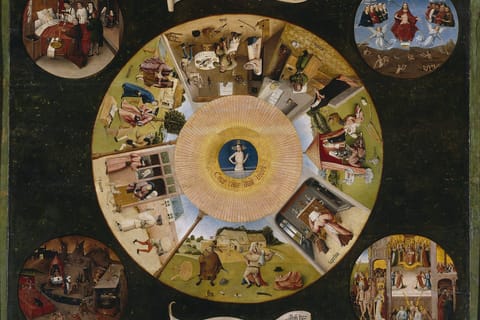
Basil the Great, the fourth-century bishop of Caesarea, preached a whole sermon on envy. He defined it as “pain caused by our neighbor’s prosperity” and observed that “an envious person is never without cause for grief and despondency.” Someone, somewhere, will always have more. In the sixth century Gregory the Great named envy among the seven deadly sins in his commentary on the Book of Job, and he taught that it springs from pride.
C. S. Lewis described the root of comparison in Mere Christianity: “Pride gets no pleasure out of having something, only out of having more of it than the next man.” Comparison turns every gift into a contest, so that a friend’s good news becomes your bad news. The Teacher of Ecclesiastes saw the same thing long ago, noting that much human striving springs from “the envy of a man’s neighbor” and calling it “a striving after wind” (Ecclesiastes 4:4).
How did the psalmist find his way out of envy?
Psalm 73 is the Bible’s great prayer for envious people. Its writer, Asaph, confesses where his heart had gone:
But as for me, my feet were almost gone. My steps had nearly slipped. For I was envious of the arrogant, when I saw the prosperity of the wicked.
He tried to reason his way through, and “it was too painful for me” (Psalm 73:16). His bitterness lasted, he says, “until I entered God’s sanctuary” (Psalm 73:17). In worship Asaph saw his life from God’s side, and he discovered that he already had the one treasure worth having:
Whom do I have in heaven? There is no one on earth whom I desire besides you. My flesh and my heart fails, but God is the strength of my heart and my portion forever.
Worship heals envy by turning your eyes. When you come before God with the gathered church, you stop measuring yourself against your neighbor and remember who you are: a beloved child whose portion is God.
What did Jesus teach about comparison?
Jesus told a parable about workers hired at different hours of the day, all of whom received the same wage. The ones who had worked since dawn complained, “You have made them equal to us” (Matthew 20:12). The landowner answered, “Or is your eye evil, because I am good?” (Matthew 20:15). In the ancient world an “evil eye” was a common way to speak of envy. The parable shows that envy is often a complaint against God’s generosity to someone else.
In the parable of the prodigal son, the older brother “was angry and would not go in” to the feast for his returned brother (Luke 15:28). The father went out to him and pleaded:
Son, you are always with me, and all that is mine is yours.
God says the same to you. Your brother’s or sister’s blessing takes nothing from you, because the Father’s love has no limit.
After the resurrection, Peter learned what his own path would cost and immediately looked at the disciple beside him: “Lord, what about this man?” Jesus answered, “What is that to you? You follow me” (John 21:21–22). Christ calls each disciple by name to a particular life. Your calling is yours, and his eyes are on you as you walk it.
How can I grow in contentment?
Contentment begins with thanksgiving. Paul asked the competitive Christians at Corinth, “What do you have that you didn’t receive?” (1 Corinthians 4:7). Every good thing in your life is a gift, and naming those gifts one by one, in prayer, retrains a heart that has learned to count only what is missing. The church’s central act of worship, Holy Communion, is also called the Eucharist, from the Greek word for thanksgiving (see Holy Communion).
Contentment also grows through love. Paul wrote that “love doesn’t envy” (1 Corinthians 13:4; see 1 Corinthians 13 in context), and he described the church as one body: “When one member is honored, all the members rejoice with it” (1 Corinthians 12:26). In Christ your neighbor’s good becomes, in a real way, your own. One of the surest remedies for envy is to pray by name for the person you envy, asking God to bless them. In the Lenten prayer of St. Ephrem, which Orthodox Christians pray many times a day through Great Lent, they ask God for the grace “to see my own errors and not to judge my brother.”
Contentment is something you learn over time. Paul said he had “learned the secret” of contentment in plenty and in want (Philippians 4:12; see Philippians 4:13 in context). Contentment leaves room for real longing. If what you envy is a marriage, a child, or health, your envy may be grief in disguise, and God welcomes that grief in prayer. Whatever you lack, you are already loved without measure (see God’s love for you).
When comparison rises in you, you can pray the psalm of a person who had found peace in what God had given:
The LORD assigned my portion and my cup. You made my lot secure. The lines have fallen to me in pleasant places. Yes, I have a good inheritance.
Common questions
What is the difference between envy and jealousy in the Bible?
In ordinary speech the words overlap. Envy usually means sorrow or resentment at someone else’s good fortune, while jealousy can mean a protective love for what is rightly yours, which is why Scripture can call God “jealous” for his people. Basil the Great defined envy as “pain caused by our neighbor’s prosperity.”
Is envy one of the seven deadly sins?
Yes. In the sixth century Gregory the Great, in his commentary on the Book of Job, gave the Western church its list of seven deadly sins, and envy is among them. The monk Evagrius Ponticus had earlier described eight troubling “thoughts,” a list the Eastern church still uses in its teaching on prayer and the spiritual life.
How do I stop comparing myself to others on social media?
Notice what scrolling does to your heart, and set limits where it leaves you bitter. Replace some of that time with thanksgiving for specific gifts in your own life, and pray by name for the people you envy, asking God to bless them. Jesus’ word to Peter, “What is that to you? You follow me,” can become a short prayer when comparison starts.
Is it wrong to want what someone else has?
Longing for good things such as a spouse, a child, health, or meaningful work is human, and Scripture is full of such prayers. Envy begins when another person’s blessing feels like your loss, or when you wish them to lose it. Bring the longing to God in prayer, and ask for grace to rejoice with the person who has what you desire.
Sources
- Genesis 4:3–7 (WEB)
- 1 Samuel 18:6–9 (WEB)
- Psalm 73 (WEB)
- Matthew 20:1–16 (WEB)
- Luke 15:25–32 (WEB)
- John 21:20–22 (WEB)
- 1 Corinthians 12:26; 13:4 (WEB)
- Basil the Great, On Envy (excerpt)
- The origins of the seven deadly sins: Evagrius and Gregory the Great (History.com)
- C. S. Lewis, Mere Christianity, Book 3, chapter 8, “The Great Sin”
- Prayer of Saint Ephrem
- Psalm 16:5–6 (WEB)