The greatest commandment
Jesus said the greatest commandment is to love the Lord your God with all your heart, soul, and mind (Deuteronomy 6:5), and that the second is like it: love your neighbor as yourself (Leviticus 19:18). Both commands come from the Hebrew Bible. Jesus taught that all the Law and the Prophets hang on these two, and his parable of the Good Samaritan shows that your neighbor includes the stranger and the outsider.
‘You shall love the Lord your God with all your heart and with all your soul and with all your mind.’ This is the greatest and first commandment. And a second is like it: ‘You shall love your neighbor as yourself.’
Matthew 22:37–39, NRSVUE
If you have ever wondered what God most wants from you, Jesus answered in two sentences. The greatest commandment is to love the Lord your God with all your heart, soul, and mind, and the second is like it: love your neighbor as yourself. Both commandments come from the Hebrew Bible, and Jesus said that all the Law and the Prophets hang on them. Everything else in the Christian life, from prayer to the sacraments to the way you treat a stranger, grows from this double love.
What did Jesus say is the greatest commandment?
Matthew tells the story as a test. After Jesus had silenced the Sadducees, a group of Pharisees gathered, and one of them, “a lawyer,” asked him which commandment in the law was the greatest (Matthew 22:34–36). Jesus answered with two commandments instead of one:
He said to him, “ ‘You shall love the Lord your God with all your heart and with all your soul and with all your mind.’ This is the greatest and first commandment. And a second is like it: ‘You shall love your neighbor as yourself.’ On these two commandments hang all the Law and the Prophets.”
Matthew 22:37–40, NRSVUE
The lawyer’s question was a real one among Jewish teachers. The rabbis later counted 613 commandments in the Torah (Babylonian Talmud, Makkot 23b), and they discussed which principle held all the others together.
Mark’s Gospel, which most scholars think is the earliest of the four Gospels, tells the same story in a friendlier tone. A scribe asks, “Which commandment is the greatest of all?” and Jesus begins with the opening line of Israel’s confession of faith: “Hear, Israel, the Lord our God, the Lord is one” (Mark 12:28–29). The scribe agrees and adds that loving God and neighbor “is more important than all whole burnt offerings and sacrifices.” Jesus tells him, “You are not far from God’s Kingdom” (Mark 12:33–34).
Where do the two great commandments come from in the Old Testament?
The first commandment comes from the Shema, a passage named for its first Hebrew word, shema (“hear”):
Hear, O Israel: The Lord is our God, the Lord alone. You shall love the Lord your God with all your heart and with all your soul and with all your might.
Deuteronomy 6:4–5, NRSVUE
Deuteronomy tells Israel to recite these words “when you lie down, and when you rise up” (Deuteronomy 6:7), and Jewish prayer has repeated the Shema evening and morning since ancient times. The Mishnah, the first great collection of rabbinic law, opens by asking when the evening Shema should be said (Mishnah Berakhot 1:1).
The second commandment comes from the Holiness Code, the name scholars give to the laws in Leviticus 17–26:
You shall not take vengeance or bear a grudge against any of your people, but you shall love your neighbor as yourself: I am the Lord.
Leviticus 19:18, NRSVUE
In Leviticus 19:18 the neighbor is one of “your people.” Sixteen verses later the same chapter widens the circle: “The stranger who lives as a foreigner with you shall be to you as the native-born among you, and you shall love him as yourself; for you lived as foreigners in the land of Egypt” (Leviticus 19:34). The Torah’s command to love the neighbor already reaches the foreigner, as the article on what the Bible says about immigrants explains.
Jewish teachers near the time of Jesus summed up the Torah in the same spirit. The Talmud tells of a gentile who asked the sage Hillel to teach him the whole Torah while he stood on one foot. Hillel answered, “That which is hateful to you do not do to another; that is the entire Torah, and the rest is its interpretation. Go study” (Babylonian Talmud, Shabbat 31a).
In the early second century, Rabbi Akiva called “love your neighbor as yourself” “an all-embracing principle in the Torah.” Another rabbi of that generation, Ben Azzai, named an even greater principle: Genesis 5:1, the verse that says God made human beings “in God’s likeness” (Sifra, Kedoshim 4:12). Jesus’s answer belongs inside this Jewish conversation, which is one reason the church remembers that Jesus was Jewish.
Who is my neighbor?
Luke tells a different version of the conversation. An expert in the law asked Jesus, “Teacher, what shall I do to inherit eternal life?” and then answered his own question with the two great commandments. Jesus said, “You have answered correctly. Do this, and you will live” (Luke 10:25–28). The lawyer pressed further: “Who is my neighbor?” (Luke 10:29).
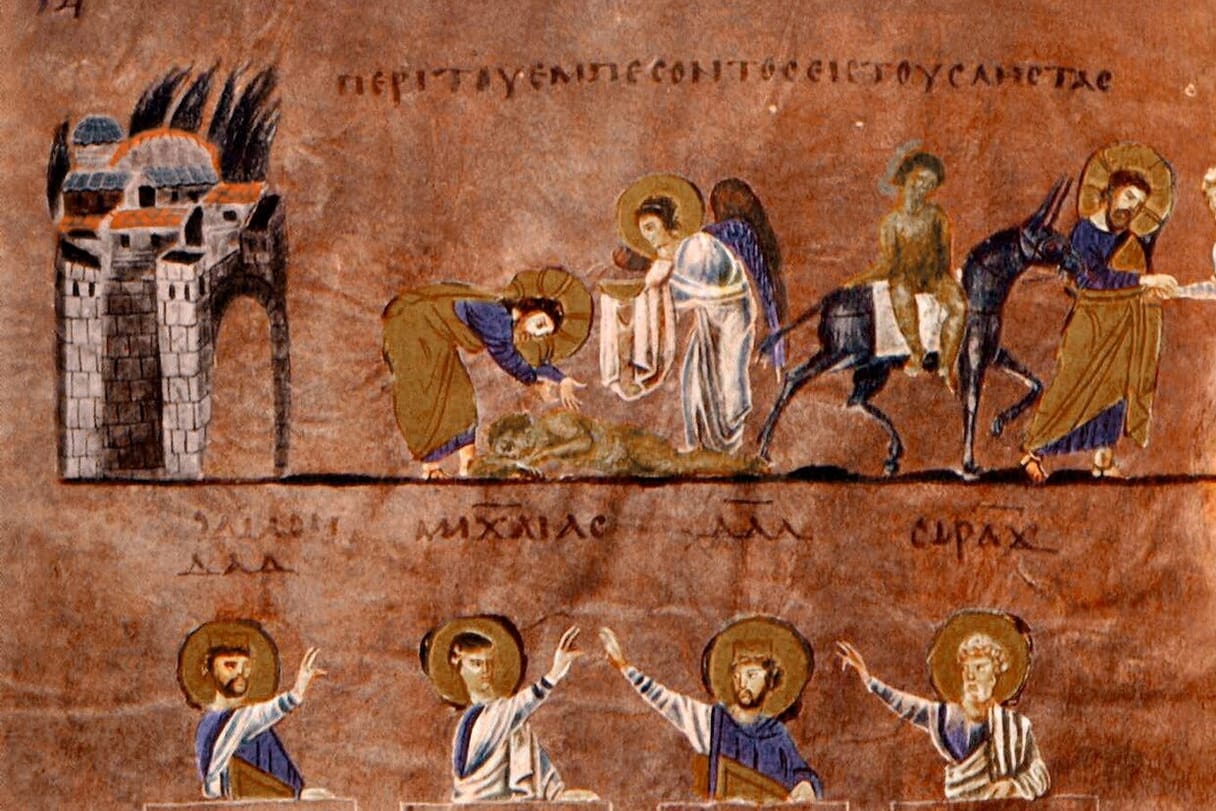
Jesus answered with the parable of the Good Samaritan. Robbers beat a man on the road from Jerusalem to Jericho and left him half dead. A priest and a Levite, both servants of the Temple, saw him and passed by on the other side. A Samaritan, a member of a people many Jews of that day regarded with hostility, “was moved with compassion,” bandaged the man’s wounds, took him to an inn, and paid for his care (Luke 10:30–35). John’s Gospel notes the depth of the division between the two peoples: “Jews have no dealings with Samaritans” (John 4:9).
Then Jesus turned the lawyer’s question around:
Which of these three, do you think, was a neighbor to the man who fell into the hands of the robbers?” He said, “The one who showed him mercy.” Jesus said to him, “Go and do likewise.”
Luke 10:36–37, NRSVUE
The lawyer wanted to know whom he was obliged to love. Jesus turned the question toward the lawyer himself, asking him to become a neighbor to anyone in need, and he made the hero of the story the person his listeners least expected. In the Sermon on the Mount Jesus carried the commandment as far as it can go: “love your enemies … pray for those who mistreat you and persecute you” (Matthew 5:44).
How are love of God and love of neighbor connected?
The New Testament treats the two commandments as one love turned in two directions. Paul writes that “the whole law is fulfilled in one word,” the command “You shall love your neighbor as yourself” (Galatians 5:14). In Romans he says the same thing more briefly: “Love therefore is the fulfillment of the law” (Romans 13:10).
The First Letter of John makes the link between the two loves explicit:
Those who say, “I love God,” and hate a brother or sister are liars, for those who do not love a brother or sister, whom they have seen, cannot love God, whom they have not seen. The commandment we have from him is this: those who love God must love their brothers and sisters also.
1 John 4:20–21, NRSVUE
Dorotheos of Gaza, a sixth-century monk whose teaching is still read in Eastern Orthodox monasteries, drew a picture of the same truth. Imagine a circle with God at the center and human lives as lines running from the edge toward the center. The closer people come to God, the closer they come to one another, and the closer they come to one another, the closer they come to God. If God feels far away from you, Dorotheos’s circle suggests one way back: draw near to someone who needs you.
At the Last Supper Jesus gave the measure of that love: “Just as I have loved you, you also love one another” (John 13:34). Paul’s hymn to love in 1 Corinthians 13 describes what such love looks like day to day.
Augustine of Hippo (354–430) made the two commandments the key to reading the whole Bible. In On Christian Teaching he wrote that anyone whose interpretation of Scripture “does not tend to build up this twofold love of God and our neighbor, does not yet understand them as he ought” (Book 1, chapter 36, section 40). In a sermon on 1 John he gave the same rule its shortest form: “Love, and do what you will.” He explained that correction and mercy alike must grow from love, because “of this root can nothing spring but what is good” (Homily 7 on 1 John, section 8).
What do the mainline churches teach about the greatest commandment?
The mainline churches read the Ten Commandments through the two great commandments, and each tradition has its own classic text for it. Martin Luther’s Small Catechism, which Lutherans in the ELCA still learn, explains each of the Ten Commandments as a way of fearing and loving God, and most of its explanations begin with the words “We are to fear and love God.” The Westminster Shorter Catechism, part of the Presbyterian Church (U.S.A.)’s Book of Confessions, says that the sum of the Ten Commandments is to love God with all the heart, soul, strength, and mind, and the neighbor as oneself. John Wesley, the founder of Methodism, described the goal of the Christian life as perfect love of God and neighbor. In Anglican and Episcopal churches, Jesus’s summary of the law may be read at the beginning of Holy Communion.
Christians of every tradition give the same answer to the question of the greatest commandment, because the answer comes from Jesus’s own words. The prophet Micah gives an older summary in the same spirit: to act justly, love mercy, and walk humbly with God, as the article on Micah 6:8 explains.
The love the commandments ask for begins with God’s love for us. As 1 John puts it, “We love him, because he first loved us” (1 John 4:19), which is why the question does God love me? comes before every other. No one keeps these commandments perfectly, and the commandments are also a promise of what God’s grace is making of you. The Collect for Purity, a medieval prayer that Thomas Cranmer translated for the first Book of Common Prayer in 1549, asks God for that very love:
Almighty God, to you all hearts are open, all desires known, and from you no secrets are hid: Cleanse the thoughts of our hearts by the inspiration of your Holy Spirit, that we may perfectly love you, and worthily magnify your holy Name; through Christ our Lord. Amen.
The Book of Common Prayer (1979), p. 355
Common questions
What are the two greatest commandments in the Bible?
The two greatest commandments are to love the Lord your God with all your heart, soul, and mind, and to love your neighbor as yourself. Jesus quoted the first from Deuteronomy 6:5 and the second from Leviticus 19:18 (Matthew 22:37–39). He said that all the Law and the Prophets hang on these two commandments.
What is the new commandment Jesus gave?
At the Last Supper Jesus told his disciples, “A new commandment I give to you, that you love one another. Just as I have loved you, you also love one another” (John 13:34). Christians have often understood the newness to lie in its measure: the love Jesus showed, which led him to the cross. Maundy Thursday, the day before Good Friday, takes its name from this commandment, from the Latin mandatum, “commandment.”
Is the greatest commandment the same as the Golden Rule?
The two are close relatives. The Golden Rule, “whatever you desire for men to do to you, you shall also do to them” (Matthew 7:12), is a practical way to keep the command to love your neighbor as yourself, and Jesus says of both that they sum up the Law and the Prophets. The Golden Rule does not mention God, while the greatest commandment puts the love of God first.
Does loving your neighbor as yourself mean you have to love yourself first?
The commandment assumes that people already care for their own lives, and it asks them to give their neighbor the same care. Augustine observed that no commandment is needed to make people love themselves. A healthy respect for yourself as someone made in God’s image and loved by God is good, and the commandment itself points outward, toward the neighbor.
Sources
- Matthew 22:34–40 (WEB)
- Mark 12:28–34 (WEB)
- Luke 10:25–37 (WEB)
- Deuteronomy 6:4–9 (WEB)
- Leviticus 19:17–18, 33–34 (WEB)
- Romans 13:8–10 (WEB)
- 1 John 4:16–21 (WEB)
- Babylonian Talmud, Shabbat 31a (Sefaria)
- Sifra, Kedoshim 4:12 (Sefaria)
- Babylonian Talmud, Makkot 23b (Sefaria)
- Augustine, On Christian Doctrine, Book 1 (New Advent)
- Augustine, Homily 7 on the First Epistle of John (New Advent)
- Dorotheos of Gaza, Instruction 6: the circle of love (Monastero di Bose)
- Westminster Shorter Catechism (CCEL)
- Book of Common Prayer (1979), Holy Eucharist: Rite Two, Collect for Purity, p. 355