Contradictions in the Bible
The Bible contains contradictions in detail: parallel accounts differ on who incited David's census, who killed Goliath, how Judas died, and the day Jesus was crucified. Most mainline Christians read these differences as signs of the Bible's human authors, whom the mainline churches teach God inspired. The church has known about the differences since its earliest centuries and kept the texts side by side. Many evangelical Christians harmonize them. None of these differences touches what the church confesses about God and Christ.
There are some things in them hard to understand,
2 Peter 3:16, NRSVUE
The Bible does contain differences in detail between parallel accounts, and the church has known about them since its earliest centuries. If you have just come across a list of them, from a friend, a class, or a video, it can feel as if the ground has shifted under your faith. It may help to know that Christians have read these same passages for nearly two thousand years, noticed the same things, and gone on loving and trusting the Scriptures. Looking closely at the differences can even lead you to read the Bible more slowly, and to hear more in it.
What are some examples of contradictions in the Bible?
Here are five well-known cases. In each, you can read both passages for yourself.
Who moved David to take a census? The Second Book of Samuel says that “the LORD’s anger burned against Israel, and he moved David against them” (2 Samuel 24:1). The later retelling in Chronicles says, “Satan stood up against Israel, and moved David to take a census of Israel” (1 Chronicles 21:1). The Chronicler, writing centuries later, seems to have been uneasy with the idea that God would provoke a sin.
Who killed Goliath? In the famous story, “David prevailed over the Philistine with a sling and with a stone” (1 Samuel 17:50). A list of heroes later in Samuel (2 Samuel 21:19, translated from the Hebrew1) says that “Elhanan son of Jaare-oregim the Bethlehemite killed Goliath the Gittite.” Chronicles appears to smooth this over: there, Elhanan “killed Lahmi the brother of Goliath” (1 Chronicles 20:5).
How did Judas die? Matthew says that Judas, throwing down the silver in the temple, “went away and hanged himself” (Matthew 27:5). Acts says that he bought a field, “falling headlong, his body burst open” (Acts 1:18).
On what day was Jesus crucified? Mark dates the Last Supper to “the first day of unleavened bread, when they sacrificed the Passover” (Mark 14:12), so Jesus eats the Passover meal with his disciples before his arrest. In John, Jesus is condemned on “the Preparation Day of the Passover” (John 19:14), so he dies as the Passover lambs are being sacrificed.
In what order were humans and animals made? In Genesis 1, God creates the animals and then, on the sixth day, creates humankind: “male and female he created them” (Genesis 1:27). In Genesis 2, God forms the man first (Genesis 2:7), and only afterward forms “every animal of the field, and every bird of the sky” and brings them to him (Genesis 2:18–19).
How do Christians explain these differences?
Christians who love the Bible answer these differences in two main ways, and both come from reverence for Scripture.
Many evangelical Christians hold that the Bible is without error in every detail. They offer harmonizations, explanations that show how both accounts could be true at once. Judas, for example, might have hanged himself and later fallen. Christians who read this way take the authority of Scripture with great seriousness, and their arguments deserve a fair hearing.
Most mainline Christians, and many biblical scholars of every tradition, read the differences another way. The Bible was written by many human authors over many centuries, using the sources, memories, and purposes of their own times. Two writers can tell the same event differently because each is teaching something. John, for instance, places the crucifixion on the day of Preparation, and his Gospel calls Jesus “the Lamb of God” (John 1:29). By telling the story that way, John helps his readers see Jesus as the Passover lamb, given for the life of the world. For the human history behind the text, see Who wrote the Bible?
Did the early church know about contradictions in the Bible?
Yes. Early Christian teachers saw the differences clearly and wrote about them openly.
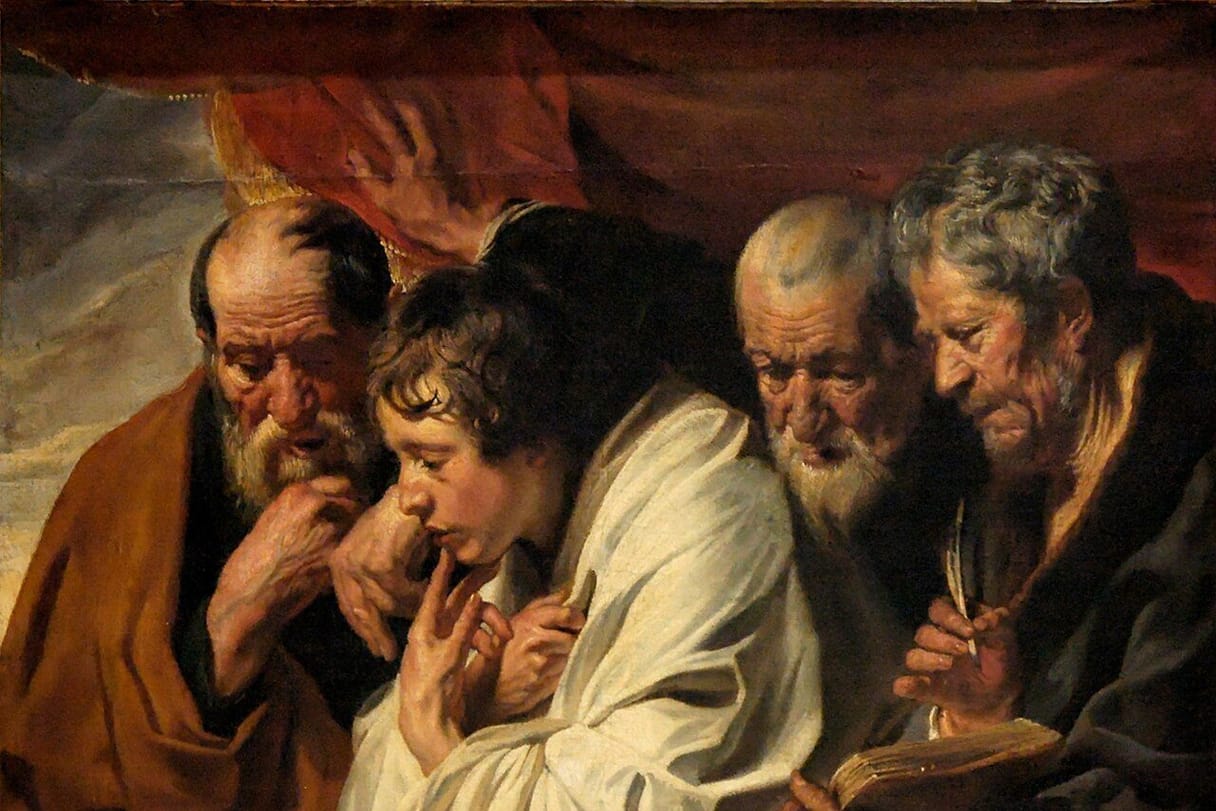
In the second century, a Christian named Tatian blended the four Gospels into a single continuous story, the Diatessaron. The wider church did not adopt it. The church chose to keep four separate Gospels, differences and all, as four witnesses to one Lord. See Who wrote the Gospels?
Origen of Alexandria, the great third-century interpreter of Scripture, noticed passages that cannot all be true as literal history. He argued that where the history could not carry the spiritual meaning, the Holy Spirit “inserted sometimes certain things which either did not take place or could not take place” (On First Principles, Book IV). For Origen, those rough places were an invitation to look deeper, toward the spiritual meaning the Holy Spirit intended.
Augustine of Hippo gave the church a rule for reading hard passages. In On Christian Teaching (1.36.40), he wrote that anyone whose reading of Scripture does not build up “this twofold love of God and our neighbor” has not yet understood it. Even the New Testament admits that Scripture can be difficult. The Second Letter of Peter says of Paul’s letters, “There are some things in them hard to understand” (2 Peter 3:16).
Do contradictions mean the Bible is not true?
The Bible remains true in what it teaches about God, about sin and grace, and about how we are to live. The mainline churches hold together God’s inspiration and the authors’ humanity. The ELCA’s confession of faith calls the Scriptures the written Word of God, inspired by God’s Spirit speaking through their authors, and the PC(USA)’s Confession of 1967 says they are also “the words of men, conditioned by the language, thought forms, and literary fashions of the places and times at which they were written.” Inspiration did not erase the authors’ humanity. For more, see Is the Bible true, and is it the Word of God?
Differences in detail can even strengthen confidence in the Bible’s truthfulness. Witnesses who agree on every word are often suspected of copying each other, a point John Chrysostom, the fourth-century preacher of Antioch and Constantinople, made about the Gospels: if the evangelists had agreed in every word, he said, critics would have suspected “some human compact,” but their disagreement “in little matters delivers them from all suspicion” (Homilies on Matthew 1.6). The four Gospels disagree on details but agree on the center: Jesus preached the kingdom of God, gathered disciples, was crucified under Pontius Pilate, and was proclaimed risen by his followers.
How should I read passages that seem to conflict?
When you meet two passages that do not agree, read each one in its own setting. Ask what each writer was trying to teach, and to whom. A study Bible with good notes, such as The New Oxford Annotated Bible, will point out the differences and explain how scholars understand them.
Then read the passage in the light of Christ and of love, as Augustine taught. Some of the Bible’s hardest texts, including its violent ones, need this kind of reading most of all. See Why is the Old Testament so violent? and Should we read the Bible as literal fact?
Most of all, bring your questions to God in prayer. On the road to Emmaus, two disappointed disciples walked with the risen Jesus without knowing him, and afterward they said, “Weren’t our hearts burning within us while he spoke to us along the way, and while he opened the Scriptures to us?” (Luke 24:32). Your questions about the Bible can be the place where Christ meets you too. Before you open it, you can pray with the psalmist: “Open my eyes, that I may see wondrous things out of your law” (Psalm 119:18).
Notes
-
Hebrew (Westminster Leningrad Codex): וַיַּ֡ךְ אֶלְחָנָן֩ בֶּן־יַעְרֵ֨י אֹרְגִ֜ים בֵּ֣ית הַלַּחְמִ֗י אֵ֚ת גָּלְיָ֣ת הַגִּתִּ֔י. Vayyak means “and he struck down”; et Golyat ha-Gitti means “Goliath the Gittite.” The Hebrew has no word for “brother” here; the World English Bible adds “brother” to match 1 Chronicles 20:5. ↩︎
Common questions
Do contradictions mean the Bible is false?
Differences in detail do not make the Bible false. They are what you would expect from several witnesses writing at different times, and the church has never staked its faith on harmonizing every number or date. The Bible's central witness, that God made the world, called Israel, and raised Jesus from the dead, rests on something deeper than those details: the faithfulness of God, which the whole Bible proclaims.
What is the biggest contradiction in the Bible?
There is no agreed answer, but one of the most discussed is the date of Jesus's crucifixion. In Mark, Matthew, and Luke, Jesus eats the Passover meal with his disciples before he dies. In John, he is crucified on the day of Preparation for the Passover, when the lambs were being prepared.
How do Christians who believe in inerrancy explain contradictions?
They usually offer harmonizations, explanations that show how both accounts could be true at once. For example, some suggest that Judas hanged himself and his body later fell. Christians who hold this view take the Bible's authority with great seriousness, and their explanations deserve a fair hearing.
Are there contradictions in the Gospels?
Yes, the Gospels differ in the order of events, in wording, and in some details, such as the day of the crucifixion and the events at the empty tomb. The early church knew this and chose to keep all four Gospels side by side, as four witnesses to one Lord.
Sources
- 2 Samuel 24:1 and 1 Chronicles 21:1 (WEB)
- 1 Samuel 17:50; 2 Samuel 21:19; 1 Chronicles 20:5 (WEB)
- Matthew 27:5 and Acts 1:18 (WEB)
- Mark 14:12 and John 19:14 (WEB)
- Genesis 1:27; 2:7, 18–19 (WEB)
- Origen, On First Principles, Book IV (New Advent)
- Augustine, On Christian Doctrine, Book I (New Advent)
- Luke 24:13–32 (WEB)
- Diatessaron (Wikipedia)
- John Chrysostom, Homilies on the Gospel of Matthew, Homily 1 (New Advent)
- Presbyterian Church (U.S.A.), The Confession of 1967 (Book of Confessions)
- ELCA: What Lutherans believe