Noah’s ark and the flood
The story of Noah’s flood is a holy story about God’s grief over human violence, God’s mercy, and God’s promise never again to destroy the earth. Some Christians read it as a worldwide event. Geologists, including Christian geologists since the 1830s, find no evidence of a flood covering the whole earth in human history, and Genesis echoes older Mesopotamian flood stories, so many Christians read it as sacred story that may remember a great regional flood.
I have set my bow in the clouds, and it shall be a sign of the covenant between me and the earth.
Genesis 9:13, NRSVUE
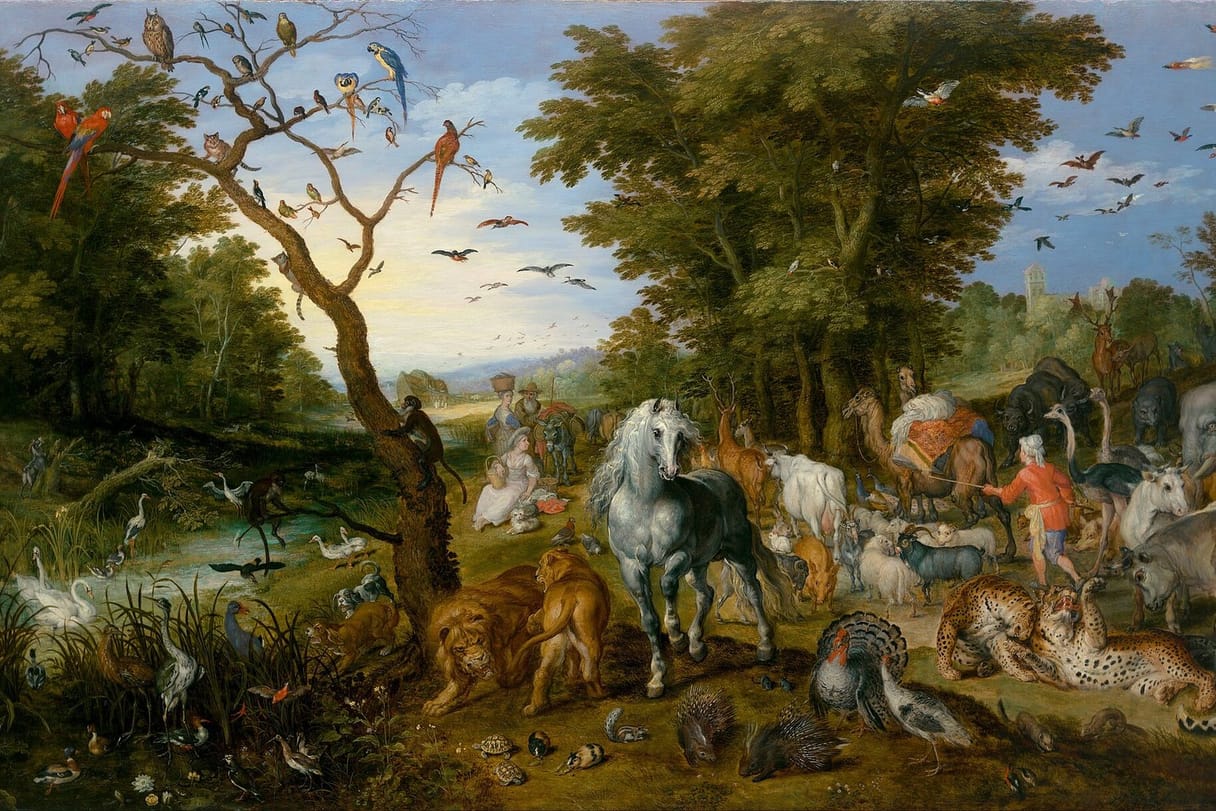
The story of Noah’s flood is a holy story about God’s grief over human violence, God’s mercy in saving a family and the animals, and God’s promise never again to destroy the earth. Some Christians read it as an event that covered the whole world, out of deep trust in Scripture; many others read it as sacred story that may remember a great regional flood. If you grew up with the first reading and are now unsure, the story is still yours. The rainbow still means what it meant when you first heard it.
What does Genesis say about Noah’s flood?
Genesis gives a moral reason for the flood. The earth “was filled with violence” (Genesis 6:11), and God grieved:
The Lord saw that the wickedness of humans was great in the earth and that every inclination of the thoughts of their hearts was only evil continually. And the Lord was sorry that he had made humans on the earth, and it grieved him to his heart.
Genesis 6:5–6, NRSVUE
God tells Noah to build an ark and bring his family and the animals into it. The rain falls, the waters cover “all the high mountains that were under the whole sky” (Genesis 7:19), and the ark comes to rest “on Ararat’s mountains” (Genesis 8:4). Afterward God makes a covenant, a binding promise, with Noah’s descendants “and with every living creature” (Genesis 9:9–10):
I have set my bow in the clouds, and it shall be a sign of the covenant between me and the earth. … and the waters shall never again become a flood to destroy all flesh.
Genesis 9:13, 15, NRSVUE
Careful readers have long noticed that Genesis tells parts of the story twice. In Genesis 6:19 God tells Noah to bring “two of every sort” into the ark, while in Genesis 7:2 God tells him to take “seven pairs of every clean animal.” In Genesis 7:12 the rain lasts “forty days and forty nights,” while Genesis 7:24 says the waters flooded the earth “one hundred fifty days.” Most biblical scholars explain these differences as the marks of two older accounts joined by a later editor (see Who wrote the Bible?).
Is there scientific evidence for a worldwide flood?
Many Christians, especially young-earth creationists, believe the flood covered the whole planet and shaped its geology. Their wish to trust every word of Scripture deserves respect.
Geologists have not found evidence of a worldwide flood. Rock layers, ice cores, and the remains of ancient settlements show no single flood that covered the earth during human history. In the early 1800s many British geologists, several of them Anglican clergymen, expected to find signs of Noah’s flood. Adam Sedgwick, a Cambridge geologist and Anglican priest, had defended that view. On 18 February 1831, in his farewell address as president of the Geological Society of London, Sedgwick publicly withdrew it because the evidence did not support it. He remained a priest and a devout Christian for the rest of his life.
Augustine taught centuries earlier that Christians should not defend readings of Scripture that contradict what careful study of the natural world has shown (see Can Christians believe in evolution?).
How is Noah’s flood related to the Epic of Gilgamesh?
Noah’s story belongs to a family of flood stories from ancient Mesopotamia. In 1872 George Smith, an assistant at the British Museum, translated a clay tablet from Nineveh that told of a flood. The tablet, now in the British Museum (number K.3375), is the eleventh tablet of the Epic of Gilgamesh, written in the Akkadian language and copied in the seventh century BCE. An older Babylonian poem called Atrahasis, preserved on tablets copied around 1646–1626 BCE, tells a similar story.
The parallels with Genesis are close. In the Gilgamesh tablet a god warns a man named Utnapishtim to build a boat and bring living creatures aboard. The boat lands on a mountain. Utnapishtim releases a dove, a swallow, and a raven, then offers a sacrifice, and the gods smell its sweet smell. In Genesis, Noah sends out a raven and a dove, offers a sacrifice, and “the LORD smelled the pleasant aroma” (Genesis 8:21).
The differences show the faith of Israel. In the Mesopotamian stories several gods quarrel and act on whim, and in the Gilgamesh tablet they crowd around the sacrifice like flies. Genesis has one God who acts for a moral reason, grieves over human evil, and binds himself by a promise to every living creature. The writers of Genesis took a story their neighbors told and retold it to proclaim a God whose heart can be grieved and whose mercy is faithful.
Did Jesus believe in Noah’s flood?
Jesus referred to the story of Noah to warn people to be ready for God’s judgment. People before the flood went on eating, drinking, and marrying, he said, until “the flood came and took them all away,” and “so will the coming of the Son of Man be” (Matthew 24:37–39).
Christians who read the flood as history hear Jesus’s words as confirming it. Others note that Jesus used a story his hearers knew well to teach readiness for the coming of the Son of Man, and they leave the extent of the waters an open question. The First Letter of Peter uses the same story to teach about baptism: eight people “were saved through water,” and “this is a symbol of baptism, which now saves you” (1 Peter 3:20–21).
What does the story of Noah mean for Christians?
The early church read the ark as a picture of Christ and the church. Augustine, who believed the flood was historical, wrote in The City of God (15.26) that the ark is “a figure of the city of God sojourning in this world; that is to say, of the church.” He saw the door in the ark’s side as a sign of “the wound which was made when the side of the Crucified was pierced with the spear.” In the next chapter (15.27) Augustine rejected both readers who take the story as bare history and readers who take it only as a figure.
Martin Luther carried that reading into worship with his “Flood Prayer,” written for his baptism service of 1523, and Thomas Cranmer adapted it for the Church of England. The 1662 Book of Common Prayer’s baptism service prays to God “who of thy great mercy didst save Noah and his family in the ark from perishing by water.” In that prayer, each person baptized is gathered into the ark of God’s mercy.
The story also teaches about God’s care for the whole creation. God’s covenant after the flood includes “every living creature” and the earth itself, which gives Christians a reason to care for the creatures God promised to keep. The prophet Isaiah used the flood to promise God’s faithfulness to Israel in exile:
This is like the days of Noah to me: Just as I swore that the waters of Noah would never again go over the earth, so I have sworn that I will not be angry with you and will not rebuke you.
Isaiah 54:9, NRSVUE
Many readers find the flood troubling, because it shows God destroying nearly every living thing. Genesis itself ends the story with God renouncing that kind of destruction forever: “I will never again strike every living thing, as I have done” (Genesis 8:21). God’s final word over a violent world is a promise. For the wider question of violence in Scripture, see Why is the Old Testament so violent?
What do the churches teach about Noah’s flood?
The Evangelical Lutheran Church in America, the Presbyterian Church (U.S.A.), the United Methodist Church, and the Episcopal Church have no teaching that requires members to believe in a worldwide flood. Their seminaries teach the historical study of the Bible, which reads Genesis 1–11 as ancient sacred story that teaches true things about God and humanity. Many conservative evangelical churches teach that the flood was a historical, worldwide event.
The Nicene Creed confesses God as “maker of heaven and earth” and says nothing about the flood. Christians on both sides can say together what the story of Noah proclaims: God takes human violence seriously, God saves, and God keeps promises. For how the church reads the early chapters of Genesis, see Should we read the Bible as literal fact? and Were Adam and Eve real people?
When you next see a rainbow after a storm, remember that Genesis says God looks at it too: “I will look at it, that I may remember the everlasting covenant between God and every living creature of all flesh that is on the earth” (Genesis 9:16). Whatever storms have passed over your own life, the God of Noah has bound himself to you by a promise, and that promise holds.
Common questions
Has Noah’s ark been found?
No. Genesis 8:4 says the ark came to rest “on Ararat’s mountains,” which names a region in what is now eastern Turkey and Armenia; Genesis does not name a single peak. Explorers have announced discoveries on Mount Ararat many times, and none has been confirmed by archaeologists.
How big was Noah’s ark?
Genesis 6:15 gives the ark’s size as 300 cubits long, 50 cubits wide, and 30 cubits high. A cubit was roughly a forearm’s length, so the ark would have been about 450 feet long. Augustine noticed that those proportions match a human body lying down, and he read the ark as a figure of Christ.
Why did God send the flood?
Genesis says that “the earth was filled with violence” and that God “was sorry that he had made humans on the earth” (Genesis 6:6, 11). In the older Babylonian flood stories, the gods send the flood for less moral reasons, such as human noise disturbing their sleep in the poem Atrahasis. Genesis makes the flood a story about human violence and God’s grief.
What does the rainbow mean in the Bible?
After the flood God sets a bow in the clouds as “a sign of the covenant between me and the earth” (Genesis 9:13). The covenant is made with Noah’s family and with “every living creature,” and God promises that the waters “shall never again become a flood to destroy all flesh” (Genesis 9:15). The rainbow is a sign of God’s mercy toward the whole creation.
Sources
- Genesis 6:5–7 (WEB)
- Genesis 6:19 and 7:2–3 (WEB)
- Genesis 8:21–22 (WEB)
- Genesis 9:9–15 (WEB)
- Matthew 24:37–39 (WEB)
- 1 Peter 3:20–21 (WEB)
- Isaiah 54:9–10 (WEB)
- Augustine, The City of God, Book 15, chapters 26–27 (New Advent)
- The Book of Common Prayer (1662), Public Baptism of Infants (Church of England)
- Gilgamesh flood myth and the Flood Tablet, British Museum K.3375 (Wikipedia)
- Adam Sedgwick (Wikipedia)