Infertility and faith
The Bible treats infertility as a real grief and honors the people who carry it. Sarah, Rebekah, Rachel, Hannah, and Elizabeth all longed for children, and Luke calls Elizabeth and her husband “righteous before God” (Luke 1:6). Scripture gives you words to pour out your sorrow to God, as Hannah did, and promises that your worth and your place in God’s family rest on God’s love, whether or not you become a parent.
You count my wanderings. You put my tears into your container. Aren’t they in your book?
Infertility is a real and often hidden grief, and Scripture honors the people who carry it. You may know the monthly rhythm of hope and disappointment, the baby showers you could not bear to attend, the questions from relatives, the clinic appointments, or a pregnancy that ended too soon. The World Health Organization reported in 2023 that about one in six adults worldwide experience infertility, so you are far from alone, even when it feels that way. God sees this sorrow, and the Bible gives you words to bring it before him.
What does the Bible say about infertility?
Some of the Bible’s most important families began with long years of waiting. Sarah waited into old age. Isaac “entreated the LORD for his wife, because she was barren” (Genesis 25:21). Rachel cried to Jacob, “Give me children, or else I will die” (Genesis 30:1), until “God remembered Rachel, and God listened to her” (Genesis 30:22). In the New Testament, Zechariah and Elizabeth had no child, and they were old.
In the ancient world people often blamed childlessness on the woman and treated it as a disgrace. Elizabeth spoke of her “reproach among men” (Luke 1:25). Luke’s verdict on her and her husband is the opposite of that reproach:
They were both righteous before God, walking blamelessly in all the commandments and ordinances of the Lord. But they had no child, because Elizabeth was barren, and they both were well advanced in years.
Elizabeth was faithful and childless at the same time, for most of her life. Infertility says nothing about your worth before God. For more on these women, see Women of the Bible.
What can I learn from Hannah’s prayer?
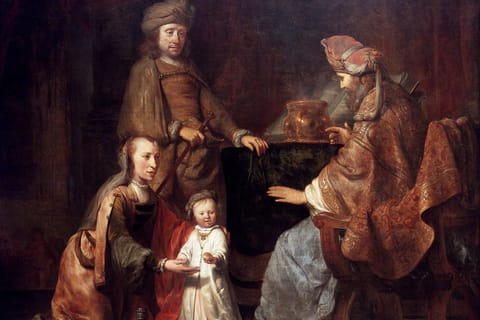
Hannah’s story in 1 Samuel is the Bible’s fullest portrait of infertility. Every year, when her family went up to worship, her husband’s other wife provoked her, and Hannah “wept, and didn’t eat” (1 Samuel 1:7). Her husband Elkanah loved her and tried to comfort her: “Am I not better to you than ten sons?” (1 Samuel 1:8). His love was real, and it could not reach the place where she hurt.
So Hannah went to the house of the Lord and prayed, “weeping bitterly” (1 Samuel 1:10). The old priest Eli watched her lips move without sound and thought she was drunk. She answered him:
No, my lord, I am a woman of a sorrowful spirit. I have not been drinking wine or strong drink, but I poured out my soul before the LORD.
Even a priest misread her grief, and God understood it fully. Hannah held nothing back. Afterward she “went her way and ate; and her facial expression wasn’t sad any more” (1 Samuel 1:18), before she had any sign that she would conceive. She had been heard. The psalm gives the same invitation to you: “Pour out your heart before him. God is a refuge for us” (Psalm 62:8).
What if my story does not end like Hannah’s?
Nearly every story of a barren woman in Scripture ends with a birth, and many real stories end differently. Scripture knows that faith sometimes goes without what it hoped for. The Letter to the Hebrews says of Abraham, Sarah, and the other ancestors of Israel that “these all died in faith, not having received the promises” (Hebrews 11:13).
God also spoke directly to people who would never have children. In ancient Israel eunuchs feared they were “a dry tree” cut off from God’s people (Isaiah 56:3), and God promised them “a name better than of sons and of daughters,” “an everlasting name that will not be cut off” (Isaiah 56:5). Your life and your love bear fruit that God will remember forever.
The Bible also honors families formed by love as well as by birth. When Naomi lost her husband and both sons, the neighbors told her that her daughter-in-law Ruth, “who loves you,” was “better to you than seven sons” (Ruth 4:15). Some people are called to adopt or foster, and many others become spiritual mothers and fathers as godparents, teachers, aunts, uncles, and mentors. Those callings are gifts in their own right, given in God’s time. Grief comes first, and no one should rush you past it.
Is it all right to be sad or angry with God?
Scripture gives you permission to lament. Psalm 13 begins, “How long, LORD? Will you forget me forever? How long will you hide your face from me?” (Psalm 13:1). The psalmist asks “how long” four times before he can say, “But I trust in your loving kindness” (Psalm 13:5). God receives both the questions and the trust.
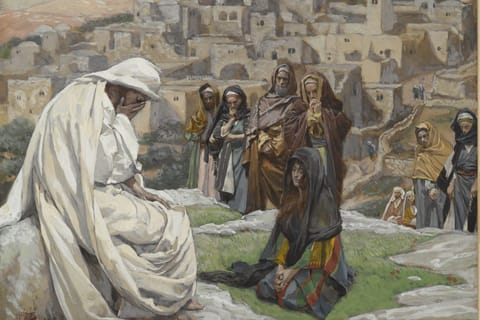
Your tears are precious to God. Another psalm says, “You put my tears into your container. Aren’t they in your book?” (Psalm 56:8). When grief leaves you without words, Paul promises that “the Spirit himself makes intercession for us with groanings which can’t be uttered” (Romans 8:26). Jesus, who wept at the grave of his friend, weeps with you. For the hard question of unanswered prayer, see Why doesn’t God answer my prayers? and Doubt and questioning God.
Where can I find support?
The Christian East keeps a story of childless parents close to its heart. An early Christian writing, the second-century Protoevangelium of James, tells that Joachim and Anna, the parents of the Virgin Mary, were childless for many years and were shamed for it before Mary was born. The Orthodox Church celebrates the Conception by St. Anna on December 9, and many Orthodox Christians ask for St. Anna’s prayers when they hope to conceive.
Infertility touches husbands and wives, same-sex couples, and single people who long to raise a child, and partners often grieve in different ways and at different times. Tell your pastor what you are carrying. A pastor can pray with you, help you mark a miscarriage with prayer or a simple service, and stand with you on hard Sundays such as Mother’s Day and Father’s Day. If you are weighing medical treatment, see IVF and Christian ethics; the mainline churches permit IVF. RESOLVE: The National Infertility Association offers support groups across the United States at resolve.org. For the grief of loss, see Grief and the Christian hope. If your grief has turned into despair or thoughts of ending your life, call or text 988 in the United States, or find a helpline in another country at findahelpline.com.
Whether or not you ever hold a child of your own, you are held. The prophet Isaiah gave God’s love the image of a mother’s love, and then said that God’s love is stronger still:
Can a woman forget her nursing child, that she should not have compassion on the son of her womb? Yes, these may forget, yet I will not forget you! Behold, I have engraved you on the palms of my hands.
Common questions
Is infertility a punishment from God?
Scripture gives no support to that fear. Luke describes Elizabeth and Zechariah as “righteous before God, walking blamelessly” during the long years they had no child (Luke 1:6–7). Infertility is a medical condition and a deep sorrow, and God meets it with compassion.
Who in the Bible struggled with infertility?
Sarah, Rebekah, Rachel, the mother of Samson, Hannah, and Elizabeth all waited years for children. Their stories show women and their husbands praying, weeping, arguing, and hoping, and God listening to them. Hannah’s prayer in 1 Samuel 1 is the fullest picture of bringing that grief to God.
Is IVF allowed for Christians?
The ELCA, the Presbyterian Church (U.S.A.), the United Methodist Church, and the Episcopal Church permit in vitro fertilization. Some Christians object to IVF because of concern for embryos that are frozen or discarded, and couples considering it should weigh those questions with prayer and pastoral counsel.
How can I support a friend facing infertility?
Listen more than you advise, and never promise a baby or suggest that relaxing or more faith will fix it. Remember hard days such as Mother’s Day, due dates, and anniversaries of a loss. Paul’s counsel to “weep with those who weep” (Romans 12:15) is the best guide.
Sources
- 1 Samuel 1:1–20 (WEB)
- Genesis 25:21; 30:1, 22 (WEB)
- Luke 1:5–25 (WEB)
- Psalm 13 (WEB)
- Psalm 56:8 (WEB)
- Isaiah 56:3–5 (WEB)
- Isaiah 49:15–16 (WEB)
- Hebrews 11:13 (WEB)
- World Health Organization, 1 in 6 people globally affected by infertility (2023)
- Conception of the Theotokos (OrthodoxWiki)
- Agia Anna and the Conception of the Theotokos (Greek City Times, 2024)
- RESOLVE: The National Infertility Association
- 988 Suicide & Crisis Lifeline