New Testament · Matthew 2:1–12
The wise men
Wise men from the east see a new star and travel to Jerusalem to look for a newborn king of the Jews. The star leads them on to Bethlehem, where they find the child Jesus with Mary, worship him, and give him gold, frankincense, and myrrh. Warned in a dream, they go home by another road.
They came into the house and saw the young child with Mary, his mother, and they fell down and worshiped him. Opening their treasures, they offered to him gifts: gold, frankincense, and myrrh.
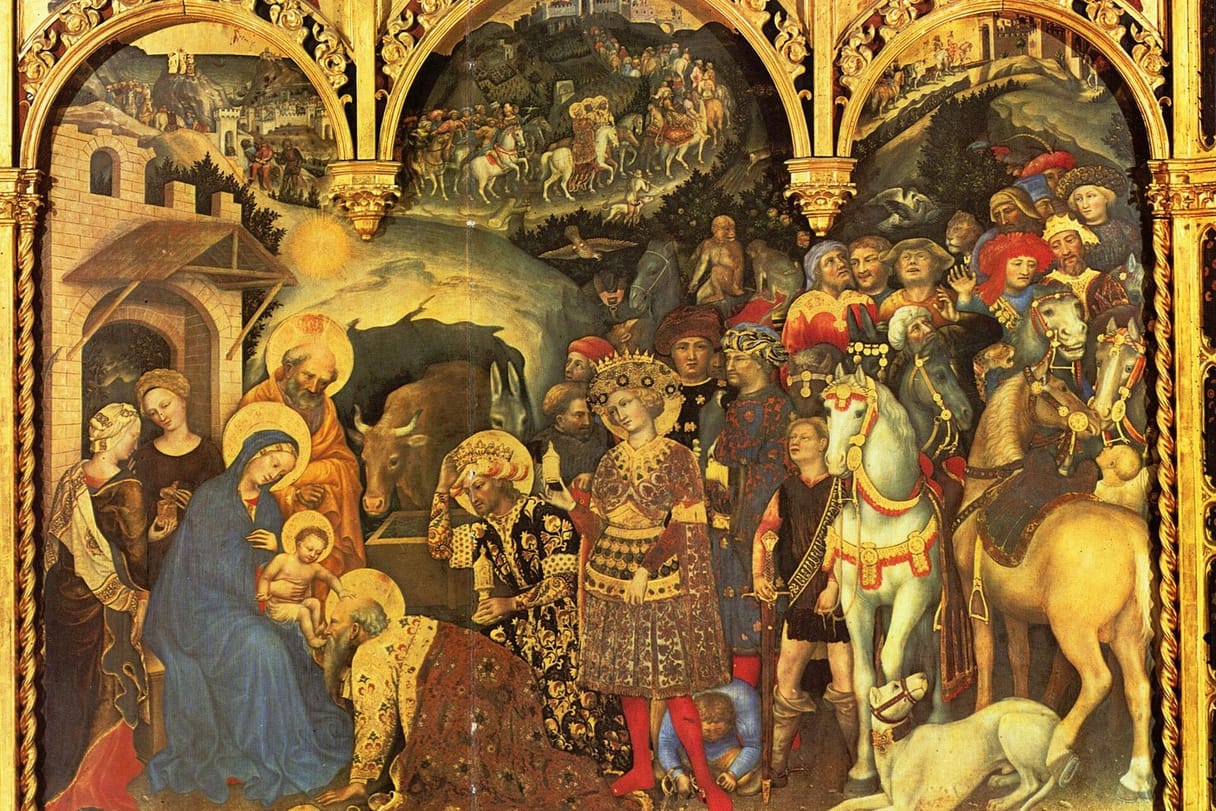

The story of the wise men comes from the Gospel of Matthew, which tells how visitors from the east followed a star to worship the child Jesus (Matthew 2:1–12). Christians remember their visit at Epiphany, on January 6, a feast whose Greek name means “appearing,” because in the wise men God showed Jesus to the nations of the world.
The story in brief
Jesus was born in Bethlehem while Herod was king. Wise men came from the east to Jerusalem and asked, “Where is he who is born King of the Jews? For we saw his star in the east, and have come to worship him” (Matthew 2:2).
King Herod was troubled, and all Jerusalem with him. The chief priests and scribes told him that the prophet Micah had named Bethlehem as the birthplace of Israel’s coming ruler (Micah 5:2). Herod sent the wise men there in secret and asked them to bring him word, so that he could worship the child too.
The star went ahead of the travelers until it stopped over the place where the child was, and “they rejoiced with exceedingly great joy” (Matthew 2:10).
They came into the house and saw the young child with Mary, his mother, and they fell down and worshiped him. Opening their treasures, they offered to him gifts: gold, frankincense, and myrrh.
Warned in a dream to stay away from Herod, the wise men went home by another road. Matthew then tells how the family fled to Egypt as refugees from Herod’s anger (Matthew 2:13–23), a hard story usually saved for older children.
The setting and background
Matthew calls the visitors magoi, the Greek word behind English “magi” and “magic.” The historian Herodotus described the Magi as a priestly tribe of the Medes, in what is now Iran, who interpreted dreams; by Jesus’s time the word could mean Persian priests, astrologers, or sorcerers.
Herod the Great ruled Judea for Rome from 37 to 4 BCE under the title King of the Jews, and he killed even members of his own family whom he feared as rivals.
Frankincense and myrrh are fragrant resins from trees that grow in southern Arabia and the Horn of Africa. Frankincense was burned in worship (Exodus 30:34), and myrrh was used in perfume, medicine, and burial (John 19:39). Matthew’s first hearers would have remembered Isaiah’s promise that the nations would bring “gold and frankincense” (Isaiah 60:6).
Matthew places the visit in a house, and Herod’s later order about young children (Matthew 2:16) suggests that it came months after the birth.
What the story means
The first people in Matthew’s Gospel to worship Jesus are foreigners who did not know the Scriptures of Israel. God met them through what they knew best, the stars, and then led them on by the words of a prophet and by a dream. The Gospel that begins with the nations coming to Jesus ends with Jesus sending his followers to “make disciples of all nations” (Matthew 28:19). The church reads the story alongside Isaiah:
Nations will come to your light, and kings to the brightness of your rising.
The wise men travel far, rejoice, kneel, and open their treasures, while Herod, with power and Scripture experts close at hand, is afraid. Preachers have often heard in the wise men’s road home, “another way” (Matthew 2:12), a picture of a life changed by meeting Christ.
How the early church read it
Ignatius of Antioch, around 110 CE, wrote that the star outshone all the others, and that the sun, the moon, and the stars formed a chorus around it. Irenaeus of Lyon, around 180, read the gifts as a confession of faith: gold because Jesus is a king, frankincense because he is God, and myrrh because he would die for the human race. Origen connected the star with Balaam’s prophecy, “A star will come out of Jacob” (Numbers 24:17). John Chrysostom argued that the star was a power of God in the form of a star, since it shone at midday and moved and stopped with the travelers.
Three became the usual number from the third century, probably because of the three gifts, and a sixth-century mosaic in Ravenna names them Caspar, Melchior, and Balthassar. Late medieval artists often painted one of them as a Black African king. In the Christian East, January 6 is Theophany, the feast of Jesus’s baptism.
What modern scholars notice
W. D. Davies and Dale Allison suggest that Matthew thought of the wise men as successors of Balaam, a seer “from the mountains of the East” (Numbers 23:7) whom the Jewish writer Philo called a magos. Raymond Brown and others hear echoes of Moses: as Pharaoh once threatened Israel’s baby boys, Herod threatens the child Jesus, and God keeps the child safe.
Johannes Kepler proposed that the star was a meeting of Jupiter and Saturn in 7 BCE, and Chinese records describe a comet in 5 BCE, though no known event fits a star that stops over a house. Many scholars read the star as Matthew’s way of announcing the Messiah in the language of Israel’s Scriptures, and many Christians read it as a sign God set in the sky. Either way, the child of Bethlehem was born for the whole world.
Questions for reflection or discussion
- Why do you think Matthew made foreign visitors the first people to worship Jesus?
- The wise men found their way by a star, by Scripture, and by a dream. How has God guided you?
- Why was Herod so afraid of a child?
- What gift would you bring to Jesus?
- Who has come to your town from far away, and how could your church welcome them?
A prayer
God of light, you led the wise men by a star to the child Jesus, and you welcome people from every land. Lead us by your light, receive the gifts we bring, and send us home by your way, full of joy. Through Jesus Christ our Lord. Amen.
For kids
When Jesus was born, some wise men lived far away in the east. They studied the stars. One night they saw a new star. “A new king is born!” they said. “Let’s go find him.”
They traveled a long, long way. At last they came to the big city of Jerusalem. They asked King Herod, “Where is the baby king?”
King Herod was worried. He wanted to be the only king. His teachers read God’s book. “The king will come from Bethlehem,” they said.
So the wise men went to Bethlehem. The star went ahead of them. It stopped over a house. The wise men were so happy!
They went inside. They saw Jesus with his mother, Mary. They knelt down and worshiped him. They gave him gifts of gold, frankincense, and myrrh.
Then God sent the wise men a dream. “Don’t go back to Herod,” God warned them. So they went home another way.
The wise men came from another country. God led them to Jesus too. God’s love is for everyone, everywhere.
Teach this story
Ready-made materials for Sunday school, children’s time in worship, and home.
- The wise men follow the star: a 45-minute Sunday school lesson for ages 7–9, with printable activity sheets and slides.
- Follow the star: a children’s sermon for Epiphany: a children’s sermon of about 4 minutes, built around a paper star on a stick.
Common questions
How many wise men were there?
Matthew does not say. Early Christian art shows two, four, or even more, and the number three became usual from the third century, probably because Matthew names three gifts. The names Caspar, Melchior, and Balthasar appear in the sixth century.
Were the wise men kings?
Matthew calls them magi, a word for Persian priests and stargazers, and never calls them kings. Christians came to picture them as kings because Psalm 72 speaks of kings bringing gifts and Isaiah 60 says that kings will come to the brightness of God’s light.
What are frankincense and myrrh?
Frankincense and myrrh are fragrant resins gathered from trees that grow in southern Arabia and the Horn of Africa. Frankincense was burned as incense in worship, and myrrh was used in perfume, medicine, and burial. Irenaeus of Lyon read the three gifts as signs that Jesus is a king, is God, and would die for the human race.
What was the star of Bethlehem?
Matthew presents the star as a sign from God that went ahead of the travelers and stopped over the house where Jesus was. Origen thought it was a new star like a comet. Johannes Kepler proposed a meeting of the planets Jupiter and Saturn in 7 BCE, and other astronomers point to a comet recorded in China in 5 BCE, but no known event fits every detail of Matthew’s account.
When do churches remember the wise men?
Western churches remember the wise men at Epiphany, on January 6, the twelfth day after Christmas, and many keep the feast on the Sunday before. In the Revised Common Lectionary the Gospel for Epiphany is Matthew 2:1–12 in every year. In the Eastern churches the feast of January 6, called Theophany, celebrates the baptism of Jesus.
Sources
- Matthew 2:1–23 (WEB)
- Micah 5:2 (WEB)
- Numbers 23:7 and 24:17 (WEB)
- Isaiah 60:1–6 (WEB)
- Psalm 72:10–11 (WEB)
- Ignatius of Antioch, Letter to the Ephesians, chapter 19 (New Advent)
- Irenaeus, Against Heresies, Book 3, chapter 9 (New Advent)
- Origen, Against Celsus, Book 1, chapters 58–59 (New Advent)
- John Chrysostom, Homily 6 on Matthew (New Advent)
- Muhammad A. Dandamayev, “Magi,” Encyclopaedia Iranica
- Index of Medieval Art, Princeton University, on the Magi in medieval art (December 2018)
- “Who was the real King Herod?” National Geographic
- Kim D. Coder, Frankincense & Myrrh: A Gift of Tree History (University of Georgia, 2011)
- P. C. van der Kruit, “Star of Bethlehem” (University of Groningen)
- W. D. Davies and Dale C. Allison, A Critical and Exegetical Commentary on the Gospel According to Saint Matthew, vol. 1 (T&T Clark, 1988)
- Raymond E. Brown, The Birth of the Messiah (Doubleday, 1977; updated edition 1993), on the Moses typology in Matthew 2
- Philo of Alexandria, On the Life of Moses, Book 1 (on Balaam as a magos)
- “Epiphany,” Encyclopaedia Britannica