New Testament · Luke 2:22–40
Simeon and Anna
Forty days after Jesus is born, Mary and Joseph bring him to the temple in Jerusalem with an offering of two birds. Simeon, a devout man who has been promised that he will see the Messiah before he dies, takes the baby in his arms and praises God. Anna, a prophet of great age, gives thanks and tells everyone who is waiting for God’s help about the child.
My eyes have seen your salvation, which you have prepared before the face of all peoples; a light for revelation to the nations, and the glory of your people Israel.

Luke tells this story near the end of his account of Jesus’s birth (Luke 2:22–40). When Jesus is about forty days old, Mary and Joseph bring him to the temple in Jerusalem, and two people who have spent long lives waiting for God meet him there.
The story in brief
When the days of purification set by the law of Moses were complete, Mary and Joseph brought Jesus to Jerusalem to present him to the Lord. They offered “a pair of turtledoves, or two young pigeons” (Luke 2:24), as the law directed.
A righteous and devout man named Simeon lived in Jerusalem, waiting for God to comfort Israel. The Holy Spirit had shown him that he would see the Lord’s Messiah before he died. Led by the Spirit, he came into the temple just as the parents brought in the child. He took Jesus in his arms and praised God:
Now you are releasing your servant, Master, according to your word, in peace; for my eyes have seen your salvation, which you have prepared before the face of all peoples; a light for revelation to the nations, and the glory of your people Israel.
Simeon blessed the parents and told Mary that her child would be a sign that many would oppose, and that a sword would pierce her own soul too.
Then Anna came up. She was a prophet of great age from the tribe of Asher, a widow who never left the temple and worshiped there with fasting and prayer night and day. At that very hour she gave thanks to God and spoke about the child to everyone who was waiting for the redemption of Jerusalem. The family went home to Nazareth, where the child grew strong and wise (Luke 2:40).
The setting and background
Two customs of the law of Moses meet in the story. Forty days after giving birth to a son, a mother brought a lamb and a bird for her purification, or two birds if she could not afford a lamb (Leviticus 12:8). The law also set apart every firstborn son as belonging to God (Exodus 13:2). The offering of two birds shows that Mary and Joseph were poor, and Luke mentions the law five times in these verses, picturing Jesus’s family as faithful Jews.
Luke never says that Simeon was old, although Christian art usually paints him that way because he speaks of being ready to die. Anna is one of the few women in the New Testament called a prophet. Her name is the Greek form of Hannah, the mother who brought the young Samuel to the house of the LORD (1 Samuel 1:24–28), and Luke’s words about Jesus growing echo the words about Samuel (1 Samuel 2:26).
What the story means
In this story God keeps a promise. Simeon and Anna had watched for years, and the answer came as a baby in the arms of a poor young couple. Simeon’s song calls the child a light for the nations as well as the glory of Israel.
The scene also honors old age. The first people in the temple to recognize Jesus are elders who had kept faith through long years of prayer, and the Spirit speaks through a man and a woman alike. The psalmist says of the righteous, “They will still produce fruit in old age” (Psalm 92:14). Christians have long heard in Simeon’s words about a sword the first hint of the cross.
How the early church read it
By the 380s the church in Jerusalem kept the fortieth day after Epiphany as a great feast; the pilgrim Egeria wrote that it was celebrated with joy, as at Easter, and that every preacher spoke of Simeon and Anna. The feast later moved to February 2, and candles carried to honor Simeon’s “light for revelation” gave it the English name Candlemas. The Eastern churches call it the Meeting of the Lord, in Greek Hypapante.
Origen, preaching on Luke in the third century, told his hearers that anyone who hopes to go forth from this life in peace should do as Simeon did and take Jesus into their arms. The Orthodox sing Simeon’s song at the end of Vespers, Western Christians sing it at Compline before sleep, the Book of Common Prayer has appointed it for Evening Prayer since 1549, and many Lutheran churches sing it after Holy Communion. Its Latin first words, Nunc dimittis, “now you let depart,” give it its name.
What modern scholars notice
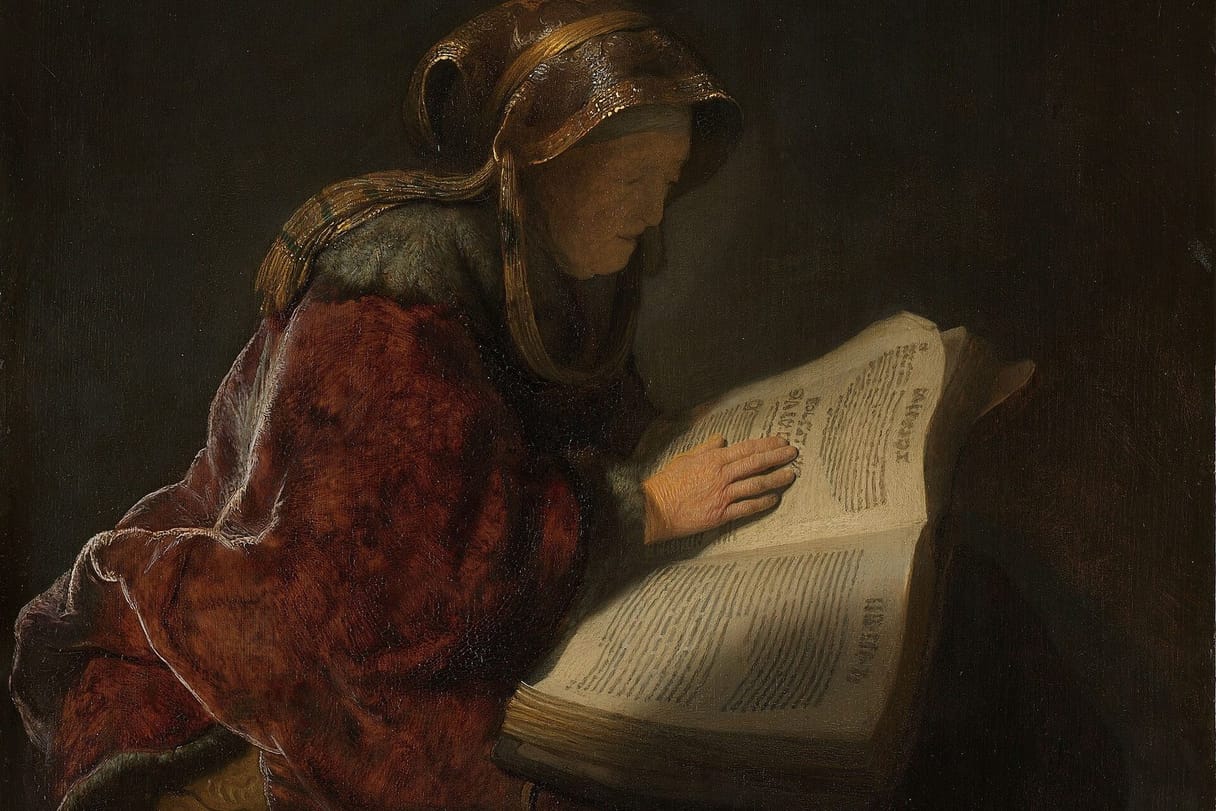
The New Testament scholar Turid Karlsen Seim describes how Luke pairs women and men throughout his Gospel: the angel Gabriel visits both Zechariah and Mary, Simeon and Anna both greet the child, and later parables come in pairs, such as the lost sheep and the lost coin. Other scholars add that Anna, although Luke calls her a prophet, is given no words of her own, while Simeon’s song is recorded in full. In 1631 Rembrandt painted an old woman bent over a great book, and the Rijksmuseum in Amsterdam, which owns the painting, identifies her as probably the prophet Anna.
Questions for reflection or discussion
- Simeon and Anna waited many years. What are you waiting for, and how do you wait?
- What does it mean to you that Jesus came to a family who could afford only two birds?
- Simeon called Jesus “a light for revelation to the nations.” Where do you see that light today?
- Who are the Simeons and Annas in your church, whose long faith has blessed others?
- What helps you to be at peace, as Simeon was?
A prayer
Faithful God, you kept your promise to Simeon and Anna and let them see your salvation. Give us patience while we wait, eyes to see Christ among us, and voices to tell others about him. Bless the old and the young in your church, and let your light shine on all people. Through Jesus Christ our Lord. Amen.
For kids
When Jesus was a tiny baby, Mary and Joseph took him to the temple. The temple was God’s house in Jerusalem. They wanted to thank God for their baby. They brought a gift of two birds.
At the temple there was a man named Simeon. Simeon loved God. He had waited a long, long time. God had made him a promise. “You will see the one I am sending.”
That day God’s Spirit nudged Simeon. “Go to the temple!” So he went. There he saw Mary and Joseph with baby Jesus. Simeon took the baby in his arms. He praised God. “My eyes have seen your salvation!” he said. “This baby is a light for all people.”
Then a woman named Anna came over. Anna was very old. She was a prophet. She stayed at the temple day and night, praying to God. When Anna saw Jesus, she thanked God. Then she told everyone about the baby.
Simeon and Anna waited a long time. And God kept the promise. God always keeps promises. God’s love is for babies, for grown-ups, for very old people, and for you.
Teach this story
Ready-made materials for Sunday school, children’s time in worship, and home.
- Simeon and Anna meet baby Jesus: a 45-minute Sunday school lesson for ages 7–9, with printable activity sheets and slides.
- Simeon and Anna waited: a children’s sermon for the Sunday after Christmas: a children’s sermon of about 4 minutes, built around a kitchen timer.
Common questions
Who were Simeon and Anna?
Simeon was a righteous and devout man in Jerusalem to whom the Holy Spirit had revealed that he would see the Messiah before he died. Anna was a prophet of great age, a widow from the tribe of Asher who worshiped in the temple night and day. Both met the baby Jesus when Mary and Joseph brought him to the temple, and both praised God for him.
What is the Song of Simeon?
The Song of Simeon is the prayer Simeon spoke while holding Jesus (Luke 2:29–32). It is also called the Nunc dimittis, from its first words in Latin, “now you let depart.” Christians have sung it at evening prayer for centuries, and the Orthodox sing it at the end of Vespers every evening.
Why did Mary and Joseph bring Jesus to the temple?
They came to keep two customs of the law of Moses. A mother brought an offering forty days after the birth of a son, and every firstborn son was presented to God. Mary and Joseph offered two birds, the offering the law allowed for families who could not afford a lamb.
How old was Anna?
Luke says Anna was of great age. His Greek can mean either that she was eighty-four years old or that she had been a widow for eighty-four years, which would make her over a hundred, and English translations differ. The World English Bible takes the second reading.
When is this story read in church?
In the Revised Common Lectionary, Luke 2:22–40 is the Gospel on the First Sunday after Christmas in Year B. Many churches also read it on February 2, the feast of the Presentation of the Lord, which some call Candlemas and the Orthodox call the Meeting of the Lord.
Sources
- Luke 2:22–40 (WEB)
- Leviticus 12:2–8 (WEB)
- Exodus 13:2 (WEB)
- 1 Samuel 1:24–2:26 (WEB)
- Psalm 92:14 (WEB)
- John Sanidopoulos, “The Oldest Written Account of the Feast of the Meeting of Our Lord” (on Egeria’s diary)
- Orthodox Church in America, “The Meeting of the Lord”
- Origen, Homilies on Luke, trans. Joseph T. Lienhard, Fathers of the Church 94 (Catholic University of America Press, 1996), Homily 15
- John Sehorn, “Luke 2:25–29 with Origen of Alexandria,” Faith & Culture (2020)
- Hymnology Archive, “Song of Simeon”
- “Nunc dimittis,” Wikipedia
- Turid Karlsen Seim, The Double Message: Patterns of Gender in Luke–Acts (T&T Clark, 1994)
- “Anna,” Bible Odyssey (Society of Biblical Literature)
- J. Reiling and J. L. Swellengrebel, A Handbook on the Gospel of Luke (United Bible Societies, 1971), on Luke 2:36–37
- Rembrandt van Rijn, Old Woman Reading, Probably the Prophetess Anna, 1631 (Rijksmuseum)