New Testament · Luke 2:1–20; Matthew 1:18–25
The Christmas story
Mary and Joseph travel to Bethlehem, where Mary gives birth to Jesus and lays him in a manger because there is no room for them in the guest room. Angels announce the birth to shepherds in the fields, and the shepherds hurry to see the child and tell everyone. Matthew adds Joseph’s dream and the name Immanuel, which means “God with us.”
She gave birth to her firstborn son. She wrapped him in bands of cloth and laid him in a feeding trough, because there was no room for them in the inn.

The Christmas story tells how Jesus was born in Bethlehem. Luke tells it with the manger, the angels, and the shepherds (Luke 2:1–20), and Matthew with Joseph’s dream and the wise men (Matthew 1:18–2:12). Luke’s telling is the Christmas Eve Gospel in most mainline churches, and most children’s pageants follow it.
The story in brief
The emperor Caesar Augustus ordered “that all the world should be enrolled” (Luke 2:1). Joseph belonged to King David’s family, so he went from Nazareth to Bethlehem, “David’s city,” with Mary, who was expecting a child. While they were there, the time came for the baby to be born.
She gave birth to her firstborn son. She wrapped him in bands of cloth and laid him in a feeding trough, because there was no room for them in the inn.
Shepherds were in the fields nearby, “keeping watch by night over their flock” (Luke 2:8). An angel of the Lord appeared, and they were terrified. The angel said, “Don’t be afraid, for behold, I bring you good news of great joy which will be to all the people” (Luke 2:10). A Savior was born, and they would find him in a feeding trough. Then a multitude of angels praised God, saying, “Glory to God in the highest, on earth peace” (Luke 2:14).
The shepherds hurried to Bethlehem, found the baby, and told everyone what they had heard. “But Mary kept all these sayings, pondering them in her heart” (Luke 2:19).
Matthew tells the birth from Joseph’s side. An angel in a dream told Joseph to take Mary as his wife, because her child was from the Holy Spirit, and Matthew hears in the birth Isaiah’s promise of a child called Immanuel, “God with us” (Matthew 1:23).
The setting and background
Luke sets the birth in the reign of Augustus, the first Roman emperor (27 BCE–14 CE). An inscription from Priene in Asia Minor, from about 9 BCE, hailed Augustus as a savior and called his birthday the beginning of good news for the world. The Lutheran scholar Stephen Hultgren notes that Luke’s angel gives that language to a baby in a feeding trough.
Bethlehem, a few miles south of Jerusalem, was the hometown of David, who kept his father’s sheep there as a boy (1 Samuel 16:11). Its name means “house of bread” in Hebrew.
A manger was a feeding trough for animals. Luke’s word for “inn,” kataluma, is the word he also uses for the “guest room” of the Last Supper (Luke 22:11). Kenneth Bailey, a Presbyterian scholar who taught for decades in the Middle East, described village homes where the animals came inside at night, close to the family’s living space. He argued that relatives took Joseph and Mary in and, with the guest room full, made a place for Mary beside the mangers.
Shepherds were working people out with their flocks at night, and Hultgren calls them “lowly shepherds.”
What the story means
Christmas celebrates the Incarnation, the church’s teaching that the eternal Son of God became a human being in Jesus. John says it in one sentence: “The Word became flesh and lived among us” (John 1:14). Luke tells the same mystery as a story, in which God comes as a newborn who must be wrapped, fed, and carried.
The angel brings joy “to all the people” (Luke 2:10), and the first to hear it are shepherds at work in the night. At Christmas the church hears a welcome for everyone, especially anyone who has found no room, and a peace greater than the one proclaimed in Augustus’s name.
How the early church read it
Justin Martyr, in the second century, wrote that since Joseph “could not find a lodging in that village,” he stayed in a cave nearby (Dialogue with Trypho 78). Origen later wrote that visitors to Bethlehem were shown “the cave where He was born, and the manger in the cave” (Against Celsus 1.51).
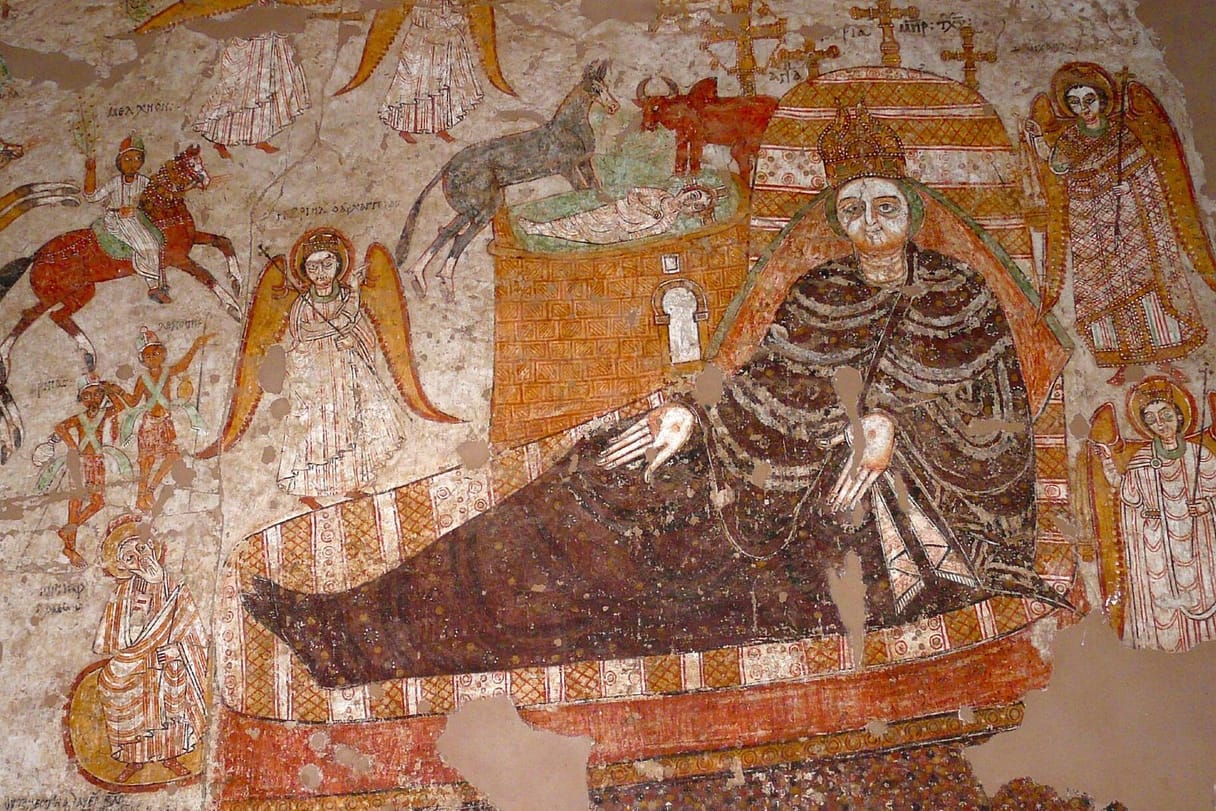
Gregory of Nazianzus, preaching on Christmas around 380, urged his hearers to glorify God with the shepherds and sing with the angels. He told them to honor the manger like the beasts in Isaiah, where “the ox knows his owner, and the donkey his master’s crib” (Isaiah 1:3). Artists drew on that verse when they set an ox and a donkey beside the manger, as in the Nubian painting from Faras Cathedral on this page. In 1223 Francis of Assisi set up a manger with hay, an ox, and a donkey at Greccio in Italy, the first Christmas crèche.
What modern scholars notice
Raymond E. Brown’s The Birth of the Messiah shows that Matthew and Luke agree on the core: Bethlehem, Mary and Joseph, and the reign of Herod. Only Luke has the shepherds, and only Matthew has the star and the wise men. Historians find no empire-wide census under Augustus, and the census of Judea under Quirinius, recorded by Josephus, came in 6 CE, about ten years after Herod died. Brown and many others read Luke’s census as a way of setting the birth on the stage of world history. Christians hold such details in different ways, some as history and others as the frame of a deeper truth.
Questions for reflection or discussion
- Why do you think the good news came first to shepherds working at night?
- What does it say about God that Jesus’ first bed was a feeding trough?
- The angel’s news is for “all the people.” Who might need to hear it this Christmas?
- What part of the story would you like to ponder this year, as Mary did?
- Where could you make room for Christ this Christmas?
A prayer
God of glory, on a crowded night in Bethlehem you came to us as a child. Give us the shepherds’ eagerness to come and see and the angels’ joy to share the good news with all the people. Make room in us for Christ and for one another. Amen.
For kids
Long ago, the emperor made a rule. Everyone had to be counted in their family’s town. So Mary and Joseph walked to Bethlehem. Mary was going to have a baby very soon.
Bethlehem was full of people. There was no room for them in the guest room. So they stayed where the animals slept.
That night, Mary’s baby was born. She wrapped him in strips of cloth. She laid him in a manger. A manger is a box that holds food for animals. The baby’s name was Jesus.
Out in the fields, shepherds were watching their sheep. Suddenly an angel came! The shepherds were scared. The angel said, “Don’t be afraid.” The angel had good news for all the people. A Savior was born in Bethlehem!
Then the sky was full of angels. They praised God. The shepherds hurried to Bethlehem. They found the baby in the manger, just as the angel said.
Christmas shows us that God came close to us. Jesus came as a tiny baby. He came for everyone. He came for you!
Teach this story
Ready-made materials for Sunday school, children’s time in worship, and home.
- Jesus is born in Bethlehem: a 45-minute Sunday school lesson for ages 7–9, with printable activity sheets and slides.
- The shepherds hear the good news: a 45-minute Sunday school lesson for ages 7–9, with printable activity sheets and slides.
- A no-rehearsal Christmas pageant: a 40-minute Sunday school lesson for ages 4–12, with printable activity sheets and slides.
- Good news for everyone: a children’s sermon for Christmas Eve: a children’s sermon of about 4 minutes, built around a wrapped box with a baby Jesus figure inside.
Common questions
Where is the Christmas story in the Bible?
Two Gospels tell of Jesus’ birth. Luke 2:1–20 tells of the trip to Bethlehem, the manger, the angels, and the shepherds. Matthew 1:18–2:12 tells of Joseph’s dream and the wise men who followed a star. Mark begins with Jesus as a grown man, and John opens with a hymn about the Word who “became flesh and lived among us” (John 1:14).
Was Jesus born in a stable?
Luke says only that Mary laid Jesus in a manger, a feeding trough for animals, “because there was no room for them in the inn.” The Greek word for “inn” can also mean a guest room, and many scholars think the family stayed in a crowded village house where animals were brought in at night. Christians as early as Justin Martyr, in the second century, spoke of a cave near Bethlehem, and the stable became the picture most Christians know.
How many wise men were there?
Matthew does not give a number. He names three gifts, gold, frankincense, and myrrh, and Western Christians came to picture three wise men. Matthew says they found the child in a house, so their visit probably came some time after the night of the shepherds. Many churches remember it at Epiphany, on January 6.
When is the Christmas story read in church?
In the Revised Common Lectionary, which most mainline churches follow, Luke 2:1–14 (with verses 15–20 as an option) is the Gospel reading on Christmas Eve every year. The same passage is the backbone of most children’s Christmas pageants.
Sources
- Luke 2:1–20 (WEB)
- Matthew 1:18–2:12 (WEB)
- Luke 22:11 (WEB)
- 1 Samuel 16:11 (WEB)
- Isaiah 1:3 (WEB)
- Justin Martyr, Dialogue with Trypho, chapter 78 (Logos Library)
- Origen, Against Celsus, Book 1, chapter 51 (CCEL)
- Gregory of Nazianzus, Oration 38, On the Theophany, or Birthday of Christ (New Advent)
- Gregory of Nazianzus, Oration 38, Greek text, section 17 (Early Church Texts)
- “The First Nativity Scene Was Created in 1223,” Smithsonian Magazine
- Kenneth E. Bailey, Jesus Through Middle Eastern Eyes: Cultural Studies in the Gospels (IVP Academic, 2008)
- Ian Paul, “Jesus was not born in a stable,” Psephizo (on Bailey and the word kataluma)
- Stephen Hultgren, Commentary on Luke 2:1–14 [15–20], Working Preacher (Luther Seminary)
- Raymond E. Brown, The Birth of the Messiah: A Commentary on the Infancy Narratives in Matthew and Luke, updated edition (Doubleday, 1993)
- Revised Common Lectionary calendar 2026–27 (Vanderbilt Divinity Library)