New Testament · Luke 1:26–38
The angel Gabriel visits Mary
The angel Gabriel comes to Mary, a young woman in the village of Nazareth who is engaged to Joseph, and tells her she will give birth to a son named Jesus, the Son of God. Mary asks how this can be, hears that nothing spoken by God is impossible, and says yes. The church calls this moment the Annunciation, from the Latin word for “announcement.”
Behold, the servant of the Lord; let it be done to me according to your word.
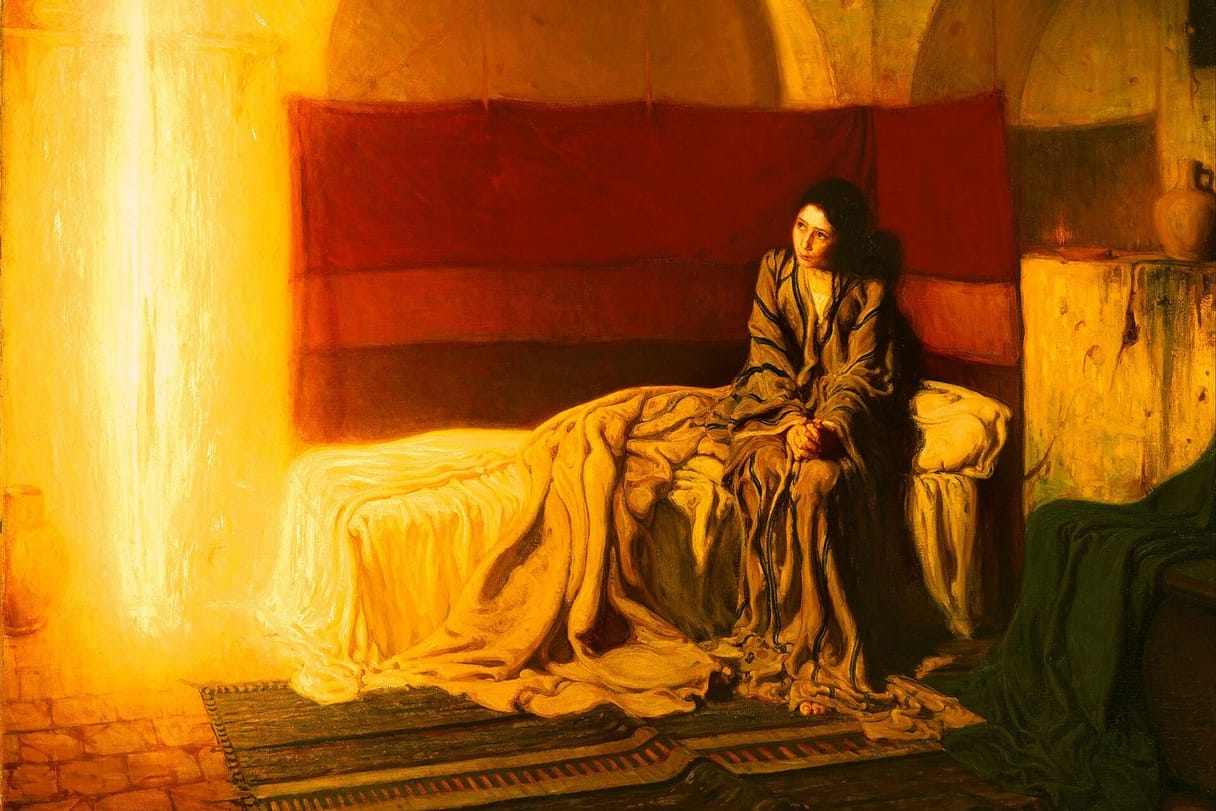

Luke begins his Gospel with two visits from the angel Gabriel: first to an old priest named Zechariah in the temple, then six months later to a young woman named Mary in Nazareth (Luke 1:26–38). The church calls the second visit the Annunciation, from the Latin word for “announcement.” It is the Gospel reading for the Fourth Sunday of Advent in Year B.
The story in brief
God sent Gabriel to Nazareth, a town in Galilee, to Mary, who was engaged to Joseph, a man from the family of King David. The angel greeted her: “Rejoice, you highly favored one! The Lord is with you” (Luke 1:28). Mary was troubled and wondered what this greeting could mean.
“Don’t be afraid, Mary,” the angel said, “for you have found favor with God” (Luke 1:30). She would give birth to a son and name him Jesus. He would be called the Son of the Most High, and his kingdom would have no end.
Mary asked, “How can this be, seeing I am a virgin?” (Luke 1:34). Gabriel answered that the Holy Spirit would come upon her, so her child would be called holy, the Son of God. He added a sign: her relative Elizabeth, who had been called barren, was six months pregnant in her old age, “for nothing spoken by God is impossible” (Luke 1:37). Mary gave her answer:
Behold, the servant of the Lord; let it be done to me according to your word.
Then the angel left her, and Mary hurried to the hill country to see Elizabeth (Mary visits Elizabeth).
The setting and background
Nazareth was a small farming village in the hills of Galilee, far from the temple in Jerusalem, and the Old Testament never mentions it.
Mary was “pledged to be married” to Joseph (Luke 1:27). In Jewish custom of the time, a betrothal was a binding agreement, and Matthew already calls Joseph Mary’s “husband” before they live together (Matthew 1:19).
Gabriel appears earlier in the book of Daniel, explaining Daniel’s visions (Daniel 8:16). Luke sets his two visits side by side. Zechariah is an old priest serving in the temple sanctuary; Mary is a young woman at home in a village. Zechariah asks how he can be sure, and he is left unable to speak until his son is born (Luke 1:18–20). Mary asks how such a thing can happen, and the angel answers her.
The promise that Jesus will receive “the throne of his father David” (Luke 1:32) recalls God’s promise that David’s throne would be “established forever” (2 Samuel 7:16), which the lectionary reads on the same Sunday.
What the story means
The Annunciation shows God coming to people the world overlooks. God’s messenger goes to a young woman in a village few had heard of, and Mary will soon sing that God “has looked at the humble state of his servant” (Luke 1:48).
Mary’s question matters too. God’s messenger answers her with patience, and faith in Luke’s Gospel has room for questions. Her answer is free and brave, and many Christians pray her words when they cannot see what lies ahead.
The Apostles’ Creed confesses that Jesus was “conceived by the Holy Spirit” and “born of the Virgin Mary.” Christians hold this in different ways, many as a literal miracle and others as true in a deeper than literal sense, and all confess that Jesus came from God as a gift (see The virgin birth and What do Christians believe about Mary?).
Jesus later said that his mother and brothers are “these who hear the word of God and do it” (Luke 8:21). Mary is the first in Luke’s Gospel to do so, and many Christians call her the first disciple.
How the early church read it
Irenaeus, a bishop from Asia Minor who led the church in Lyon, in Gaul, around 180 CE, read the Annunciation beside the story of Eden. Eve turned from God’s word, and Mary trusted it. “The knot of Eve’s disobedience was loosed by the obedience of Mary,” he wrote (Against Heresies 3.22.4).
The church keeps the Feast of the Annunciation on March 25, nine months before Christmas. Its Greek name, Evangelismos, comes from the word for good news, and the Orthodox hymn for the feast calls the day “the beginning of our salvation.” In Orthodox churches the central doors of the icon screen usually show Gabriel on one door and Mary on the other.
What modern scholars notice
The Hebrew Bible tells several stories in which God promises a child, often to a woman who has long been unable to have one, such as Sarah and Hannah. Elizabeth’s story follows that older pattern. Madhavi Nevader, a scholar of the Hebrew Bible, observes that Mary “is neither barren, nor in plight,” and suggests reading the scene as an appearance of God’s messenger in which Mary herself is the main character.
The African American painter Henry Ossawa Tanner painted his Annunciation, shown on this page, in 1898, after a trip to Egypt and Palestine. His Mary is a village girl in peasant clothing, with no halo, looking up at a column of light.
Questions for reflection or discussion
- Why do you think God’s messenger came to a young woman in a small village?
- Gabriel tells Mary not to be afraid. What makes you afraid when God seems to ask something new of you?
- Mary asks a question before she says yes. What would you have asked?
- Compare Zechariah’s response in Luke 1:18–20 with Mary’s in Luke 1:34–38. What do you notice?
- When have you said yes to something before you understood all of it?
A prayer
Holy God, you sent your angel to Mary in Nazareth, and she answered with trust. Give us ears to hear your word, courage to ask our questions, and hearts ready to say yes. Make room in us for Christ your Son, who came to be with us. Amen.
For kids
A young woman named Mary lived in a small town called Nazareth. She was going to marry a man named Joseph.
One day an angel came to see her. His name was Gabriel. He said, “Hello, Mary! God is with you!”
Mary was surprised. What could this mean?
“Don’t be afraid,” said Gabriel. “God is very happy with you. You will have a baby boy. You will name him Jesus. He will be called the Son of God. He will be a king forever.”
Mary asked, “How can this be?”
Gabriel said, “God’s Holy Spirit will do it. And here is more good news. Elizabeth is part of your family. She is old, and she is going to have a baby too! Nothing is impossible for God.”
Mary thought about it. Then she said yes. “I am God’s helper. Let it happen just as you said.”
Mary trusted God, even when she did not know everything. God came to Mary in a small town. God comes to us too, wherever we are. God loves us and is always with us.
Teach this story
Ready-made materials for Sunday school, children’s time in worship, and home.
- Love: Mary says yes: a 45-minute Sunday school lesson for ages 7–9, with printable activity sheets and slides.
- Mary says yes: a children’s sermon for the fourth Sunday of Advent: a children’s sermon of about 4 minutes, built around a sealed envelope with a message inside.
Common questions
What does “annunciation” mean?
Annunciation means announcement. It comes from the Latin word annuntiatio. The church uses it for the angel Gabriel’s announcement to Mary that she would give birth to Jesus, told in Luke 1:26–38.
Who was the angel Gabriel?
Gabriel is one of the few angels the Bible calls by name. In the book of Daniel he explains Daniel’s visions, and in Luke 1 he brings God’s news first to the priest Zechariah and then to Mary. In both stories he tells the person he visits not to be afraid.
Is the Annunciation the same as the virgin birth?
The Annunciation is the angel’s message to Mary. The virgin birth is the church’s confession, in the Apostles’ and Nicene Creeds, that Jesus was conceived by the Holy Spirit and born of the Virgin Mary. Christians hold the virgin birth in different ways, some as a literal miracle and others as true in a deeper than literal sense, and all confess that Jesus came from God.
When is the Annunciation read in church?
In the Revised Common Lectionary, which most mainline churches follow, Luke 1:26–38 is the Gospel reading on the Fourth Sunday of Advent in Year B. Many churches also keep the Feast of the Annunciation on March 25, nine months before Christmas.
Sources
- Luke 1:5–38 (WEB)
- Matthew 1:18–19 (WEB)
- Daniel 8:16; 9:21 (WEB)
- 2 Samuel 7:16 (WEB)
- Luke 8:21 (WEB)
- Irenaeus, Against Heresies, Book 3, chapter 22 (New Advent)
- Troparia and kontakia for March 25, the Annunciation (Orthodox Church in America)
- OrthodoxWiki, “Annunciation to the Theotokos”
- OrthodoxWiki, “Holy Doors”
- Madhavi Nevader, “When Gods Talk to Men: Reading Mary with the Annunciations of the Hebrew Bible and the Ancient Near East,” in Annunciations: Sacred Music for the Twenty-First Century, ed. George Corbett (Open Book Publishers, 2019)
- “The Annunciation (Tanner),” Wikipedia
- Revised Common Lectionary calendar 2026–27 (Vanderbilt Divinity Library)