Ephesians 5:22 in context
Ephesians 5:22 tells wives to be subject to their husbands “as to the Lord.” In the oldest Greek manuscript the verse has no verb of its own and borrows it from verse 21, which asks every Christian to be subject “to one another in the fear of Christ.” The letter then asks husbands to love their wives as Christ “gave himself up” for the church. The mainline churches read the passage as a call to mutual, self-giving love in marriage.
subjecting yourselves to one another in the fear of Christ. Wives, be subject to your own husbands, as to the Lord.
Ephesians 5:22 asks wives to be subject to their husbands, and it asks it inside a passage that calls every Christian to yield to every other. Perhaps this reading has been chosen for your wedding, or you have heard the verse used to end an argument or to keep a woman in her place. The passage deserves a slow and prayerful reading, because the chapter that contains it opens with a call to love that every husband and every wife can hear as good news.
What does Ephesians 5:22 say?
subjecting yourselves to one another in the fear of Christ. Wives, be subject to your own husbands, as to the Lord.
In the oldest surviving manuscript of Ephesians, a papyrus copied around 200 CE, verse 22 has no verb of its own. Translated from the Greek, it reads literally, “Wives, to your own husbands, as to the Lord.”1 It borrows its verb from verse 21, hypotassomenoi, “subjecting yourselves,” which the letter addresses to the whole church; later copies and English Bibles supply “be subject.” The submission of wives is one example of the mutual submission that all believers owe one another “in the fear of Christ,” that is, out of reverence for him.
What is the context of Ephesians 5:22?
The whole chapter begins with a command that governs everything after it:
Be therefore imitators of God, as beloved children. Walk in love, even as Christ also loved us and gave himself up for us, an offering and a sacrifice to God for a sweet-smelling fragrance.
A few verses later the letter tells its readers to “be filled with the Spirit” (Ephesians 5:18) and then describes what a Spirit-filled church looks like. Its members speak to one another “in psalms, hymns, and spiritual songs” (Ephesians 5:19), they give thanks to God for all things, and they submit to one another. Ephesians 5:22 continues that same sentence.
After verse 21 the letter speaks in turn to wives and husbands, to children and fathers, and to slaves and masters (Ephesians 5:22–6:9), a pattern scholars call a household code. The Ephesian code speaks directly to wives, children, and slaves as members of the church who answer to Christ, and it lays duties of love and restraint on husbands, fathers, and masters. Masters are told to “give up threatening, knowing that he who is both their Master and yours is in heaven” (Ephesians 6:9).
The same code tells slaves to obey their masters “with fear and trembling” (Ephesians 6:5), and Christians of every tradition now read that instruction as counsel for believers in a first-century Roman household (see Does the Bible support slavery?). Many scholars think a disciple of Paul wrote Ephesians in his name between about 70 and 100 CE, though others hold that Paul wrote it himself (see Who wrote the Bible?).
What does “the husband is the head of the wife” mean?
Ephesians 5:23 gives the reason for the wife’s submission: “the husband is the head of the wife, as Christ also is the head of the assembly, being himself the savior of the body” (Ephesians 5:23). The Greek word for “head,” kephalē, can mean the one in charge, and many Christians read the verse that way. Scholars disagree about how strongly the word carried that sense in the first century. Earlier in the letter, Christ the head is the one “from whom all the body, being fitted and knit together … makes the body increase to the building up of itself in love” (Ephesians 4:15–16). In chapter 5 the head is the “savior of the body.” In Ephesians the head gives the body life, holds it together, and saves it.
The letter then shows a husband what that headship asks of him:
Husbands, love your wives, even as Christ also loved the assembly and gave himself up for her,
Husbands are to “love their own wives as their own bodies,” caring for them as a person “nourishes and cherishes” his own flesh (Ephesians 5:28–29). John Chrysostom, preaching on this passage in the late fourth century, told husbands that if they were ever called to give their lives for their wives, they should “refuse it not.” He even suggested words for a young husband to say to his bride: “I love you, and prefer you to my own soul” (Homily 20 on Ephesians).
Does Ephesians 5:22 mean a wife must obey her husband?
Ephesians uses the ordinary Greek word for “obey,” hypakouō, when it speaks to children and to slaves (Ephesians 6:1, 6:5). It never uses that word for wives. The verb for wives is the verb of verse 21, the yielding and deference that Christians show one another. Verse 24 adds that wives should be subject “in everything” (Ephesians 5:24), and Christians who read the passage as a lasting pattern for marriage take that phrase seriously, teaching that a husband should lead his home with servant love and his wife should support him.
The words “as to the Lord” set a limit on every reading, because a wife’s first loyalty belongs to Christ. When human authorities commanded what God forbids, the apostles answered, “We must obey God rather than men” (Acts 5:29). No reading of Ephesians requires a wife to stay with a husband who threatens or harms her, and a husband who demands obedience by force is breaking the command of verse 25. If you are in danger at home, you can call the National Domestic Violence Hotline at 1-800-799-7233 or text START to 88788. A pastor can also help you find safety, and When your marriage is hard offers more help.
How do the mainline churches read Ephesians 5:22?
Christians read these verses in good faith in different ways. Many evangelical churches teach that God gives husbands a loving authority in the home. The mainline churches read Ephesians 5:22 through verse 21 and the self-giving of Christ, and they see in marriage two people who give themselves to each other as equals (see Should wives submit to their husbands?).
The ELCA’s social statement Faith, Sexism, and Justice, adopted by its Churchwide Assembly in 2019 by a vote of 863 to 26, notes that scholars call these New Testament passages “the household codes.” It asks Lutherans to read difficult passages of Scripture through Christ, the lens for the whole Bible. The Presbyterian Church (U.S.A.)’s Book of Order describes marriage as a commitment between two people “to love and support each other for the rest of their lives.” The wedding services of the ELCA, the PC(USA), the United Methodist Church, and the Episcopal Church give both spouses the same vows, and neither promises to obey.
What is the “great mystery” of Ephesians 5:32?
The passage ends by quoting Genesis: “the two will become one flesh” (Ephesians 5:31). Then it says, “This mystery is great, but I speak concerning Christ and the assembly” (Ephesians 5:32). For Ephesians, a Christian marriage is a living picture of the love between Christ and his church, a love that gives itself away and makes two into one.
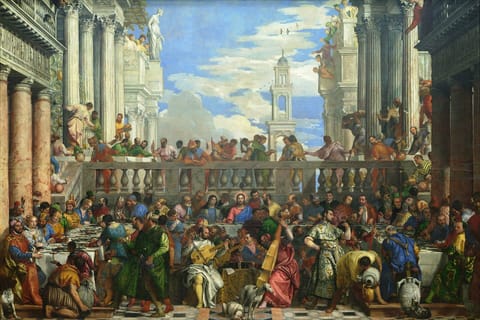
The Eastern Orthodox churches count marriage among the holy mysteries, their name for the sacraments. At an Orthodox wedding the epistle comes from Ephesians 5, the Gospel tells of the wedding at Cana (John 2:1–11), and the priest crowns the groom and the bride alike. For Paul’s hymn to the love that sustains a marriage, see What does 1 Corinthians 13 mean?
Whatever shape your marriage takes, the call of Ephesians is the same for both of you: to walk in love as Christ loved you. The letter’s own prayer for its readers can become your prayer for your home:
that Christ may dwell in your hearts through faith, to the end that you, being rooted and grounded in love, may be strengthened to comprehend with all the saints what is the width and length and height and depth, and to know Christ’s love which surpasses knowledge, that you may be filled with all the fullness of God.
Notes
-
Greek (SBL Greek New Testament): ὑποτασσόμενοι ἀλλήλοις ἐν φόβῳ Χριστοῦ. Αἱ γυναῖκες τοῖς ἰδίοις ἀνδράσιν ὡς τῷ κυρίῳ. Hypotassomenoi (verse 21) means “subjecting yourselves.” Verse 22, hai gynaikes tois idiois andrasin hōs tō kyriō, means literally “the wives to their own husbands as to the Lord.” Papyrus 46 and Codex Vaticanus have no verb in verse 22; most later manuscripts add one. ↩︎
Common questions
Does Ephesians 5:22 say wives must obey their husbands?
Ephesians uses the Greek word for “obey” when it speaks to children and to slaves (Ephesians 6:1, 5), and it never uses that word for wives. Wives are asked to be subject, with the same verb that verse 21 applies to every Christian. No Christian teaching asks anyone to obey a spouse in wrongdoing or to stay in danger.
Who wrote Ephesians?
The letter names Paul as its author, and the church read it as his for most of its history. Many modern scholars think a disciple of Paul wrote it in his name between about 70 and 100 CE, while others still hold that Paul wrote it. Either way, the church receives it as Scripture.
Why is Ephesians 5 read at weddings?
Ephesians 5:21–33 describes marriage as a living picture of Christ’s self-giving love for the church, and it quotes Genesis: “the two will become one flesh.” The Eastern Orthodox wedding service reads it as the epistle, followed by the Gospel of the wedding at Cana (John 2:1–11). The reading reminds a couple that their love can show the world something of Christ’s love.
What does Ephesians 5:33 mean by respect?
Ephesians 5:33 sums up the passage by asking each husband to love his wife “even as himself” and each wife to respect her husband. The Greek verb for “respect” comes from the same root as the “fear of Christ” in verse 21, the reverence all Christians owe to Christ and show to one another. Love and respect belong to both partners in a Christian marriage.
Sources
- Ephesians 5:1–33 (WEB)
- Ephesians 6:1–9 (WEB)
- Ephesians 4:15–16 (WEB)
- Ephesians 3:17–19 (WEB)
- Acts 5:29 (WEB)
- Textual Criticism & Translation: Ephesians 5:22 (koine-greek.com)
- Epistle to the Ephesians: authorship and household code (Wikipedia)
- John Chrysostom, Homily 20 on Ephesians (New Advent)
- ELCA, Faith, Sexism, and Justice: A Call to Action (2019)
- Christian Century: PC(USA) changes marriage definition in its constitution (2015)
- United Methodist Book of Worship, A Service of Christian Marriage I
- The Orthodox wedding service and its readings (Greek Orthodox Archdiocese of Canada)
- National Domestic Violence Hotline