New Testament · Luke 19:1–10
Zacchaeus
Zacchaeus, a rich chief tax collector in Jericho, is too short to see Jesus over the crowd, so he runs ahead and climbs a sycamore tree. Jesus stops, calls him by name, and invites himself to his house while the crowd grumbles. Zacchaeus welcomes him with joy and gives half of his goods to the poor, and Jesus says that salvation has come to his house.
For the Son of Man came to seek and to save that which was lost.
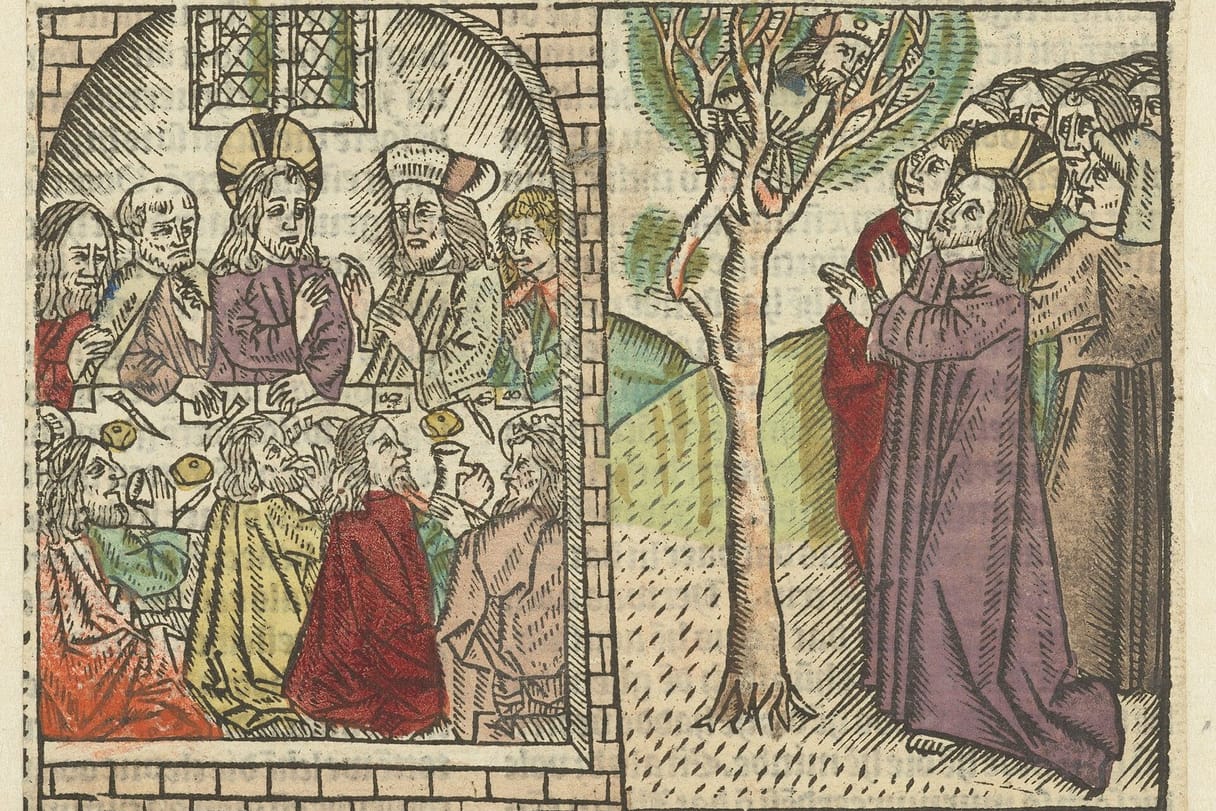

The story of Zacchaeus is told only in the Gospel of Luke (Luke 19:1–10). It takes place in Jericho as Jesus makes his way to Jerusalem, just after he heals a blind beggar outside the same town (Luke 18:35–43). It gathers up a pattern that runs through Luke: Jesus welcomes tax collectors and sinners, and the respectable grumble.
The story in brief
Jesus was passing through Jericho, where a man named Zacchaeus lived. He was a chief tax collector, and he was rich. He wanted to see who Jesus was, and he was too short to see over the crowd. So he ran ahead and climbed a sycamore tree beside the road.
When Jesus reached the place, he looked up and called him by name: “Zacchaeus, hurry and come down, for today I must stay at your house” (Luke 19:5). Zacchaeus hurried down and “received him joyfully” (Luke 19:6). Everyone who saw it grumbled that Jesus had gone in “to lodge with a man who is a sinner” (Luke 19:7).
Zacchaeus stood up and said, “Behold, Lord, half of my goods I give to the poor. If I have wrongfully exacted anything of anyone, I restore four times as much” (Luke 19:8). Jesus answered that salvation had come to his house that day, “because he also is a son of Abraham.” Then he added:
For the Son of Man came to seek and to save that which was lost.
The setting and background
Jericho was a wealthy town in the Jordan Valley, famous for its fragrant balsam. Rebecca Denova of the University of Pittsburgh explains that Rome collected taxes through public contracts. Tax collectors received no salary, so people assumed they took extra to pay themselves, and as agents of a foreign power they were widely despised. Luke calls Zacchaeus a “chief” tax collector, a title used nowhere else in the New Testament, so he probably oversaw other collectors.
The name Zacchaeus comes from a Hebrew word meaning “pure” or “innocent.” The sycamore was a sycamore fig, a tree of the warm lowlands (1 Kings 10:27). Lawrence Farley, an Orthodox priest, points out that important grown men did not run in public or climb trees. Zacchaeus set his dignity aside to see Jesus.
His promise goes far beyond the law. Someone who had wronged a neighbor was to repay it “in full” and add a fifth (Numbers 5:7). Fourfold repayment was the penalty for stealing and selling a sheep (Exodus 22:1).
What the story means
Jesus sees Zacchaeus first. He stops under the tree, calls him by name, and asks to be his guest before Zacchaeus has said a word about his money. The welcome comes first, and the change in Zacchaeus follows it. Luke loves the word “today”: the angels announce a Savior born “today” (Luke 2:11), and here salvation comes to a house “today.” Salvation in this story looks like a home opened to Jesus, the poor fed, the cheated repaid, and a man restored to his people as a “son of Abraham” (see What does it mean to be saved?).
Just before this story, a rich ruler goes away sad when Jesus asks him to give to the poor, and Jesus says that “the things which are impossible with men are possible with God” (Luke 18:23–27). Zacchaeus is that possibility. His joy overflows into generosity and justice (see Wealth and generosity).
The crowd belongs to the story as well. Like the grumblers in Luke 15:1–2, they cannot believe Jesus would eat with such a man. Jesus answers with the work of the good shepherd, echoing God’s promise in Ezekiel: “I will seek that which was lost” (Ezekiel 34:16).
How the early church read it
Cyril of Alexandria, in a sermon on Luke from the fifth century, said that Christ saw that Zacchaeus was ready to obey and called him, and he told the grumblers in the crowd to stop murmuring when Christ saves sinners. A fourth-century church order, the Apostolic Constitutions (7.46), names “Zacchaeus the publican” as the first bishop of Caesarea, a later legend.
The Orthodox Church reads the story on Zacchaeus Sunday, just before the Lenten Triodion begins. Steven Kostoff of the Orthodox Church in America sees in Zacchaeus’s desire to see Jesus our own “better impulses.” Lawrence Farley writes, “The sprinting and tree-climbing of Zacchaeus challenges us as we head into Great Lent.” In the West, the passage became a reading for the dedication of a church, a fitting choice for a story about salvation coming to a house.
What modern scholars notice
In Greek, Zacchaeus speaks in the present tense: “I give” and “I restore.” Joseph Fitzmyer, Joel Green, and Alan Mitchell read his words as a description of what he already does, a defense against the crowd’s judgment that Jesus confirms. Most readers through the centuries, and scholars such as Ladislav Tichý, hear a promise to begin a new life. In both readings, Jesus restores to his community a man the town had shut out.
Questions for reflection or discussion
- Why do you think Zacchaeus wanted so much to see Jesus?
- Jesus invited himself to Zacchaeus’s house before Zacchaeus changed anything. What does that say about God?
- Who are the people your community grumbles about?
- Do you hear Zacchaeus’s words as a promise or as a defense, and why?
- What would it look like for salvation to come to your house today?
A prayer
Lord Jesus, you looked up into the tree and called Zacchaeus by name. Call us by name, come and stay with us, and make our homes places of joy and welcome. Give us generous hearts toward the poor and courage to make things right. Amen.
For kids
Zacchaeus lived in a town called Jericho. His job was collecting tax money. Sometimes he took more money than he should. Many people did not like him.
One day Jesus came to town! A big crowd filled the road. Zacchaeus wanted to see Jesus. But he was short, and the crowd was tall.
So Zacchaeus ran ahead. He climbed up a big tree. Now he could see!
Jesus walked down the road. He stopped right under the tree. He looked up. “Zacchaeus, hurry and come down! I want to stay at your house today.”
Jesus knew his name! Zacchaeus slid down the tree. He was so happy!
But the people grumbled. “Why is Jesus going to that man’s house?”
At his house, Zacchaeus stood up. “Jesus, I will give half of my money to the poor. If I cheated anyone, I will pay them back four times as much!”
Jesus smiled. “Today God’s love has come to this house. I came to find people who are lost.”
Jesus saw Zacchaeus. Jesus loved him and came to his house. That love changed his heart. Jesus sees you too. Jesus knows your name, and Jesus loves you.
Teach this story
Ready-made materials for Sunday school, children’s time in worship, and home.
- Zacchaeus climbs a tree: a 45-minute Sunday school lesson for ages 7–9, with printable activity sheets and slides.
Common questions
Who was Zacchaeus in the Bible?
Zacchaeus was a chief tax collector in the town of Jericho, and he was rich. He appears only in Luke 19:1–10, where he climbs a tree to see Jesus, welcomes Jesus into his home, and gives half of his goods to the poor. His name comes from a Hebrew word meaning “pure” or “innocent.”
Why did Zacchaeus climb a tree?
Zacchaeus wanted to see Jesus, and he was too short to see over the crowd. So he ran ahead of everyone and climbed a sycamore tree beside the road where Jesus would pass. The sycamore of the Bible is the sycamore fig, a fig tree that grew in the warm lowlands of Israel.
Why did people dislike tax collectors?
Tax collectors worked under contracts with the Roman government and received no salary, so people assumed they collected extra to pay themselves. As agents of a foreign power, they were widely despised. When tax collectors asked John the Baptist what to do, he told them to collect no more than they were owed (Luke 3:12–13).
What did Zacchaeus promise to do?
Zacchaeus told Jesus that he gives half of his goods to the poor and that he repays four times as much to anyone he has cheated. The law of Moses asked a person who had wronged someone to repay it plus a fifth (Numbers 5:7), so Zacchaeus went far beyond what the law required.
When is the story of Zacchaeus read in church?
In the Revised Common Lectionary, which most mainline churches follow, Luke 19:1–10 is the Gospel for Proper 26 in Year C, the Sunday between October 30 and November 5. The Orthodox Church reads it on Zacchaeus Sunday, the Sunday before the Lenten Triodion begins, as a first sign that Great Lent is coming.
Sources
- Luke 19:1–10 (WEB)
- Luke 3:12–13; 15:1–2; 18:18–43 (WEB)
- Exodus 22:1 (WEB)
- Numbers 5:6–7 (WEB)
- Ezekiel 34:16 (WEB)
- 1 Kings 10:27 (WEB)
- Rebecca Denova, “Zacchaeus,” World History Encyclopedia (2022)
- Zacchaeus (Wikipedia)
- Cyril of Alexandria, Commentary on the Gospel of Luke, Sermon 127, translated by R. Payne Smith (CCEL)
- Lawrence Farley, “Zacchaeus Up a Tree,” Orthodox Church in America, February 1, 2014
- Steven Kostoff, “The Week of Zacchaeus: Embracing Pre-Lent by Being ‘Pro-Lent,’” Orthodox Church in America, February 3, 2014
- Joseph A. Fitzmyer, The Gospel According to Luke X–XXIV (Anchor Bible 28A; Doubleday, 1985)
- Joel B. Green, The Gospel of Luke (New International Commentary on the New Testament; Eerdmans, 1997)
- Alan C. Mitchell, “Zacchaeus Revisited: Luke 19,8 as a Defense,” Biblica 71 (1990)
- Ladislav Tichý, “Was hat Zachäus geantwortet? (Lk 19,8),” Biblica 92 (2011)
- Proper 26, Year C, Revised Common Lectionary (The Hymn Society)