New Testament · Luke 15:11–32
The parable of the prodigal son
A younger son takes his inheritance, wastes it in a far country, and comes home hoping to be hired as a servant. His father runs to meet him, restores him as a son, and throws a feast, then goes out to plead with the angry older brother. Jesus told the story to show the joy of God over everyone who comes home.
He arose and came to his father. But while he was still far off, his father saw him and was moved with compassion, and ran, fell on his neck, and kissed him.
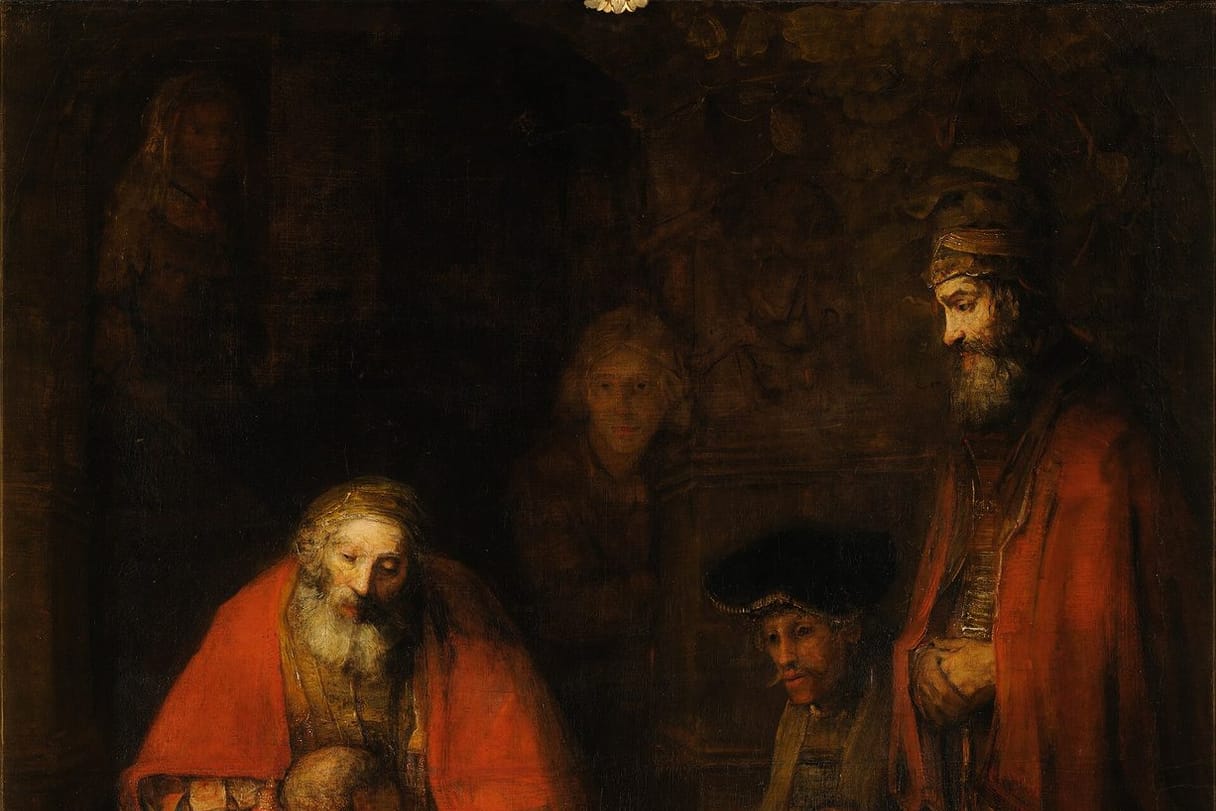

Jesus told the parable of the prodigal son to answer a complaint. Religious leaders grumbled that he welcomed sinners and ate with them, and Jesus replied with three stories about something lost and found: a sheep, a coin, and a son (Luke 15:1–3). Only Luke tells the third story, which is named for its “prodigal,” or wasteful, younger son.
The story in brief
A man had two sons. The younger son asked for his share of the property while his father was still alive, and the father divided his living between them. Soon the young man left for a distant country and spent everything on reckless living.
When a famine struck, he hired himself out to feed pigs, and he was so hungry that he longed to eat the pigs’ food. At last, Luke says, “he came to himself.” He decided to go home, confess that he had sinned against heaven and against his father, and ask to be taken on as a hired worker.
He arose and came to his father. But while he was still far off, his father saw him and was moved with compassion, and ran, fell on his neck, and kissed him.
Before the son could finish his speech, the father called for the best robe, a ring, sandals, and a feast, because his son “was dead and is alive again. He was lost and is found” (Luke 15:24).
The older son came in from the field, heard the music, and refused to go in. When his father came out to plead with him, he complained that in years of service he had never been given even a young goat for a party. The father answered, “Son, you are always with me, and all that is mine is yours” (Luke 15:31). Jesus ends the story there, without saying whether the older brother went in.
The setting and background
In Jesus’s world, eating with someone meant accepting them, and the Pharisees and scribes objected that Jesus shared his table with tax collectors and sinners. All three parables end with a party that the grumblers are invited to join.
Under the law of Moses an older son received a double share of the inheritance (Deuteronomy 21:17), so the younger son probably received a third. Kenneth Bailey, a Presbyterian scholar who taught in the Middle East for decades, wrote that asking for an inheritance while the father lived was as good as wishing him dead. Pigs were unclean animals under the law (Leviticus 11:7), so a Jewish young man feeding pigs for a foreigner had fallen as low as anyone could.
Bailey also observed that a dignified village elder would not run in public, because running meant hitching up his long robe, and the father runs anyway. The robe, the ring, and the sandals restore the young man’s place in the family; Bailey notes that servants went barefoot while sons wore shoes.
What the story means
The parable shows what God is like. The father sees his son while he is still far off, as if he had been watching the road, and he runs to him before the young man can finish his apology. The son hopes to work his way back as a servant, and the father gives him back his place as a son. The psalmist sang the same truth: “Like a father has compassion on his children, so the LORD has compassion on those who fear him” (Psalm 103:13).
The younger son is the church’s great picture of repentance, which in the Bible means turning around. His motives were mixed, since he was hungry and his speech sounds rehearsed, and the father receives him with joy all the same. The older son is the character Jesus’s critics were meant to recognize. He has been faithful, and his anger is easy to understand. The father goes out to him too, and because Jesus leaves the ending open, every listener has to decide whether to go in to the feast.
How the early church read it
The church fathers read the parable as the story of every soul. Augustine, writing his Confessions around 400 CE, remarked that the younger son needed no horses, chariots, or ships to reach the far country, because a person leaves God through the desires of the heart. Tertullian, in the early third century, read the younger son as the nations returning to God and saw in the robe the first dignity that Adam had lost. Jerome explained the parable verse by verse in a letter to Bishop Damasus of Rome in 383 or 384. The Orthodox Church still gives the parable its own Sunday before Great Lent, and its hymns put the younger son’s words in the mouth of every worshiper.
What modern scholars notice
Amy-Jill Levine, a Jewish scholar of the New Testament, warns readers against turning the older brother into a picture of Judaism, since Jesus, his hearers, and both sons were Jewish. In Rembrandt’s painting of about 1668, the old father rests his hands on his kneeling son’s back while the older brother watches.
Questions for reflection or discussion
- Which character in the story do you find it easiest to understand, and why?
- Why do you think the father interrupts his son’s rehearsed speech?
- What do the robe, the ring, and the sandals say to the son and to the village?
- When have you felt like the older brother?
- The father goes out to both of his sons. What does that suggest about God?
- How would you finish the story?
A prayer
Merciful God, you see us while we are still far off, and you run to meet us. Bring home everyone who is lost, soften the hearts of everyone who is angry, and gather us all at your table, where there is bread enough for all. Through Jesus Christ our Lord. Amen.
For kids
A father had two sons. One day the younger son said, “Give me my share of your money now.” The father gave it to him. The son went far away. He spent all his money on fun things until it was gone.
Then the food ran out in that land. The son got a job feeding pigs. He was so hungry that he wanted to eat the pigs’ food!
Then he had an idea. “I will go home. I will say I am sorry. Maybe my father will let me be a helper.”
So he walked home. His father saw him far down the road. The father ran to him! He hugged him and kissed him. The son said, “I am sorry.” The father said, “Bring the best robe! Bring a ring and shoes! Let’s have a party! My son was lost, and now he is found!”
The older brother was mad. “You never gave me a party!” The father said, “You are always with me. All I have is yours. Come and be glad with us. Your brother is home!”
Jesus told this story to show us what God is like. God loves us like that father. God is always glad when we come home.
Teach this story
Ready-made materials for Sunday school, children’s time in worship, and home.
- The prodigal son: a 45-minute Sunday school lesson for ages 7–9, with printable activity sheets and slides.
- The father who ran: a children’s sermon of about 4 minutes, built around a pair of running shoes.
Common questions
What does “prodigal” mean?
Prodigal means wastefully extravagant: spending money or gifts freely and carelessly. The word comes from the Latin prodigus, “lavish.” The parable itself never uses the word; English readers named the story for the younger son, who wasted his inheritance.
Where is the story of the prodigal son in the Bible?
The parable is in Luke 15:11–32. It is the third of three stories about lost things in Luke 15, after the lost sheep and the lost coin. Luke is the only Gospel that tells it.
What is the main lesson of the prodigal son?
The parable teaches that God welcomes people home with joy. The father runs to meet his returning son and throws a feast, and he goes out to his angry older son as well. The story invites every listener to receive that welcome and to share it.
Why was the older brother angry?
The older brother had worked faithfully for years, and he felt that his father was rewarding his brother’s waste while overlooking his own loyalty. His father answers that the older son has always been with him and that everything the father has is his. Then he asks him to join the celebration.
When is the prodigal son read in church?
In the Revised Common Lectionary, which most mainline churches follow, the parable is the Gospel reading on the Fourth Sunday in Lent in Year C. The Orthodox Church reads it on the Sunday of the Prodigal Son, in the weeks before Great Lent.
Sources
- Luke 15:1–32 (WEB)
- Deuteronomy 21:17 (WEB)
- Leviticus 11:7 (WEB)
- Psalm 103:13 (WEB)
- Augustine, Confessions, Book 1, chapter 18 (CCEL)
- Tertullian, On Modesty, chapter 9 (New Advent)
- Jerome, Letter 21, to Damasus (New Advent)
- J. P. K. Kritzinger, “The interpretation of the parable of the prodigal son by two Latin Patristic authors, St Jerome and St Peter Chrysologus,” Bogoslovni Vestnik 81, no. 2 (2021)
- Kenneth E. Bailey, The Cross and the Prodigal: Luke 15 Through the Eyes of Middle Eastern Peasants (InterVarsity Press, 2005)
- Amy-Jill Levine, Short Stories by Jesus: The Enigmatic Parables of a Controversial Rabbi (HarperOne, 2014)
- “The Home of Repentance,” America, February 2016 (on Levine’s reading of the parable)
- Fourth Sunday in Lent, Year C, Revised Common Lectionary (Vanderbilt Divinity Library)
- John Sanidopoulos, “The Sunday of the Prodigal Son Is the Second Sunday of the Triodion”