Old Testament · Genesis 6:9–9:17
Noah’s ark
God grieves over a world filled with violence and tells Noah, who walks with God, to build an ark for his family and the animals. The flood covers the earth, God remembers Noah and every creature in the ark, and the waters go down. Then God makes a covenant with every living creature and sets the rainbow in the clouds as a sign of the promise never to flood the earth again.
I set my rainbow in the cloud, and it will be a sign of a covenant between me and the earth.
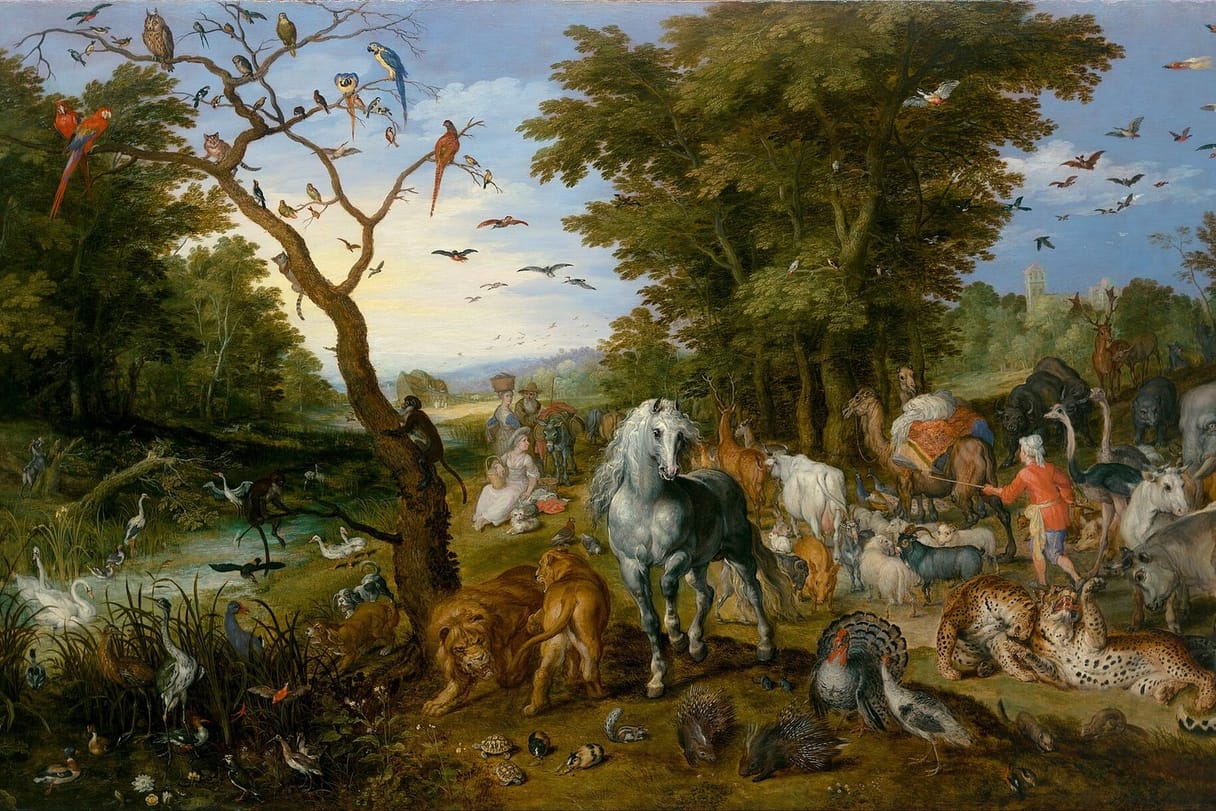

The story of Noah’s ark comes near the beginning of the Bible, in Genesis 6:9–9:17. It is the best-loved children’s story in Scripture and one of the hardest. Genesis tells it as a story of God’s grief over violence, God’s care for one family and the animals, and God’s promise never to flood the earth again.
The story in brief
The world God had made was “filled with violence” (Genesis 6:11), and God grieved over it: “it grieved him in his heart” (Genesis 6:6). One man lived differently. “Noah walked with God” (Genesis 6:9).
God told Noah to build an ark, a great wooden vessel with three decks and a door in its side, and to bring his wife, his sons Shem, Ham, and Japheth, their wives, and two of every kind of animal. “Thus Noah did. He did all that God commanded him” (Genesis 6:22).
The rain fell for forty days and forty nights, and the waters rose over the mountains. Every living thing on the land died, and “only Noah was left, and those who were with him in the ship” (Genesis 7:23). Then “God remembered Noah, all the animals, and all the livestock that were with him” (Genesis 8:1). The waters went down, and the ark came to rest on the mountains of Ararat. Noah sent out a dove, and the second time she came back with a fresh olive leaf in her beak.
When the ground was dry, everyone came out, and Noah built an altar and worshiped. God promised never again to strike every living thing (Genesis 8:21) and made a covenant, a binding promise, with Noah’s family and “every living creature” (Genesis 9:9–10).
I set my rainbow in the cloud, and it will be a sign of a covenant between me and the earth.
The setting and background
Noah’s story belongs to a family of flood stories from ancient Mesopotamia. In 1872 George Smith of the British Museum translated a clay tablet from Nineveh, part of the Epic of Gilgamesh, in which a man named Utnapishtim builds a boat, brings living creatures aboard, and sends out birds. In the older Babylonian poem Atrahasis, the gods send the flood because human noise disturbs them. Genesis tells of one God who grieves over violence, saves a family and the animals, and binds himself by a promise.
The Hebrew word for the ark, tevah, means a box or chest, and its only other use is for the basket that carried baby Moses on the Nile (Exodus 2:3). The World English Bible calls the ark a “ship,” about 450 feet long (Genesis 6:15).
Genesis tells some details twice, such as “two of every sort” of animal (Genesis 6:19) and “seven pairs of every clean animal” (Genesis 7:2). Most biblical scholars see two older tellings woven into one.
What the story means
Genesis shows God’s heart before it shows the flood. Luther Seminary’s Enter the Bible describes the God of Genesis 6 as “a grieving and pained parent.” The turning point comes at the center of the story, when “God remembered Noah.” In the Bible, when God remembers, God acts in faithfulness, as when “God remembered his covenant” and set out to free Israel from Egypt (Exodus 2:24).
After the flood, God sees that the human heart has not changed (Genesis 8:21) and chooses to bear with the world as it is. The covenant names “every living creature” four times in Genesis 9:8–17, and many Christians find in it a reason to care for creation (see Climate change and creation care).
Christians read the story as history or as sacred story in different ways (see Did Noah’s flood happen? and Why is the Old Testament so violent?).
How the early church read it
The First Letter of Peter says that in the ark “eight souls were saved through water,” and that “this is a symbol of baptism” (1 Peter 3:20–21). The Revised Common Lectionary reads that letter with the rainbow covenant on the First Sunday in Lent in Year B. From at least the third century, Christians painted Noah in the Roman catacombs, praying in a small chest-shaped ark as the dove returns with the olive branch.
Augustine noticed in The City of God (15.26) that the ark’s proportions match a human body lying down, and he read the ark as a figure of Christ and the church. Martin Luther wrote a “Flood Prayer” for his baptism service of 1523, and the Book of Common Prayer carried it on, thanking God “who of thy great mercy didst save Noah and his family in the ark from perishing by water.”
What modern scholars notice
The Hebrew word for rainbow, qeshet, is first of all a warrior’s bow. Ronald Hendel, a Hebrew Bible scholar at the University of California, Berkeley, reads the bow God hangs in the sky as “a sign of peace,” turned away from the earth. He cites the medieval Jewish commentator Nachmanides, who compared it to warriors who “invert the instruments of war” when they call for peace.
Questions for reflection or discussion
- Violence grieved God’s heart. What do you think grieves God today?
- What does it mean to you that “Noah walked with God”?
- Why do you think the story says God “remembered” Noah and the animals?
- God’s covenant includes every living creature. How might that shape the way you treat the earth?
- After a storm in your own life, what signs of God’s faithfulness have you seen?
A prayer
Faithful God, you grieve over the violence of the world, and your mercy holds every creature. Remember us, as you remembered Noah and all who were with him in the ark. When we see your bow in the clouds, renew our trust in your promise and our care for the earth. Amen.
For kids
Long ago, God looked at the world. People were hurting each other. God was very sad.
But Noah was God’s friend. The Bible says, “Noah walked with God.”
God said, “Noah, build a big boat. It is called an ark. Take your family. Take two of every kind of animal.” So Noah built the ark. He did everything God asked.
The animals came, two by two. Lions and lambs. Bears and birds. Noah’s family went in too. Then God shut the door.
The rain fell for forty days and forty nights. Water covered the whole earth. But the ark floated, and everyone inside was safe.
God remembered Noah and every animal in the ark. The water went down. Noah sent out a dove. She came back with a green leaf. Dry land was coming back!
At last everyone came out of the ark. Noah said thank you to God.
Then God made a promise. “I will never flood the whole earth again.” God put a rainbow in the sky to show the promise.
When you see a rainbow, remember God’s promise. God loves the whole world. God cares for every creature, big and small, and that includes you!
Teach this story
Ready-made materials for Sunday school, children’s time in worship, and home.
- Noah builds the ark: a 45-minute Sunday school lesson for ages 7–9, with printable activity sheets and slides.
Common questions
Where is the story of Noah’s ark in the Bible?
The story is in Genesis 6:9–9:17, near the beginning of the Bible. It runs from God’s grief over a violent world, through the building of the ark and the flood, to God’s covenant with every living creature and the sign of the rainbow.
How big was Noah’s ark?
Genesis 6:15 gives the ark’s size as 300 cubits long, 50 cubits wide, and 30 cubits high. A cubit was the length of a forearm, from elbow to fingertip, so the ark would have been about 450 feet long, 75 feet wide, and 45 feet high, longer than a football field with both end zones.
Did Noah take two of every animal or seven?
Both are in Genesis. In Genesis 6:19 God tells Noah to bring “two of every sort,” and in Genesis 7:2 to take “seven pairs of every clean animal” and two of the others. Most scholars explain the difference as the mark of two older tellings woven into one story.
What does the rainbow mean in the story of Noah?
The rainbow is the sign of God’s covenant, a binding promise, with Noah’s family and with every living creature, that waters will never again flood the whole earth (Genesis 9:11–17). God says that when the rainbow appears, “I will look at it, that I may remember the everlasting covenant.”
Did Noah’s flood really happen?
Some Christians read the flood as an event that covered the whole world. Geologists find no sign of a worldwide flood in human history, and Genesis echoes older flood stories from Mesopotamia, so many Christians read it as a sacred story that may remember a great regional flood. Both can hear in it God’s grief, mercy, and promise.
Sources
- Genesis 6:5–9:17 (WEB)
- Exodus 2:3, 24 (WEB)
- 1 Peter 3:20–21 (WEB)
- The Flood Tablet, tablet 11 of the Epic of Gilgamesh, British Museum K.3375
- Gilgamesh flood myth (Wikipedia)
- “Genesis 6:5–7: The Flood Story, a Grieving God, Not an Angry God,” Enter the Bible (Luther Seminary)
- Ronald Hendel, “The Rainbow in Ancient Context,” TheTorah.com (2016), with Nachmanides on Genesis 9:12
- Augustine, The City of God, Book 15, chapter 26 (New Advent)
- Richard Stracke, “Noah,” Christian Iconography (early Christian images of Noah)
- The Book of Common Prayer (1662), Public Baptism of Infants (Church of England)
- First Sunday in Lent, Year B, Revised Common Lectionary (Vanderbilt Divinity Library)