New Testament · Mark 1:1–8; John 1:6–8, 19–28
John the Baptist
John the Baptist preached in the wilderness near the Jordan River, calling people to turn back to God and be baptized. He wore camel’s hair, ate locusts and wild honey, and told the crowds that someone greater was coming after him. In John’s Gospel he calls himself a witness to the light, and the light is Jesus.
The voice of one crying in the wilderness, ‘Make ready the way of the Lord! Make his paths straight!’
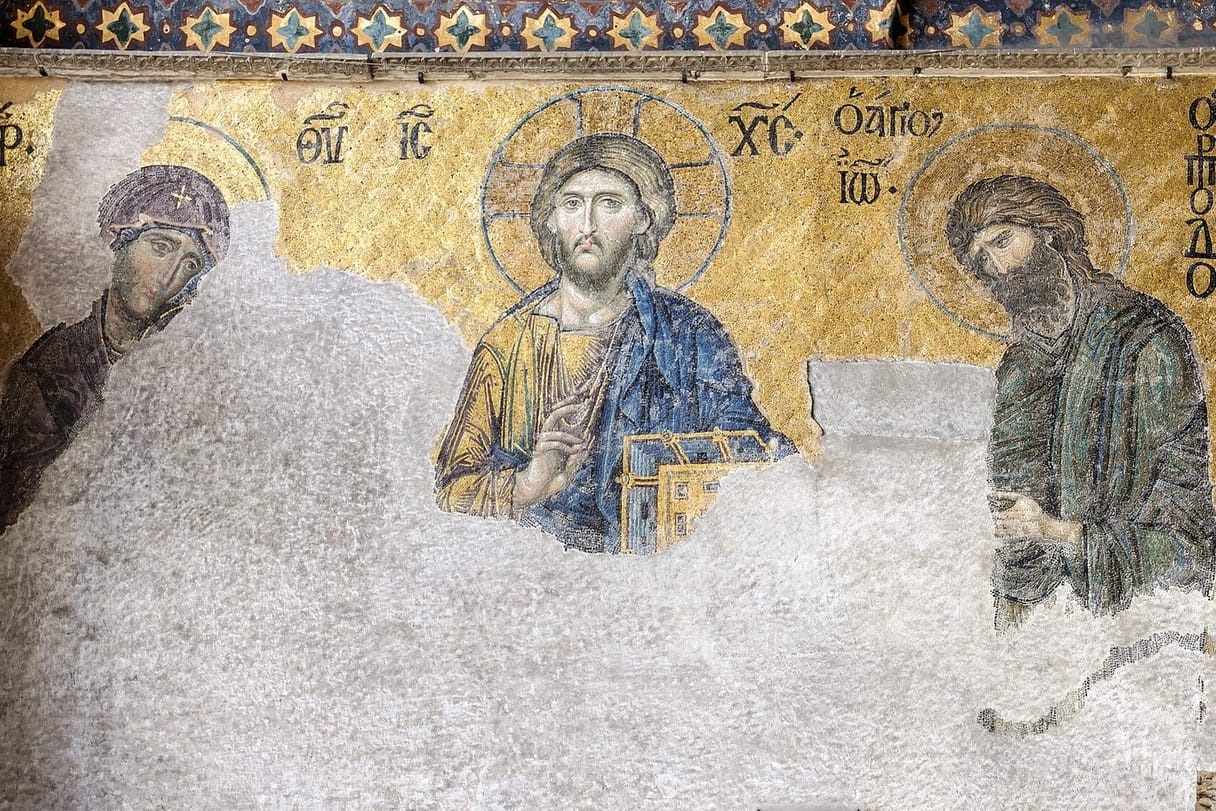

John the Baptist is the prophet who prepared the way for Jesus, and Mark’s Gospel opens with him preaching in the wilderness (Mark 1:1–8). In Year B of the lectionary, Mark 1:1–8 is read on the Second Sunday of Advent and John 1:6–8, 19–28 on the Third.
The story in brief
Mark’s first line announces “the beginning of the Good News of Jesus Christ, the Son of God” (Mark 1:1). Then he quotes the prophets:
The voice of one crying in the wilderness, ‘Make ready the way of the Lord! Make his paths straight!’
John appeared in the wilderness, “preaching the baptism of repentance for forgiveness of sins” (Mark 1:4). People came from all over Judea and from Jerusalem, confessed their sins, and were baptized by him in the Jordan River. John wore clothing of camel’s hair with a leather belt, and he ate locusts and wild honey. He told the crowds that someone more powerful was coming after him: “I baptized you in water, but he will baptize you in the Holy Spirit” (Mark 1:8).
The Gospel of John tells it differently. There the Baptist came “as a witness, that he might testify about the light” (John 1:7). When priests and Levites came from Jerusalem to ask who he was, he answered that he was neither the Christ nor Elijah. He called himself “the voice of one crying in the wilderness” (John 1:23) and said he was unworthy to untie the sandal strap of the one coming after him.
Soon Jesus came from Nazareth and was baptized by John in the Jordan (Mark 1:9; see The baptism of Jesus).
The setting and background
Luke tells of John’s birth. His parents, the priest Zechariah and his wife Elizabeth, had grown old without children, and the angel Gabriel promised them a son who would “go before him in the spirit and power of Elijah” (Luke 1:17). John grew up “in the desert” (Luke 1:80).
The wilderness mattered. Israel had wandered there after the exodus, and the prophet Isaiah promised exiles a highway home through the desert: “Prepare the way of the LORD in the wilderness!” (Isaiah 40:3). The lectionary reads that chapter, which begins with God’s comfort, beside Mark 1.
John’s clothes recalled the prophet Elijah, “a hairy man, and wearing a leather belt around his waist” (2 Kings 1:8). Malachi had promised that God would send Elijah before the day of the LORD (Malachi 4:5), and Jesus later said that John was the messenger Malachi foresaw (Matthew 11:10). Locusts, a kind of grasshopper, were food the law allowed (Leviticus 11:22).
Washing in water was an old Jewish practice for becoming ritually clean. John offered one washing in the river as a sign of repentance, which in the Bible means turning around.
What the story means
Advent is a season of getting ready, and John shows how. In Luke’s Gospel the crowds ask John what they should do, and he answers, “He who has two coats, let him give to him who has none. He who has food, let him do likewise” (Luke 3:11). For John, repentance meant sharing coats and food, dealing fairly, and making room for God.
John also prepared the way by pointing away from himself. In John’s Gospel he says of Jesus, “He must increase, but I must decrease” (John 3:30). His whole life was a finger pointing to Jesus.
John’s message is good news. God was coming close, and John invited everyone, even tax collectors and soldiers (Luke 3:12–14), to get ready.
How the early church read it
Augustine of Hippo, preaching on the feast of John’s birth, set the voice beside the Word: “John is the voice, but the Lord is the Word who was in the beginning” (Sermon 293). A voice carries a word for a moment; the Word remains.
The Eastern churches call John the Forerunner, Prodromos in Greek. Orthodox icons sometimes give him an angel’s wings, because Malachi calls the one who prepares the way God’s messenger, and the Greek word for messenger, angelos, also means angel. In the Deësis, a design found in many Byzantine churches, John and Mary stand on either side of Christ and turn toward him in prayer. The mosaic on this page, from Hagia Sophia in Istanbul, is a famous example.
What modern scholars notice
The Jewish historian Josephus, writing in the 90s CE, called John “a good man” who urged Jews to practice righteousness toward one another and piety toward God. He says that Herod Antipas feared John’s influence over the crowds and had him put to death at the fortress of Machaerus (Jewish Antiquities 18.116–119).
Most scholars agree that John baptized Jesus, since early Christians would hardly have invented that story. The community whose library survives in the Dead Sea Scrolls also lived in the Judean wilderness and used Isaiah 40:3 to describe its own calling. Some scholars have wondered whether John knew that community; the Gospels do not say.
The Swiss theologian Karl Barth kept a reproduction of Matthias Grünewald’s Isenheim Altarpiece in his study. In it John the Baptist stands beside the cross with an open book and points to Christ, and Barth took that pointing finger as a picture of the theologian’s task.
Questions for reflection or discussion
- Why do you think so many people went out to the wilderness to hear John?
- What would it look like to prepare the way of the Lord in your life this Advent?
- John told people with two coats to share. What might he say to your church?
- John said, “He must increase, but I must decrease.” Where is that hard for you?
- Who has pointed you toward Jesus?
A prayer
God of comfort, you sent John to prepare the way for your Son. Turn our hearts toward you, make the rough places in us level, and teach us to share what we have. Like John, may we point to Jesus, the light of the world. Amen.
For kids
John was a special messenger from God. When he grew up, he lived in the wilderness. That is a wild, empty place with rocks and sand.
John wore scratchy clothes made of camel hair. He ate locusts and wild honey. Locusts are big bugs, like grasshoppers. Crunch!
People came from far away to hear John. He said, “Get ready! God is coming! Turn back to God. Be kind. Share what you have. If you have two coats, give one away.”
Then John baptized them in the Jordan River. It was a sign of a fresh start with God.
Some people asked, “Are you the one God promised?”
John said, “No. Someone greater is coming after me. I am not even good enough to untie his sandals.”
One day Jesus came to the river. John pointed to him. “Look! Here he is!”
John was like a finger pointing to Jesus. At Advent, we get ready for Jesus too. God loves us and comes close to us.
Teach this story
Ready-made materials for Sunday school, children’s time in worship, and home.
- Peace: John the Baptist prepares the way: a 45-minute Sunday school lesson for ages 7–9, with printable activity sheets and slides.
- Prepare the way: a children’s sermon for the second Sunday of Advent: a children’s sermon of about 4 minutes, built around a broom and a toy road.
Common questions
Why is he called John the Baptist?
John is called the Baptist because he baptized people in the Jordan River as a sign that they were turning back to God. The Greek word baptizein means to dip or wash. The Jewish historian Josephus, writing in the 90s CE, also calls him John the Baptist.
Was John the Baptist related to Jesus?
Luke says that John’s mother, Elizabeth, was a relative of Jesus’s mother, Mary, and that John was born about six months before Jesus (Luke 1:36). Christians often call John and Jesus cousins, although Luke does not say exactly how the two families were related.
What did John the Baptist eat?
Mark says that John ate locusts and wild honey (Mark 1:6). Locusts are large grasshoppers, and the law of Moses allowed them as food (Leviticus 11:22). John ate what the wilderness provided.
What happened to John the Baptist?
Herod Antipas, the ruler of Galilee, arrested John after John spoke against Herod’s marriage, and later had him put to death (Mark 6:17–29). The historian Josephus adds that Herod feared John’s influence over the crowds. Jesus honored John and said that no one born of women was greater (Matthew 11:11).
When is John the Baptist read in church?
In the Revised Common Lectionary, John the Baptist is the focus of the Gospel readings on the Second and Third Sundays of Advent in all three years. In Year B the readings are Mark 1:1–8 and John 1:6–8, 19–28. Many churches also remember his birth on June 24.
Sources
- Mark 1:1–9 (WEB)
- John 1:6–8, 19–29 (WEB)
- Luke 1:5–25, 57–80 (WEB)
- Luke 3:7–18 (WEB)
- Isaiah 40:1–11 (WEB)
- 2 Kings 1:8 (WEB)
- Malachi 3:1; 4:5–6 (WEB)
- Matthew 11:10–11 (WEB)
- John 3:30 (WEB)
- Mark 6:17–29 (WEB)
- Leviticus 11:22 (WEB)
- Augustine, Sermon 293, on the birth of John the Baptist (excerpt, Crossroads Initiative)
- “John the Forerunner,” First Things
- Josephus, Jewish Antiquities 18.116–119 (Livius)
- Joshua Schachterle, “Where Was Jesus Baptized? Unearthing the Evidence” (bartehrman.com)
- “John the Baptist, Qumran and the Voice in the Wilderness” (Israel Bible Center)
- “Crucifixion, Matthias Grünewald,” The Christian Century
- Revised Common Lectionary calendar 2026–27 (Vanderbilt Divinity Library)